Tuesday, June 29, 2010

Red Terror unabated, India watches football


Maobadis slaughter 27 CRPF jawans
UPDATE
.According to Chhattisgarh DGP Viswa Ranjan, at least 15 Maobadis were possibly killed when CRPF personnel retaliated during the ambush. The bodies of the Maobadis have however not been found. Maobadis are known to take away the bodies of their cadre killed in encounters with security forces.
.Around 100 Maobadis, who struck with automatic rifles, were involved in the ambush and the gunbattle lasted for two to three hours.
.The death toll in Tuesday's attack on CRPF personnel has gone up to 27 after the body of a CRPF constable was found by search parties.

Maobadis have struck again, this time in Chhattisgarh, killing 27 CRPF jawans in a deadly ambush on Tuesday, June 29. Eight security personnel (among them four SPOs of Chhattisgarh Police) were injured, five of them seriously. The attack took place while the CRPF jawans were returning after clearing a road in a remote area of Chhattisgarh's Narayanpur district. Among the dead is Assistant Commandant of the force Jatin Gulati.

Union Home Secretary GK Pillai said in New Delhi: “A large number of heavily-armed Maoists, perched on a hilltop, opened fire from automatic weapons on a 63-member security contingent which was returning on foot from road opening duty.”

The latest attack by Maobadis comes three months after the massacre of 75 CRPF jawans and one Chhattisgarh policeman in Dantewada district on April 6. On May 17, Maobadis blew up a bus carrying 50 people, including 18 special police officers, near Sukma in Dantewada. Only six people -- all seriously injured – were believed to have survived that attack; the rest, including women and children, were killed. On May 8, eight men of the CRPF were killed when Maobadis blew up a vehicle in Narayanpur district.

On May 28, Gyaneswari Express was derailed in West Bengal’s Midnapore district after men of the PCPA, a Maobadi front organisations, damaged the tracks. At least 141 passengers died after a goods train came and rammed into the derailed express almost immediately.

[My views on Maobadi attack on Gyaneswari Express on NDTV special programme.]

Some points to ponder upon:

. UPA Government continues to flounder in its search for an effective counter-Maobadi strategy.
. Ongoing security offensive remains largely ineffective as there are no well-defined objectives.
. In the absence of well-thought out tactics, Maobadis continue to have the upper hand.
. The Prime Minister is either indifferent or incompetent to deal with the Maobadi challenge.
. Manmohan Singh says Maobadis pose ‘single biggest threat to internal security’; does nothing.
. Home Minister P Chidambaram’s efforts to launch a fight-back are stymied by a ‘limited mandate’.
. CCS meets and disperses without even discussing counter-Maobadi strategy.
. Army and IAF chiefs speak out of turn ruling out military intervention.
. Coordination among States remains abysmally poor, near absent.
. Senior Ministers continue to speak in different voices on how to confont the menace.
. Sonia Gandhi and her cronies like Digvijay Singh are pushing for ‘dialogue’ and a soft line.
. Congress is a divided house: Nobody wants to take a firm stand.
. Congress’s ally Trinamool Congress won’t let UPA act with firm determination.
. Mamata Banerjee refused to blame Maobadis for Gyaneswari derailment.
. CBI inquiry shows PCPA (a Maobadi front) planned and executed Gyaneswari disaster.
. Maobadis continue to enjoy upper hand; jawans, innocents regularly with impunity.
.India continues to bleed. Urban middleclasses, since they are not affected, are not bothered.
. Media glosses over Maobadi crimes, offers platform for ‘intellectuals’ to propagate Maobadi ideology.

Trust the National Human Rights Commission, now headed by retired Chief Justice of India KG Balakrishnan, to claim the ‘human rights’ of Maobadis are being violated by security forces! A statement issued by NHRC on Tuesday, June 29, says:
The National Human Rights Commission has taken suo motu cognizance of media reports depicting photographs of security men carrying the bodies of Naxalites, including women, with their hands and feet tied to bamboo poles.
The report was published on the 18th June, 2010. It was alleged that the photograph was taken following an anti-Naxal operation in West Midnapore, West Bengal.
The Commission in its proceedings on the 21st June, 2010, observed that the report, if true, raises a serious issue of violation of human rights of the victims.
A notice has been issued to the Secretary, Ministry of Home Affairs, Government of India inviting factual report in the matter by the 27th July, 2010.
In a major success, security forces had gunned down 12 Maoists, including three women (among them one who had led the attack on the EFR camp at Sildah, West Bengal, in which 24 jawans were killed) in a fierce encounter in Ranja forest of Salboni in West Midnapore on June 16.

Since NHRC is so bothered about the ‘human rights’ of the practitioners of inhuman barbarity, they should take note of this story from Jhargram, West Bengal, filed by PTI on June 29:
A 10th class student was killed by Maoists at Jamirdiha village in West Midnapore district. Police said the bullet-riddled body of Phulchand Mahato, still in his school uniform, was found on the side of Kasmar canal Tuesday morning. The Maoists left a poster near the body proclaiming Mahto as a ‘police informer’.
Mahto had attended classes on Monday and left his Banspahari High School building in the afternoon but remained untraced ever since, prompting his family to lodge a missing report at Belhapari police station Monday night. The family identified the body on Tuesday.
It may be recalled Maobadis had raped a 16-year-old girl in Jharkhand for daring to stand up to them, and threatened to kill her if she went to the police.
Whose side is NHRC on? The people of India or those who are waging war on the state and the people of India?
Another report says:
Five Maoists, including a top aide of the outfit's senior leaders Kishenji and Telugu Dipak, were arrested from the outskirts of Kolkata on Tuesday. Acting on a tip off, five Maoists were arrested from South 24 Parganas. Of the arrested Maoists, Madhusudhan Mondal alias Narayan, Rajesh Mondal, Sachin Ghosal were arrested from Amtala, while Siddhartha and Sanjay from Garia in the district. Madhusudhan alias Narayan was the zonal committee secretary of the Maoists during the Nandigram movement and was close to Kishenji and Telugu Dipak. He arranged the stay of Kishenji when he went to Nandigram.

So Nandigram wasn't a 'people's movement' after all!

And here is a chronology of Maobadi terrorism in the past couple of years:
June 29, 2008: Maoists attack a boat on Balimela reservoir in Orissa carrying four anti-Maoist police officials and 60 Greyhound commandos, killing 38 troops.
July 16, 2008: 21 policemen killed when a police van is blown up in a landmine blast in Malkangiri district of Orissa.
April 13, 2009: 10 paramilitary troops killed in eastern Orissa when Maoists attack a bauxite mine in Koraput district.
April 22, 2009: Maoists hijack a train with at least 300 people on board in Jharkhand and force it to Latehar district before fleeing.
May 22, 2009: Maoists kill 16 policemen in the jungles of Gadchiroli district in Maharashtra.
June 10, 2009: Nine policemen, including CRPF troops and officers, ambushed by Maoists during a routine patrol in Saranda jungles in Jharkhand.
June 13, 2009: Maoists launch two landmine and bomb attacks in a small town close to Bokaro, killing 10 policemen and injuring several others.
June 16, 2009: Maoists kill 11 police officers in a landmine attack followed by armed assault. In a separate attack, four policemen were killed and two others seriously injured when Maoists ambush them at Beherakhand in Palamau district.
June 23, 2009: A group of motorcycle-borne armed Maoists open fire on Lakhisarai district court premises in Bihar and free four of their comrades including the self-style Zonal Commander of Ranchi.
July 18, 2009: Maoists kill a villager in Bastar and in a separate incident torch a vehicle engaged in road construction work in Bijapur district of Chhattisgarh.
July 27, 2009: Six persons killed when Maoists trigger a landmine blast at Dantewada district in Chhattisgarh.
July 31, 2009: A special police officer and another person killed by Maoists in Bijapur district.
Sep 4, 2009: Maoists kill four villagers in a forest in Aaded village in Chhattisgarh's Bijapur district.
Sep 26, 2009: Maoists kill BJP MP from Balaghat Baliram Kashyap's sons at Pairaguda village in Jagdalpur (Chhattisgarh).
Sep 30, 2009: Maoists set ablaze Gram Panchayat offices at Korchi and Belgaon in Gadchiroli district of Maharashtra.
Oct 8, 2009: 17 policemen killed when Maoists ambushed them at Laheri police station in Gadchiroli district of Maharashtra.
Feb 15, 2010: 24 personnel of the Eastern Frontier Rifles (EFR) killed as Maoists attack their camp in Silda in West Midnapore district of West Bengal.
April 4, 2010: Maoists trigger a landmine blast killing 11 security personnel of the elite anti-Maoist force Special Operations Group (SOG) in Koraput district of Orrisa.
April 6, 2010: 75 CRPF personnel and a Chhattisgarh police official killed in a Maoist attack in Dantewada district.
May 8, 2010: Eight CRPF jawans were killed when Maoists blow up a bullet-proof vehicle in Bijapur district of Chhhattisgarh.
June 29, 2010: At least 15 CRPF personnel killed in a Maoist ambush in Naraynpur district of Chhattisgarh.

[Bus attack photograph courtesy ANI.]

Monday, June 28, 2010

Not a matter of faith, but of state!


Mercy petitions can't be decided by Pratibha Patil's 'religious beliefs'

The President of the Republic of India is not the head of Government, but the titular head of state whose decisions and actions are governed by the ‘advice’ of the Union Council of Ministers, headed by the Prime Minister. In his or her official capacity, the President performs ceremonial duties, many of them a legacy of India’s colonial past, and is designated Supreme Commander of India’s armed forces. That apart, the President is the custodian of the Constitution of India and is bound by oath of office to protect and uphold its provisions, unless Parliament decides to amend any one of them. But even amendments moved by the executive and approved by the legislature cannot change the basic character of the Constitution which lays down that India is and shall remain a secular republic. By implication, no decision or action of the state can be dictated by the faith or religious beliefs of those in authority irrespective of the office they hold.

If media reports are to be believed -- and they have not been denied by Rashtrapati Bhavan so far -- President Pratibha Patil is said to have ‘informally’ communicated to the Ministry of Home Affairs that because of her religious beliefs she will not turn down mercy petitions of criminals on death row forwarded to her. Seen in this context, Ms Patil’s decision to commute the death sentence given to nine persons held guilty by the Supreme Court of committing heinous crimes deserving capital punishment into life term in jail, if influenced by her religious beliefs, is at once both outrageous and downright dangerous. The law of the land allows those sentenced to death to file mercy petitions to the President. Contrary to popular belief, the President does not unilaterally decide on mercy petitions. They are studied by the Ministry of Home Affairs and the Cabinet takes a considered view, which is then communicated to the President, who either apends his or her signature to the decision or returns the file for a second opinion. If the Government sticks to its decision, the President is bound to sign on the dotted line or, if he or she feels morally compelled not to agree with the advice of the Council of Ministers, keep the file aside; in the extreme, the President has the option of resigning from office. It would be in order for the Government to clarify whether it had decided to commute these nine death sentences; if it had not, then it must explain why the decision was not reiterated and the files sent back to the President to abide by the Council of Ministers’ advice. Silence won’t do for under no circumstances can the religious beliefs of the President over-ride either the law of the land or the advice of the Council of Ministers.

The issue here is not whether capital punishment is morally right or wrong, or if there was sufficient reason to commute these death sentences. The death penalty can be debated endlessly on other fora, but till such time capital punishment exists on the statute book, it makes little or no sense to seek to upturn the decision of the Supreme Court, unless the Government is convinced that there is compelling reason which, of course, must be justifiable and have nothing to do with either religious beliefs or moral compunctions, to commute the sentence. This has been the practice all this while; of the 77 mercy petitions in the past three decades, only 10 have been considered fit for commutation. The larger issue here is of the undesirability of a President dragging his or her religious beliefs into the affairs of a secular state. Unless contested, this will set a dangerous precedence. What if India faces external aggression and the President were to refuse to authorise the declaration of war, which he or she must by virtue of being the Supreme Commander, because of his or her religious beliefs? Or, if a President, guided by his or her religious beliefs, were to place faith above nation? Or, for that matter, refuse to sign an Act of Parliament into law because it contradicts the religious injunctions to which a President may subscribe?

Since doubts have been raised, the President must disclose the reasons behind her decision to commute the death sentences. If she doesn’t, the Government must make them public and tell the people whether it endorses them; if it doesn’t, then the files should be returned to Rashtrapati Bhavan immediately. Meanwhile, the pending mercy petitions should remain untouched.

What do you think? Register your opinion on this issue by participating in the blog poll in the left column.

[This is an expanded version of the editorial comment I wrote for The Pioneer. My stuff published in The Pioneer can be read here.]

When Indira was India...


... and India was Indira!

Recalling Mrs Gandhi's Emergency, 1975-77


It would be an exaggeration to suggest, as was done by a critic of the Emergency late Thursday night, that “... Hitler was Indira and Indira was Hitler, actually!” That comment came after he had drawn some telling comparisons between the Emergency regime of Adolf Hitler and that of Mrs Indira Gandhi. Hitler had imposed Emergency under a constitutional provision, so had Mrs Gandhi. Hitler had killed freedom of speech with censorship, so had Mrs Gandhi. Hitler had a 25-point programme, so did Mrs Gandhi (well, she had a 20-point programme; her younger son, Sanjay, had a five-point programme). A sycophant in Hitler’s camp is believed to have said, “Hitler is Germany and Germany is Hitler”; Dev Kant Baruah, who was president of the Congress during the Emergency, affirmed his loyalty by declaring, “Indira is India and India is Indira!” There would be other comparisons, too. For instance, Hitler had his Nazi goons, Mrs Gandhi had her Youth Congress thugs. In Hitler’s Germany trains are believed to have run on time, so also in Indira’s India, lending credence to the Government’s claim that “The nation is on the move.”
[The Judgement that Shook Indira Gandhi!]

Yet, despite the stunning similarities that marked free India’s loss of liberty during those joyless 21 months of the Emergency that was clamped on an unsuspecting nation 35 years ago on the night of June 25, it would be unfair to describe Mrs Gandhi as Herr Hitler. After all, while the Emergency may have witnessed several outrages, including the incarceration of virtually the entire political opposition, the hounding of those who dared raise their voice against the Government, among them a handful of journalists, and the subversion of the Constitution of India to place Mrs Gandhi above the party and the Congress above the nation, but we were spared the sight of men, women and children being marched to concentration camps, adorned with signboards proclaiming ‘Work Liberates’, and their eventual death in gas chambers. The closest we came to this was a silly slogan, “Talk less, work more.” There were two other equally silly slogans that were ubiquitous. “Emergency: An era of discipline,” which was attributed to Gandhian Bhoodan leader Acharya Vinoba Bhave and prominently stamped on postcards and inland letter forms. The other was, “The leader is right, the future is bright.”

Having said that, it is not as if people were not bothered about the Emergency regime and life went on as usual in the country’s cities, towns and villages. With fundamental rights suspended, the judiciary packed with ‘committed’ judges and no jholawallahs around to light candles for people who mysteriously disappeared after the proverbial midnight knock on their doors or file PILs demanding they be located and produced in court (even if they had done so their petitions would have been dumped into the nearest dustbin), a strange sense of fear gripped everybody. Some activists did try the habeas corpus route but it was ruled against by the Supreme Court. Four senior judges upheld the Government’s view that along with fundamental rights, even the right to life stood abrogated. The only judge who spoke for freedom was Justice HR Khanna: He gave a dissenting opinion, asserting that the right to life and liberty enshrined in the Constitution was inviolable and not subject to executive decree. Not that it helped.

Parents worried themselves sick if their children were not home by sunset. Wives panicked if their husbands were late in returning from work. Friends stopped trusting friends; relatives were cautious in what they told each other; Government employees avoided sharing chai and gossip with colleagues; nobody spoke to strangers. You never knew who had been co-opted by the Emergency mukhabaraat. In coffee houses, popular among college and university students those days — the brew was cheap and cigarettes were shared — the staff discouraged overcrowding at tables. Schools had to seek prior approval for elocution contests and essay competitions. I recall an incensed Fr Powell cancelling the annual elocution contest at our school after a paan-chewing babu refused to clear the perennial favourite, Patrick Henry’s “Give me Liberty, or give me Death!” and accused him of “polluting young minds”. Not one to give up without a fight, later that year Fr Powell went back to the babu for approval to stage the annual play. What’s the play? The Caine Mutiny, Fr Powell replied. This time it was the babu’s turn to be apoplectic with rage. Needless to add, there was no annual play.

But these are frivolous details that do not quite capture the enormity of the crime that was committed in the name of ‘saving’ the nation from the Opposition led by Jayaprakash Narayan. Mrs Gandhi should have resigned after the Allahabad High Court held her guilty of corrupt practices during the 1971 Lok Sabha poll, declared her election from Rae Bareli null and void, and barred her from contesting elections for six years. Instead, Mrs Gandhi imposed Emergency, had the judgement set aside by the Supreme Court, packed off her critics to jails, extended the life of Parliament and subverted the Constitution.

There were horror stories of young men, some in their teens, being picked up and ‘sterilised’ by zealous district officials eager to meet targets set for them. Overnight all goons and thugs became active members of the Youth Congress and took to wearing white kurtas with Chinese collars in deference to their leader, Sanjay Gandhi, whose meteoric rise to power by virtue of being Mrs Gandhi’s son was described by Russi Karanjia as “history’s own answer to our prayers”. The venerable Khushwant Singh, who was then editor of The Illustrated Weekly, was an unabashed supporter of Mrs Gandhi and Sanjay Gandhi, and found nothing wrong with their deeds.

Newspaper editors had to send galley proofs to censors who would laboriously read through the text, cross out portions they thought were not in conformity with official policy or had a whiff of criticism or simply because they couldn’t understand and and hence were deemed not fit to be published. A copy of next morning’s paper had to be hand-delivered to the censors to prove that the might of their blue pencil had not been defied. Not that too many editors were eager to fall foul of the Emergency regime or create problems for the owners of the papers they edited. In fact, a group of editors marched to Mrs Gandhi’s residence and presented her with a petition pointing out that the censorship laws were not strict enough and needed to be made harsher. As Mr LK Advani was to later famously comment, “Asked to bend, many chose to crawl.”

Mrs Gandhi was not exaggerating when, amazed by the ease with which she had been able to strip the people of their liberty, she told a confidant, “Not a dog barked!”

* * *

LK Advani has written extensively on the Emergency on his blog. Here's a revealing extract:

"In 1977, as Information and Broadcasting Minister in Morarji Desai’s Government I appointed a special committee, headed by a former Secretary in my ministry, to prepare a White Paper on the excesses committed on the media under cover of press censorship. The committee completed its job in record time and I was able to table a White Paper in Parliament in August 1977. The facts and figures that it revealed were shocking.
As many as 253 journalists were arrested during the Emergency. Of these, 110 were arrested under MISA, 110 under DIR and thirty-three under other laws. Entry into India was banned for twenty-nine foreign journalists, which included Mark Tully, the highly popular BBC correspondent. The Government disaccredited fifty-one foreign journalists and expelled seven of them.

Number of Arrests and Detentions in Various States/ UTs during Emergency:
State/ UT Detention under MISA/DISIR
Andhra Pradesh 1135 451
Assam 533 2388
Bihar 2360 7747
Gujarat 1762 2643
Haryana 200 1079
HP 34 654
Jammu & Kashmir 466 311
Karnataka 487 4015
Kerala 790 7134
Madhya Pradesh 5620 2521
Maharashtra 5473 9799
Manipur 231 228
Meghalaya 39 20
Nagaland 95 4
Orissa 408 762
Punjab 440 2463
Rajasthan 542 1352
Sikkim 4 -
Tamilnadu 1027 1644
Tripura 77 99
Uttar Pradesh 6956 24781
West Bengal 4992 2547
Andman & Nicobar Islands 41 88
Arunachal Pradesh - 1
Chandigarh 27 74
Dadra & Nagar Haveli - 3
Delhi 1012 2851
Goa, Daman & Diu 113 -
Lakshdweep Islands - -
Mizoram 70 136
Pondicherry 54 63
Total 34988 [MISA Detentions] 75818 [DISIR Arrests]
TOTAL BEHIND BARS : 1,10,806
[Source : Shah Commission's Report on Emergency]

Tuesday, June 22, 2010

Rip Van Winkles wake up to Bhopal


Everybody was sleeping for 26 years!

It’s extremely unflattering for media, especially the so-called national television news channels, that after a fortnight of sustained hyper-coverage of events related to the 1984 Union Carbide disaster in Bhopal and outpouring of anger over nobody being punished for the horrific death of 15,342 people, there appears to have been little, if any, impact on the masses that populate this country. Just because the politically correct in media have suddenly woken up to a gruesome mass murder that occurred 26 years ago and decided to make common cause with perpetually aggrieved jholawallahs — it has helped fill column space and air time during Delhi’s silly season — does not mean everybody else is equally energised.

The popular Gujarati newspaper Sandesh had an interesting story about aspiring journalists who appeared for this year’s entrance test for the media course offered by Saurashtra University. I have no idea about the quality of the course, but it would be safe to presume that those who applied for admission are from average middle-class families, representatives of what political parties, particularly the Congress, refer to as aam admi — the common man, average Indian, or whatever term you may want to use for the masses. The answer scripts have revealed that among the applicants are those who believe Warren Anderson is a Hollywood superstar and (though not connected with the Bhopal tragedy) Teesta Setalvad is a Bollywood actress.

Cruel and uncaring as it may sound, the fact is that most people do not really care about whether Warren Anderson, who was chairman of Union Carbide Corp, the US-based parent company of Union Carbide India Ltd when lethal gas leaked from the company’s ill-maintained pesticides factory with virtually no plant safety system in place on the intervening night of December 2-3, 1984, was allowed safe passage by the then Congress Government at the Centre headed by Rajiv Gandhi under American pressure or for reasons that, if stated in print, could invite charges of libel and defamation. It’s not only cynicism that prevents a mass upsurge bordering on rebellion against a ‘system’ that allows criminals to walk free but also certain unsavoury facts that cannot be wished away.

In a country with appalling poverty levels — we are yet to figure out how many millions of families live below the poverty line — there is little or no appreciation of the value of human life. Those of us who are beneficiaries of an unregulated market economy allow ourselves to be persuaded by glib talk of India as an emerging global power and are impressed by GDP figures that by no means reflect gross domestic well-being. For us, India is shining. Those who struggle to make ends meet, and they do not necessarily belong to the underclasses, know claims of prosperity are bunkum. For them, life is a drudge, an unexciting passage of days, weeks, months and years in the hope that things will improve, which, of course, won’t happen in their lifetime. Incremental betterment, when it happens, is wiped out by inflation which the Prime Minister wants the people to grin and bear, as if it’s their bounden duty to silently suffer his indifference and incompetence.

The political resolution adopted at the BJP’s National Executive last weekend had a revealing paragraph which should provide the thinking classes with some food for thought: According to the Planning Commission, 27.3 per cent of rural households are below the poverty line. The NC Saxena Experts Group, basing its estimates on calory intake, says 50 per cent of rural households are below the poverty line. The Arjun Sengupta Commission has found that 77 per cent of the population lives on less than Rs 20 a day and said this should be the basis for determining poverty levels. The Suresh Tendulkar Committee, on the other hand, has concluded that 37.2 per cent of the population lives below the poverty line.

So, nobody really knows either the extent of poverty in India or the number of people who are barely able to keep body and soul together. Just as nobody really knows how many people actually died and were injured in the Bhopal disaster even 26 years after the ghastly incident. Nor do the authorities have any comprehensive statistics on compensation paid to victims over the years and their rehabilitation.

I had asked our bureau chief in Bhopal to access relevant details from the officials handling relief and rehabilitation. And here is what he could ferret out. More than 11,000 people affected by the disaster are still waiting for the compensation awarded to them simply because there’s no way of contacting them, or so we are told. This despite the elaborate bureaucratic machinery that was set up to deal with compensation claims. Mr Bharat Bhushan Shrivastava, one of the officials involved with disbursing compensation, told this newspaper that he and his colleagues are still waiting for 11,735 people who have been awarded compensation in different categories to turn up and collect their money. “We have sent several notices to them at their addresses, provided lists of such claimants to voluntary organisations and widely circulated their names, but to no avail.”

Who are these claimants? Are they real people without real addresses as most poor people in this country are? Were they migrant workers who lived in the shanties that were allowed to proliferate in the vicinity of the hazardous factory? Did they move to industrial slums with open drains carrying toxic wastes in other cities after the disaster? Or are they ghost claimants whose names were submitted by racketeers who are now unable to produce people whose identities match those recorded on paper? Or is this part of the elaborate charade mounted by jholawallahs, ironically funded by foreign donors, who have made Bhopal’s tragedy into a prosperous enterprise? Why is it that media has never bothered to seek answers to these questions over the past 26 years? Why has no RTI been filed as yet?

It’s easy to wax eloquent on the plight of Union Carbide’s victims and berate America. But shouldn’t we also look within? Do we really care for the poor for whom we now feign treacly concern? Do we really want them to rise above poverty levels through higher wages? What would that do to profit margins, India as a favoured destination for investors looking for cheap labour, and stock prices? Or is the outrage we read about in newspapers and hear on television just so much poppycock and no more? A reality game show by another name? Little wonder that in Saurashtra youngsters believe Warren Anderson is a Hollywood superstar and Congress spokesman Manish Tewari condescendingly declares that anybody pointing a finger at Rajiv Gandhi is being “unpatriotic”. We do live in a wondrous land.

[This appeared as my Sunday column, Coffee Break, in The Pioneer on June 20, 2010.]

Friday, June 18, 2010

It's unpatriotic to say Rajiv knew of collusion!


Congress spins web of deceit, manufactures a dozen lies!

The Congress is at sea while responding to why Warren Anderson was given safe passage and allowed to flee India instead of being incarcerated and prosecuted for the horrendous crime committed by Union Carbide in Bhopal.
Congress leader and Finance Minister Pranab Mukherjee: “There was deterioration of law and order situation in Bhopal and to avert that he had sent Anderson out of Bhopal.”Reports in Indian and foreign newspapers of that time (the week spanning December 3 to 10) do not mention any “deterioration of law and order”.
Then Chief Minister of Madhya Pradesh Arjun Singh on video standing just outside the Union Carbide plant: “There was no intention to prosecute anyone or try to, sort of, harass anyone. Therefore, he (Anderson) was granted bail and he agreed to be present in court when the charges are made.”
Anderson on video (December 7, 1984): “House arrest or no arrest and bail, no bail, I am free to go home... There is a law of the United States... India, bye, bye!”
Congress spokesman Manish Tewari: “At the end of it, there was a systemic failure and there is a need to address it... If we go into the game of finger-pointing, there can be no end.”
According to Manish Tewari, anybody pointing a finger at Rajiv Gandhi, who was then Prime Minister, for having agreed to give Anderson safe passage under American pressure is “unpatriotic”!
[SEE POLL ON SIDEBAR]
On whether the Rajiv Gandhi Government was aware of safe passage being promised to Anderson, Tewari said: “I reject the conclusions with the contempt they deserve. There was never ever any intention of the Central Government to allow any culprit to go scot-free.”
Really, Mr Tewari?
Gordon Streeb, who was Deputy Chief of Mission at the American Embassy when the Union Carbide disaster happened and was filling in for the Ambassador, has told India’s premier news agency IANS that “safe passage” for Anderson and immunity from legal action during his visit to India were part of the assurances given to him by the Ministry of External Affairs before the UC chairman arrived.
Excerpts from the IANS exclusive:
Streeb recalled that Union Carbide contacted the American Embassy indicating that its chairman, Anderson, wanted to fly to India to see for himself what had happened and to show "concern for the victims" at the "highest level of the company".
"The issue was whether he would be guaranteed access to the site and eventual safe return to the US," Streeb told IANS, adding: "This was a reasonable precaution since legal systems differ so widely around the world."
With the Ambassador, Harry G. Barnes, out of India, Streeb was liaising with the Ministry of External Affairs on the sensitive issue.
The Ministry "advised that it would be a very welcome gesture if Anderson could come to India and that the Government of India could assure him that no steps would be taken against him during his visit".
Anderson came to India and reached Bhopal with the plan to meet with then Madhya Pradesh chief minister Arjun Singh. Instead, he was arrested on December 7 by the State police.
"I immediately contacted the foreign ministry and was assured the (that) government of India would honour its commitment to provide Anderson safe passage in and out of India," said Streeb in his communication to IANS.
Based on the Indian Government's assurance, Anderson was brought to New Delhi and "departed on the next commercial flight back to the United States".
Streeb said that then foreign secretary, M.K. Rasgotra, had been his chief interlocutor during this period. "I am in no position to comment on the decision making process within the government of India, i.e., who made the decisions referred to above and how Anderson's release was arranged," said Streeb, who is also member of the India China America Institute's advisory board.

M K Rasgotra told Karan Thapar in an exclusive interview aired by CNN-IBN that Union Carbide CEO Warren Anderson was given safe passage after a decision taken by PV Narasimha Rao, the then Home Minister, and to which Rajiv Gandhi had no objections.
Ragotra said: “He (Gordon Streeb) said Anderson wanted to come here. There was a tragic situation and he wanted to see things himself, wanted to offer his condolences but he would come only if granted safe passage.”
The former diplomat added, “I said, I cannot assure of safe passage. I would have to consult concerned authorities and I will get back to you.... I got in touch with the Home Ministry and I got in touch with the Cabinet Secretary. I told them what Streeb had asked for and I waited for the instructions.” He admitted to have got the instructions the “same day”.
Terming the request for safe passage by Anderson as “understandable”, Rasgotra also described his arrest as wrong. “It was quite understandable request. This man wanted to come, express his condolences and sorrow. I thought it was quite understandable and if he wanted to come, we should let him come.... He was given safe passage and the arrest was wrong. And the authorities, I think, realised that was a bad thing to do and they released him,” he said, adding, “Matters were left with Narasimha Rao, may have asked the home ministry to release Anderson as it was a wrong thing to arrest Anderson. Releasing Anderson was in India's interest.” Rasgotra emphasised that Rajiv Gandhi was informed later and he concurred with the decision.
Ragotra also hinted that former US President Ronald Reagan could have called Rajiv Gandhi.

The Pittsburgh Press carried a statement issued by Union Carbide’s headquarters in the US, saying that the arrest (of Anderson) had violated an Indian Government promise to provide him with safe passage. “Warren Anderson went to India fully expecting to be of assistance and was provided with safe passage assurances from the Indian Government,” the company was quoted as saying by The Pittsburgh Press.
After such knowledge, what forgiveness?

Thursday, June 10, 2010

Toxic Arjun helped Anderson flee India


Congress owes an explanation!
Warren Anderson, the then chairman of Union Carbide Corp, arrived in Bhopal via Mumbai on December 7, 1984, four days after the catastrophe caused by lethal methyl isocyanate which had ‘leaked’ from the company’s pesticides plant in Bhopal. He was arrested and charged with culpable homicide.

Instead of being taken to the jail, he was escorted to Union Carbide’s so-called R&D centre on Shyamla Hills. Moti Singh, the then Collector of Bhopal, recalls how he was summoned by Brahma Swaroop, who was then Chief Secretary of Madhya Pradesh, and told to arrange for Anderson’s bail and take him to the airport and put him on the State Government’s plane.

According to Moti Singh, "At around 2 pm, the Chief Secretary called the police chief and me and told us to release Anderson and send him to Delhi by plane. Accordingly we went to that place, did the formalities, and he was released on bail and sent to Delhi by plane."

Anderson was granted bail on personal surety of Rs 25,000. He was escorted by senior officials to Bhopal airport where the State Government plane was waiting for him. He was flown to Delhi from where he took a flight to America, never to return to India again to face trial for mass murder by another name.

A former Madhya Pradesh aviation official now says he received a call from the then Chief Minister Arjun Singh's office to arrange for Anderson’s departure. The identity of Anderson was “kept a secret and not revealed” to the pilots of the State Government plane who flew him out of Bhopal on December 7, 1984.

"I got a call from the CM's office that we have to arrange for an aircraft for Delhi flight... Accordingly we arranged the aircraft belonging to the Government of Madhya Pradesh," Captain R S Sodhi, who was the Director of Aviation in 1984, told TV channels on Thursday. According to Sodhi, Bhopal’s Superintendent of Police and Collector Moti Singh “waved to Anderson as he boarded the plane”.

Captain SH Ali, who piloted the plane, said the identity of his passenger was kept a secret and not revealed to him. Ali said Anderson was looking tired and upset. "We got flight information from director R S Sodhi for a flight from Bhopal to Delhi. I was told to keep aircraft ready. I planned it one hour before-hand. We waited for Mr Anderson," Ali recalled. Ali said Anderson came with the Superintendent of Police and Collector of Bhopal.

"It was a one-hour-35-minute flight. We landed in Delhi. An Ambassador car picked him up from next to the plane. I left him with the airport manager," he said. Asked who gave the orders to him to fly out Anderson, Ali told NDTV, "This came from our captain, RS Sodhi. He was our Director -- he gets the information from the Chief Minister (CM) or CM's staff or Secretary to the CM. They pass the order to the Director and the Director passes them to the pilots... Or he himself flies."

What all this adds up to is:

• The Congress Government in Madhya Pradesh, headed by Arjun Singh, colluded with Union Carbide to protect the guilty officials of the company.

• The Congress Government at the Centre, headed by Rajiv Gandhi, could not but have known about Arjun Singh’s extraordinary effort to facilitate Warren Anderson’s flight to safety and beyond the pale of Indian law.

• The Madhya Pradesh Government must file criminal charges against Arjun Singh, have him arrested and made to face trial for colluding with the guilty men of Union Carbide. Does the BJP have the gumption to bring a toxic politician, accused of virtually every possible crime, including corruption, to justice?

What do you think? Register your opinion by posting your response or voting in the poll (see sidebar).

Tuesday, June 08, 2010

India's shame!


26 years after leak at Union Carbide plant in Bhopal killed 15,000 people, the guilty sleep in peace.

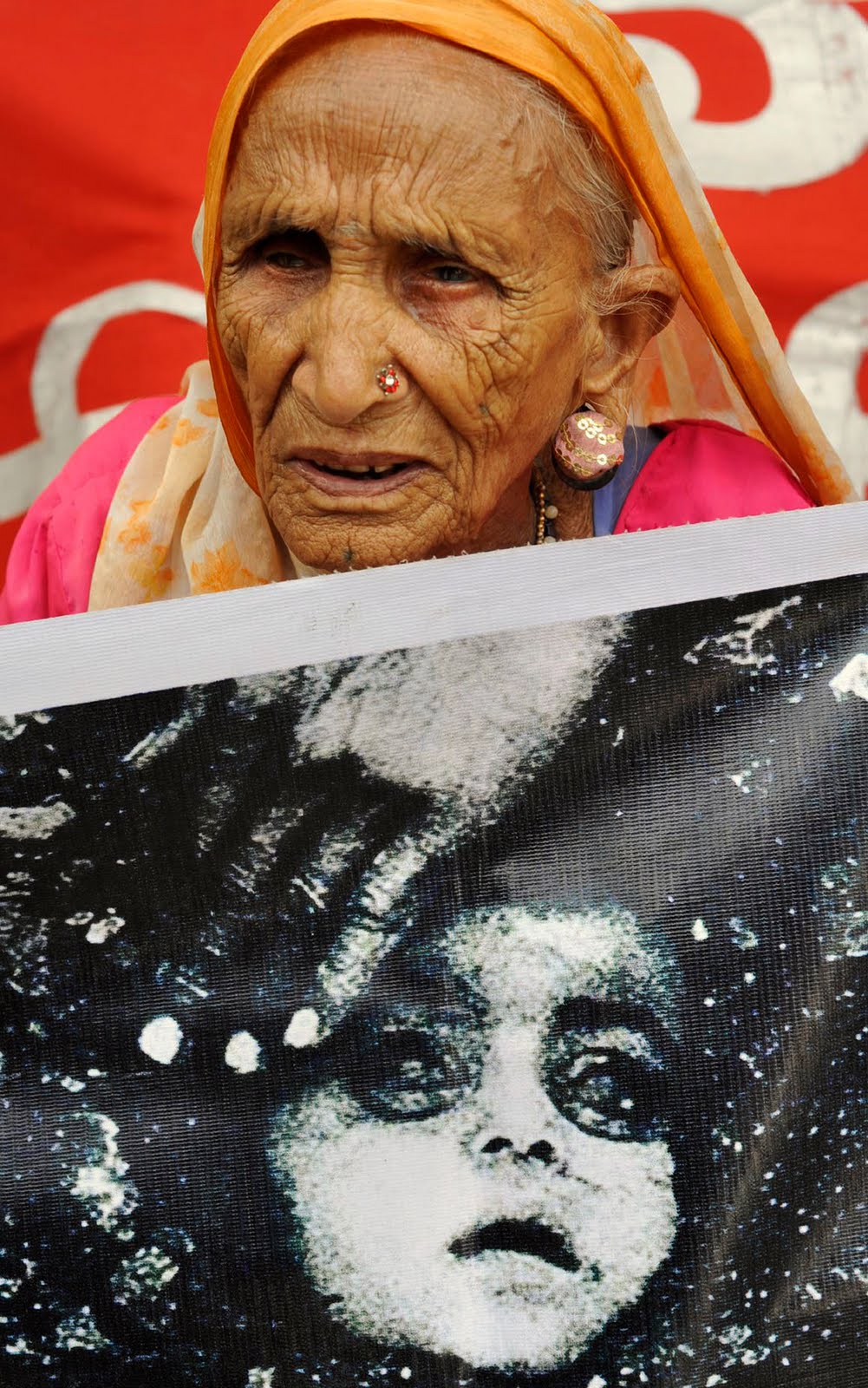
On the intervening night of December 2-3, 1984, deadly methyl isocyanate gas ‘leaked’ from a storage tank at the pesticides factory of Union Carbide India Ltd in Bhopal. Men, women and children sleeping in nearby slums and colonies died gasping for breath.

I was a sub-editor on the news desk of The Telegraph and have vivid memories of the tragic story unfolding through the day and late into the night of December 3. Those days there was no Internet and reports came via agency tickers. The enormity of the disaster emerged as PTI and UNI kept on updating the death toll. It was my third exposure to mass murder – the Nellie massacre was first; the anti-Sikh pogrom after Mrs Indira Gandhi’s assassination was second.

The official death toll of what came to be known as ‘Bhopal Gas Disaster’ – how cleverly Union Carbide’s name was erased from the event! -- was “around 4,000”, which was a gross under-estimation; thousands more died over the next few days, taking the toll to at least 15,000 dead. Many more thousands were afflicted with blindness, respiratory problems and other illnesses. Unborn babies died in the wombs of their mothers; children were born with deformities; life became a living hell for many. (See the legacy of Union Carbide's crime.)

Arjun Singh was Chief Minister of Madhya Pradesh those days, heading a Congress Government. Rajiv Gandhi was Prime Minister, defending the butchery that had followed Mrs Indira Gandhi’s assassination and couldn’t care a toss about what turned out to be the world’s worst industrial disaster.

Warren Anderson, chairman of the US-based Union Carbide Corporation, parent company of Union Carbide India Ltd, flew to see for himself the devastation wrought by the American multinational firm. Probably he wanted to verify whether media stories were true or exaggerated. He did not show either remorse or sorrow but was high on bluster.

The police arrested Anderson; he was escorted to Union Carbide’s plush guest house where he relaxed while Arjun Singh arranged for his bail which was ‘granted’ within six hours. That evening a Government plane was placed at Anderson’s disposal: He flew out of Bhopal to Mumbai from where he boarded a flight to America. That was the last occasion he came anywhere near India.

The CBI was given the task of investigating the disaster. And it was instructed by the Congress Government at the Centre not to seek Anderson’s extradition.

Trial in the case against those accused of culpability (eight senior executives of Union Carbide India Ltd, including its chairman Keshub Mahindra) began 23 years ago in a Bhopal court. The accused were charged by the CBI under Section 304(II) of the Indian Penal Code which provides for a maximum of 10-year imprisonment.

The accused petitioned the Supreme Court. Interestingly, a bench headed by Justice A H Ahmadi, who later went on to become the Chief Justice of India, in 1996 converted the CBI charge under Section 304(II) of the IPC to Section 304A with a maximum of two years’ imprisonment.

Ahmadi now defends that decision by insisting that “There is no concept of vicarious liability. If my driver is driving and meets with a fatal accident, I don't become liable to be prosecuted under Section 304(II).” In other words, for Ahmadi the death of 15,000 people is no different from his driver hitting another car or a pedestrian.

On Monday, June 7, the Bhopal District Court gave its verdict: Two years imprisonment and a fine of Rs 1 lakh for each of the accused and a fine of Rs 5 lakh for Union Carbide. Bail was granted to those held guilty.

This was no travesty of justice, it was perversion of justice.

The outrage following the verdict is justified, but nothing more by way of ‘punishment’ was expected. We should ask ourselves some searching questions:

. Union Carbide’s culpability apart, isn’t our Government, our system, to blame too?
. How is it that slums were allowed to proliferate in the immediate neighbourhood of a toxic industrial plant?
. Why were regular inspections not carried out at the plant? Who were the babus certifying the plant’s safety standards?
. Why did the State Government fail to even do a proper tally of the number of people killed? Why were numbers fixed to minimise casualties?
. How come we still do not have a law to deal with industrial disasters 26 years after the world’s worst industrial disaster occurred in our country?
. And, shouldn't we as a nation be ashamed, shouldn't we the people of India hang our heads in shame that our criminal justice system is so decrepit and callous that it took 23 years to deliver a bogus judgement in a case involving mass murder by another name?


TIMELINE
Congress Government
2-3 December 1984
Poisonous gas leaks from Union Carbide India Ltd (UCIL) pesticide plant in Bhopal at night, killing ‘around 4,000 people’ within days and thousands more since then.
4 December 1984
Police file a case against UCIL and arrest nine.
Chairman and CEO of US-based Union Carbide Corp (UCC) Warren Anderson is released on bail and leaves India
6 December 1984
Case is transferred to the Central Bureau of Investigation (CBI)
February 1985
India files a $3.3 billion claim against UCC in a US court
1986
US district court transfers all litigation to India
1 December 1987
CBI files chargesheet against Anderson, UCIL chairman Keshub Mahindra and seven others. Charges include culpable homicide
February 1989
UCC agrees to pay $470 million as compensation in an out-of-court deal with Indian government
1992
Only a part of the compensation is disbursed among victims. Anderson is declared a fugitive after igonring court summons.
1994
UCC sells stake in UCIL to McLeod Russell (India) Ltd. of Kolkata
13 September 1996
Supreme Court reduces the charge to death by negligence
NDA Government
1999
UCC announces merger plans with US firm Dow Chemicals
2001
UCC declines responsibility for UCIL’s liabilities in India
2002
Court maintains charge of culpable homicide against Anderson and demands his extradition. UK newspaper reports he is in New York, after US authorities say they can’t locate him
2003
India sends formal request for Anderson’s extradition
March 2004
India issues ’No Objection’ certificate to allow Dow Chemicals to clean the soil and ground water at the tragedy site
UPA Government
June 2004
US rejects India’s request for Anderson’s extradition
July 2004
Supreme Court orders the government to disburse the rest of the compensation
25 October 2004
Protest against the government’s failure to pay the compensation
26 October 2004
Supreme court sets 15 November as deadline for payment of compensation. Authorities begin disbursal
22 July 2009
Bhopal court issues new arrest warrant against Anderson. His trial is separated from others
7 June 2010
Local court declares all the eight accused guilty. Sentences them to 2 years in jail; imposes a piddly fine.
They are freed on bail.

On Israel, India plays Boy Scout


India has violated Sri Lanka's sovereignty to 'help' Tamils!
India has blockaded Nepal to 'teach Kathmandu a lesson'!
India votes with OIC countries; OIC countries votes against India!


It was the summer of 1987 and passions were running high in Tamil Nadu over the Sri Lankan Government’s decision to impose a blockade on Jaffna peninsula, which was the stronghold of the Liberation Tigers of Tamil Eelam. Colombo believed that it could force a breach between the Tamils of Jaffna and the LTTE by using coercive, non-military measures like an economic blockade: Starving masses would any day settle for food over homeland.

It didn’t quite work that way. The LTTE was in those days a fearsome fighting force and the civilian patrons of the Tigers were sufficiently impressed by V Prabhakaran’s machismo to begin believing in the balderdash about how Tamils constitute a separate nation and should not hesitate to pay any price for a Tamil Eelam. The LTTE demanded that the people of Jaffna should simply grin and bear the hunger and hardship caused by the blockade; the masses had no option but to concur.

Soon, the Tamils in India were seething with anger, as were their leaders with both AIADMK and DMK trying to outdo each other in ‘standing by’ their brethren in Jaffna. They demanded immediate intervention by India to ‘liberate’ Jaffna from the ‘clutches’ of Colombo. Rajiv Gandhi, who was then Prime Minister, was not particularly bothered about the deprivations forced on Jaffna’s Tamils by the blockade, but he was in a rage: How could Colombo thumb its nose at New Delhi in so blatant a manner in the middle of peace negotiations?

It was not possible to send an Indian armada across the Palk Strait, but Rajiv Gandhi did what he (or his advisers) thought was the next best thing: Indian planes were despatched to drop food packets over Jaffna. Six AN-32 aircraft made repeated sorties from Chennai to Jaffna, dropped food packets, and returned to base. Ostensibly, New Delhi was determined to showcase its human face in the neighbourhood. Of course, it’s another story that the same Rajiv Gandhi had ordered a virtual economic blockade of Nepal by closing all except one border crossing with Nepal to force Kathmandu to fall in line with New Delhi.

On spotting the AN-32 over Jaffna, it was Colombo’s turn to feel outraged: Its airspace had been violated with impunity by India. Nor were the Tamils of Jaffna pleased. This was no aid but mere scoring of political points. The subsequent India-Sri Lanka Accord and the disastrous Indian peace-keeping expedition are now footnotes of history.

Years later, Pakistan decided to repeat that act of Indian belligerence, albeit with a twist. It encouraged various Government-sponsored pro-azadi organisations based in Pakistan-occupied Kashmir to organise a long march to Srinagar. The idea was to create a spectacle of hundreds of thousands of men, women and children rushing through the Line of Control, leaving Indian security forces nonplussed: They couldn’t possibly shoot at civilians in such large numbers. Mediapersons from around the world gathered for the event as PV Narasimha Rao went into a tizzy, desperately trying to ward off a showdown. In the end, Mr Nawaz Sharif panicked (some say after a harsh telephone call from the White House prompted by Rao pleading with the Americans) and the Pakistani Rangers didn’t allow the ‘freedom marchers’ to proceed beyond Muzaffarabad.

The point is that India is the last country which should feel compelled to criticise Israel’s use of force to prevent the so-called ‘Freedom Flotilla’ led by a Turkish ship from breaching the naval blockade of Gaza. Having violated a similar blockade in another country and paid a terrible price for that folly, and also having enforced a pernicious blockade on Nepal which caused enormous and lasting damage to bilateral relations, and, last but not least, having scurried to the Americans for their help to stall a ‘Freedom March’ from Pakistan-occupied Kashmir to Srinagar, it ill behoves us to issue a denunciatory statement even before the full facts of what happened on the sea off the coast of Gaza were known. Had those who drafted the statement admonishing India bothered to watch the videotapes of the Israeli raid on the flotilla, they would have desisted from formally issuing it.

[Text of statement on 'incident involving boats carrying supplies for Gaza' issued by Ministry of External Affairs on May 31, 2010:

India deplores the tragic loss of life and the reports of killings and injuries to people on the boats carrying supplies for Gaza. There can be no justification for such indiscriminate use of force, which we condemn. We extend our sympathies to the families of the dead and wounded. It is our firm conviction that lasting peace and security in the region can be achieved only through peaceful dialogue and not through use of force.
New Delhi.]

It is amazing that we have not yet learned a lesson from voting blindly with the block of Organisation of Islamic Conference countries at all international and multilateral fora every time they have chosen to denounce Israel. This has not fetched India any benefits, diplomatic or otherwise. Nor has it stopped the OIC from adopting anti-India resolutions and repudiating India’s sovereign right over Jammu & Kashmir.

We can vote against Iran at the IAEA to please America (it would have been an entirely defensible and justifiable decision had New Delhi voted against Tehran on its own and not at Washington’s behest) but we can’t refuse to vote against Israel bearing in mind our national interest? Must we forget that Israel came to India’s help at a moment of national crisis when we urgently needed battlefield hardware during the Kargil incursion by Pakistani soldiers? More importantly, must we remain captive to vacuous political posturing of the past when it was fashionable to align with the Arabs against the Jewish state?

By rushing into criticising Israel, we may think we have scored brownie points with Turkey, which has recalled its Ambassador to Tel Aviv and threatened to snap six decades of diplomatic relations, but such expectations are entirely misplaced. The Islamist AKP regime in Ankara has made it abundantly clear that its sympathies lie with Islamabad and not New Delhi on a host of issues, especially the future role of Pakistan and India in Afghanistan; that it will facilitate Tehran’s bomb-in-the-basement programme through subterfuge and sleight of hand and, that it sees itself as the new centre of Islamic politics and Islamist revanchism.

If anything, India looks as silly as Nicaragua and South Africa — the first is trying to rediscover Left radicalism in a world that cruelly mocks at the Left; the second is blessed with a succession of Muslim Deputy Foreign Ministers who abuse Israel to satiate their lust for anti-Semitism. As if that were not enough, we have been bracketed with China which amazingly lectured Israel on the need to be mindful about safeguarding human rights. We could, of course, compare our hypocrisy with that of Britain which earlier this year expelled an Israeli diplomat over the targeted killing of a Hamas terrorist in Dubai. Few know that sanctimonious Britain provides caring shelter to Islamists wanted for horrible crimes around the world.

[This appeared as my weekly column Coffee Break in The Pioneer on June 6, 2010.]

Tuesday, June 01, 2010

Israel takes on bogus crusade


What's Turkey's Islamist AKP regime playing at?

It is laughable to hear the Prime Minister of Turkey describe Monday’s raid by Israeli commandoes on the so-called ‘Freedom Flotilla’ in which nine ‘peace activists’ -- eight Turks and an American of Turkish origin -- were killed as a “bloody massacre”. If the death of eight Turks who set upon the Israeli commandoes with knives and clubs, and shot at them after seizing their pistols, is a “bloody massacre”, then the chilling atrocities committed on Armenians by Turks surely amount to the genocide which they are described as but persistently denied by Turkey.

Let us not forget that the Armenian Genocide witnessed little girls being snatched from their mothers’ arms, dragged to the streets, raped and left to bleed to death; that young and old, men and women, were despatched to horrific deaths; that Armenian property was looted and what could not be stolen was set on fire; and, that tens of thousands were disinherited of their nationality and forced to seek shelter in alien lands. And all this happened without Turkish authorities lifting so much as a finger in admonishment.
Neither should we forget that till date Turkey has not owned up to that crime against its own people and against humanity, nor has it allowed others to recognise the massacre and worse for what it was. So much so, US President Barack Hussein Obama, who has sought a full report on the raid on the ‘Freedom Flotilla’ from Israeli Prime Minister Benjamin Netanyahu “ASAP”, chose not to use the word ‘genocide’ in his message on the 95th anniversary of the Armenian Genocide after promising to do so, presumably because he was mindful of Turkish sentiments.

Therefore, we really need not be distracted by the official reaction of Turkey which, apart from indulging in fiery rhetoric denouncing Israel and allowing thousands of Islamists to march on the Israeli Embassy in Ankara, has recalled its Ambassador to Tel Aviv. This could be Turkey’s first step towards snapping diplomatic ties with Israel, a country with which it has had cordial relations for six decades. It is Turkey’s sovereign right to decide how it conducts its foreign policy, as much as it is Israel’s right to decide how it responds to what is clearly a blatant Turkish provocation inspired by the ruling Justice and Development Party, or AKP, which is increasingly veering towards assertive Islamism for reasons which I shall dwell upon later. First, a brief account of what happened on Monday and who is responsible for what Turkey has so colourfully described as a “bloody massacre”.

The ‘Freedom Flotilla’, a convoy of six ships of varying sizes, led by the Turkish-flagged Mavi Marmara, had set sail for the coast of Gaza, ostensibly carrying “urgently required relief material for impoverished Palestinians” living in the blockaded territory. The three-year-old blockade of Gaza Strip is being enforced by two countries, Israel and Egypt, for different though inter-linked reasons. Israel has imposed its blockade, including maritime blockade off the coast of Gaza, because it is currently in a “state of armed conflict” with the Hamas regime which has repeatedly attacked civilian targets in Israel with weapons that have been smuggled in via the sea route and through tunnels connecting the Palestinian territory with Sinai in Egypt. Gaza’s Rafah border crossing with Egypt has also been consistently misused by the Hamas militia for smuggling in arms, ammunition and explosive material. Egypt, which has a peace agreement with Israel and whose President Hosni Mubarak is not enamoured of either the Muslim Brotherhood, which is the progenitor of Hamas, or the Islamists who dream of Hamastan instead of Palestine, has not only closed the Rafah crossing but is also building a steel-and-concrete underground wall to prevent tunnels from being dug. The blockade of Gaza Strip, really, is in effect a joint Jewish-Arab enterprise. We could endlessly quibble over the details, but that would not change the reality on the ground.

The ‘Freedom Flotilla’ was ostensibly organised by the ‘Free Gaza Movement’, which claims the 1.5 million Palestinians of Gaza Strip are living in abject poverty on account of the blockade. Israel says food, medicines, fuel and all civilian goods are allowed to pass through the blockade and tales of suffering, impoverished Palestinians are either sheer propaganda meant to generate support for Hamas or exaggerated to paint Jews as the persecutors of helpless Arabs, put countries otherwise favourably disposed towards Israel on a guilt trip, and keep the mills of anti-Zionism grinding in Arabia and beyond. What is true is that Israel has prohibited the supply of material which can be used for building tunnels and fashioning improvised rockets that are regularly fired by the Hamas militia.

The tenuous ceasefire that followed ‘Operation Cast Lead’ has held, but there’s nothing permanent about it as Hamas considers it no more than a hudna, to be used for regrouping and rearming its forces before launching fresh attacks. Israeli authorities had repeatedly requested the ‘Freedom Flotilla’ organisers to hand over its ‘relief supplies’ for inspection before being despatched to Gaza Strip and not to attempt reaching the Gaza coast. The organisers refused to either allow an inspection of the cargo or to hand it over to the relevant Israeli authorities.

That’s understandable, because the purpose behind the ‘Freedom Flotilla’ was not to help the poor and the famished of Gaza Strip, but make a political statement that would find a resonance around the world, forcing Governments and people to lend their voice to a ‘moral crusade’ while ignoring Israel’s national security imperatives. The media chose to romanticise the ‘Freedom Flotilla’, sensing a soft story that would tug at the heartstrings of newspaper readers and television viewers, instead of raising relevant questions about the entire dubious exercise and exposing the real organiser of the flotilla, the Turkish Insani Yardim Vakfi, or IHH, an Islamic charity with a radical anti-Western orientation. There is sufficient documentation to prove that beyond its legitimate philanthropic activities, the IHH provides extensive support to radical Islamist organisations, including Hamas, and that in the past it has maintained contacts with and provided support to global jihad organisations.

Given these facts about those behind the ‘Freedom Flotilla’ and its dubious cargo of material to help Hamas build tunnels and produce improvised rockets, Israel was within its rights under international law to stop the ships in international waters as the purpose behind the ‘moral crusade’ was to undermine Israel’s sovereignty. Israel had two options: Either score cheap brownie points by retreating before bogus ‘moral crusaders’, or court equally bogus international opprobrium by protecting its national interest. It chose the latter, which, we in India with an effete Government must concede, requires a lot of gumption.

This brings us back to the enraged reaction of Turkey, more specifically of the AKP regime in Ankara, to Monday’s unfortunate incident provoked by the belligerence of the so-called peace activists, among them a crew of Al Jazeera and a Pakistani television anchor, on board the Turkish ship Mavi Marmara. A recent poll suggests a dramatic shift in Turkish public opinion with the Left-secular Republican People’s Party, or CHP, surging ahead of the Islamist AKP. The CHP is now seen to be commanding 33 per cent of the vote, compared to 31 per cent for the AKP. The Right-wing Turkish nationalist MHP stands third with 19 per cent of the vote. The next election is scheduled for 2011, but the AKP, according to reports, has been toying with the idea of calling an early poll rather than risk a worsening economic situation. In such a scenario, what better way for the AKP to shore up its electoral fortunes than by painting Jews as villains guilty of “bloody massacre” of Turks and by extension Muslims? Other Islamist regimes have played this game successfully, so why not the AKP regime?

[This appeared as the main Edit Page article in The Pioneer on June 2, 2010.]

Wednesday, May 26, 2010

Canada regrets visa refusal letters


News Flash!
The following statement was issued by Canada’s Citizenship and Immigration Minister Jason Kenney on visa refusals by the Canadian High Commission in India:

Ottawa, May 28, 2010 — “Canada has the highest regard for India, its government institutions and processes. Our friendship as democratic nations who operate under the rule of law grows ever stronger and we share a common bond of ethnic, religious, and linguistic diversity. Our economic and trade ties continue to strengthen both of our economies.
“Furthermore, at a time when global security continues to be a cause for concern, Canada values the increasing ties and cooperation with India in the fields of defence, security and counter-terrorism. Each year, Canada welcomes about 131,000 Indian residents on both a temporary and permanent basis, including many individuals from the various Indian security forces.
“The Government of Canada therefore deeply regrets the recent incident in which letters drafted by public service officials during routine visa refusals to Indian nationals cast false aspersions on the legitimacy of work carried out by Indian defence and security institutions, which operate under the framework of democratic processes and the rule of law.
“This language, or the inaccurate impression it has created, in no way reflects the policy or position of the Government of Canada. While, under Canadian law, admissibility to Canada is determined by a number of different criteria, candidate assessments should in no way question Indian institutions which operate under the rule of law and within a democratic framework.
“As to the decision process itself, decisions on visa applications are made on a case-by-case basis by non-partisan public servants following an independent process based on Canada’s immigration law as it currently stands. However, this unfortunate incident has demonstrated that the deliberately broad legislation may create instances when the net is cast too widely by officials, creating irritants with our trusted and valued international allies. For this reason the admissibility policy within the legislation is under active review at this time.”

* * * * * *
May 26, 2010
Canada cans India!

*Canadian High Commission officers malign, insult India

*No need for diplomatic niceties with boorish 'diplomats'


Last week when media reported how the High Commission of Canada had denied visa to a retired head constable of the BSF (whose daughter lives in Canada) on the grounds that the para-military force he had served was a “violent” and “notorious” force, there was more amusement than anger in New Delhi. Here was a naïve visa officer being self-righteously sanctimonious.
I was later told that the visa officer is a relatively junior official, a First Secretary, who knows next to nothing about India, is a cussed individual prone to being nasty, and for the most basic facts about her host country and its institutions, ‘googles’ for information. It is possible she looked up ‘BSF’ on Website operated by Kashmiri separatists and came to the conclusion that it is a “violent” and “notorious” force.
It now transpires that there is a pattern to Canada rejecting visa applications submitted by a certain category of Indians. On Wednesday, May 26, PTI put out the following story:
New Delhi, May 26: In fresh revelations of provocative actions, Canada has denied visas to a member of the Armed Forces Tribunal, three serving Brigadiers, a retired Lt General and a former senior IB official on the grounds that their organisations have been “engaging in violence”.
A serving Intelligence Bureau officer, assigned to travel to Toronto in connection with the Prime Minister's trip there next month, was also denied visa recently but was later allowed to travel after protest from India.
The denial of visas, over the last two years, has angered the Home Ministry which has warned that India would also "retaliate" by denying visas to Canadian officials who go to Afghanistan via this country.
I have posted alongside a copy of the letter issued to the former senior IB officer by the High Commission of Canada, signed by First Secretary S Auger. The details are self-explanatory. You can read it by clicking on it. I wonder if Ms Auger is the visa officer at the High Commission who decided on the visa applications that were turned down by citing the most absurd, outrageous and astonishing reasons.
If the Manmohan Singh Government had any sense of self-respect and dignity, had it been bothered about India’s stature and national pride, and had the Prime Minister not been so enamoured of Western Governments whose approval matters to him more than approval by the masses at home, then the Ministry of External Affairs would have been instructed to summon the Canadian High Commissioner, give him 24 hours to set things right, de-roster the guilty visa officer/s and send them back to wherever they have come from. Simultaneously, it would have issued a statement declaring no more visas for Canadians travelling to and from Afghanistan via New Delhi.
Since no ostensible purpose will be served by the Prime Minister’s tax-payer funded junket to Toronto, it should have been called off too. In the event of the Canadians not complying with the MEA’s demands, the relevant officers should have been declared persona non grata and asked to leave the country by the first available flight. There is no scope for diplomatic niceties over another country’s diplomatic crudity.

Canada has no moral authority to play good cop. Its own record of officially-sanctioned racism and racist violence would shame any country. The ‘exclusion laws’ devised by Canada to keep ‘darkies’ out of the country are not entirely forgotten. The Komagata Maru incident in 1914 will forever remain a blot on Canada’s history.
We must also not forget that Canada was the biggest sanctuary for Khalistani terrorists wanted for crimes against civilians in India. Canada refused to entertain any requests from India on either restraining the Khalistanis or handing over criminals to stand trial for murder and worse in India. The Babbar Khalsa International was launched right under the noses of Canadian authorities.

The bombing of Air India’s Kanishka (flying on the Montreal-London-Delhi-Bombay route) on June 23, 1985, was planned and executed by Khalistanis living in Canada. The aircraft blew up off Ireland, killing 329 people on board – 307 passengers and 22 crew members. Among the dead were 280 Canadian nationals, most of them of Indian origin, and 22 Indians. Twenty-five years and a 20-year sham trial later, the conspirators remain unpunished.
Canada also happens to be one of the most secure sanctuaries for supporters, members and fund-raisers of the Liberation Tigers of Tamil Eeelam.
I have travelled through Canada and have happy and fond memories of that country and its people. I don’t think the denial of visa by ill-informed, boorish officials at the Canadian mission in New Delhi on such ridiculous grounds enjoys any degree of support among Canadians and their political leadership. Yet, this nonsense must be halted and an example made out of it so that other missions are not tempted to treat India and Indians shabbily while enjoying our hospitality.

Tuesday, May 25, 2010

Pakistan's gesture of friendship: Hafiz Saeed walks free!


A slap in the face of India

But Manmohan Singh is unmoved

On Monday, May 24, Prime Minister Manmohan Singh defended his decision to resume bilateral dialogue with Pakistan at the Foreign Secretary and Foreign Minister level. This decision, announced at Thimpu where Manmohan Singh met Pakistani Prime Minister Yousuf Raza Gilani on the sidelines of the SAARC Summit, flies in the face of public opinion in India. It proves that Manmohan Singh’s grovelling capitulation at Sharm el-Sheikh, where he agreed to delink Pakistan’s yet-to-be-fulfilled promise to act against anti-India Islamist terrorist groups operating out of territory under Islamabad’s control from the resumption of the ‘composite’ bilateral dialogue which had been suspended after 26/11, was no mistake. He did with the purpose of resuming talks without securing India’s national interest; he did it under American pressure; and, he did it knowing full well that he does not have mandate to do so.
At his May 24 Press conference Manmohan Singh defended his decision to resume dialogue with the Pakistani political-military-jihad alliance by insisting:
a. India cannot but seek peace and better relations with its “largest neighbour” (which is bunkum, not least because Pakistan is not India’s ‘largest’ neighbour);
b. India cannot progress economically unless it has “resolved” all issues with Pakistan (which is not true as India’s growth has been independent of its relations with its rogue, terror-sponsoring neighbour); and,
c. India must reduce the “trust deficit” that stands in the way of better relations with Pakistan (which is hogwash because the ‘trust deficit’ is of Pakistan’s account and it is for Pakistanis to reduce it).

Expectedly, the Left-liberal section of Delhi’s commentariat waxed eloquent while heaping praise on Manmohan Singh for discounting national interest in pursuit of peace with Pakistan. Our self-seeking middleclass, which is obsessed with furthering its own wellbeing at the expense of India’s wellbeing, of course, is unable to fathom the consequences of Manmohan Singh’s disastrous decision. Arun Jaitley did make a valiant attempt to highlight the folly of the Prime Minister’s action, but his other senior colleagues in the party, especially Leader of Opposition Sushma Swaraj, maintained a strange, inexplicable silence.
On Tuesday, May 25, the Pakistani Supreme Court allowed Hafiz Saeed, the chief terrorist of Lashkar-e-Tayyeba / Jamaat-ud-Dawah and one of the key men who plotted the 26/11 fidayeen attack on Mumbai, to walk free. Apparently, the three-judge bench came to the conclusion that there was no evidence to keep Hafiz Saeed under house arrest – leave alone in jail – for his role in the 26/11 mass murder.
The Pakistani Supreme Court’s decision is in keeping with the Pakistani Government’s repeated insistence that the Government of India has failed to provide any evidence against Hafiz Saeed and his fellow terrorists. Several dossiers with stacks of documents supplied by New Delhi to Islamabad have been glibly labelled as ‘fiction’.
Pakistan’s mocking inaction against the masterminds behind the 26/11 outrage is in sharp contrast to the haste with which it has detained friends, associates and family members of Faisal Shahzad, the Pakistani American arrested in New York for planting a car bomb at Times Square. The bomb was defused before it could explode.
Obviously the Americans are pleased. And they couldn’t give a damn about Pakistan sponsoring cross-border terrorism against India. Just as they couldn’t bother with giving Indian agencies access to another Pakistani American, David Coleman Headley alias Daood Gilani, a member of Chicago’s LeT cell who did the groundwork for the 26/11 attack and other planned terrorist outrages.
It would be in order to presume that Pakistan has impressed upon its benefactor the need to protect Headley/Gilani lest he tell Indian investigators all about the involvement of the Islamabad-Rawalpindi alliance in waging jihad against India. US President Barack Hussein Obama couldn’t but have obliged his favourite criminal regime. That favour has been returned by acting promptly against the alleged allies of Faisal Shahzad.
America is happy. Pakistan is happy. As for India, it better do what B Hussein O instructs Manmohan Singh to do. With an effete Prime Minister, India has no other option but to comply with what America demands, which is really what Pakistan wishes.
Meanwhile, the self-righteous, sanctimonious UN Secretary-General would do well to ponder over the contempt with which Pakistan, with the full backing and support of America, has treated the UN Security Council resolution against JuD and its terrorist leaders.

Saturday, May 22, 2010

The secret diary of Hamid Mir


Or why news telly in India is so insensitive!

If Saturday morning’s crash of an Air India plane in Mangalore that resulted in the loss of 159 lives was shockingly tragic, the coverage of the horrific incident by television news channels was appallingly callous. Chasing TRPs, some channels tripped over each other to be the first to get ‘exclusive’ tid-bits of the accident, and took ghoulish delight in presenting macabre details. What was most insensitive was television reporters thrusting their mikes into the faces of survivors and asking stunningly bovine questions. Actually, they were not asking, but demanding replies to questions that were uncalled for. So we had these shaken and injured survivors, too traumatised to think straight and possibly still in a daze, unable to comprehend what had gone wrong in the last few minutes before the plane they were travelling in from Dubai was to have come to a halt on the runway and then slowly made its way to the parking bay, recounting their horror for the benefit of television news channels. What they (or grieving families) said made little sense, which is understandable. Our smart alec anchors would have been far more incoherent and incomprehensible had they been through something far less traumatic and life-threatening.

Make no mistake. The survivors, who were in need of immediate medical assistance and could do without television cameras at their moment of ordeal, were not being brought to the screens of your television sets to inform you about what happened, why it happened, how it happened. In any event, none of the few who survived the crash could possibly throw any light on what went wrong with a landing that was supposed to be smooth — the commander and his co-pilot had landed the same aircraft on the same runway innumerable times in the past and are believed to have known the terrain like the backs of their hands — but proved to be fatal. The survivors were pounced upon by camera crews because it gave them a great high (they were able to get ‘exclusive’ grabs for their channels) and their bosses an opportunity to claim that they had it before anybody else did. That in the process all norms of decency, dignity and discretion were rudely trampled upon, and editorial caution that should have been exercised was thrown to the wind, matters little to our television channels.

Which, of course, is nothing new. Why else would our television channels have sought out Hamid Mir, the now disgraced ‘star’ of Pakistani television and chief of Geo TV, for his comments whenever issues related to that country or India-Pakistan relations cropped up? That Hamid Mir has a dubious past is known to everybody on either side of the Radcliffe Line. Nor is it a well-kept secret that Hamid Mir’s sympathies have all along been with the Islamists and not the modernists of Pakistani society and politics. By extension, his association with the ISI and the Pakistani Army has often been a subject of animated discussion. Yet, what is known as ‘mainstream media’ in India had no compunctions about showcasing Hamid Mir and presenting his views as those representing ‘mainstream opinion’ in Pakistan!

Well, mainstream opinion in Pakistan, at least that which reflects what the educated, thinking classes of that country think, is at the moment heavily loaded against Hamid Mir. Recently, a tape surfaced on Facebook which had him talking to a member of the Tehrik-e-Taliban Pakistan, or what is popularly referred to as the ‘Punjabi Taliban’ by Pakistanis. The conversation had nothing to do with news-gathering: It amounted to Hamid Mir instigating the TTP to kill Khalid Khwaja, a former ISI agent known to be close to the Americans who had been kidnapped by the Punjabi Taliban. The tape reveals Hamid Mir accusing Khalid Khwaja of having links with the minority Ahmedis and the Americans, both sufficiently sinful in the books of the Pakistani Taliban to merit the death sentence. Subsequently, Khalid Khwaja was killed. Hamid Mir tried to disown the tape, saying it was not his voice. Strangely, the ISI has confirmed that it was indeed Hamid Mir’s voice on the tape; senior journalists who have known Hamid Mir for years have also confirmed the tape’s authenticity.

A debate is now raging in Pakistani media circles about who taped the conversation between Hamid Mir and the TTP, and why was the tape leaked. According to some journalists, the outing of Hamid Mir also exposes the deep rifts within Pakistan’s intelligence agencies, namely the ISI, the Military Intelligence and the Intelligence Bureau. Any one of them could be trying to embarrass the other as Hamid Mir is said to have had livewire links with all of them. Another theory has it that the whole purpose was to expose the Islamists within Pakistan’s intelligence agencies by those sections in the ISI, MI and IB aligned with the either the US or China — sort of an ‘ideological’ war which has now come into the open. This is discounted by knowledgeable members of Pakistan’s commentariat who believe, and perhaps rightly so, that there is little that divides Pakistani intelligence agencies and their operatives ‘ideologically’; any alliance with either the Americans or the Chinese is purely tactical and does not automatically denote rejection or repudiation of Islamism.

The fine print, really, is inconsequential. The fact remains that Hamid Mir is more than just chief of Geo TV; he is also in cahoots with Pakistani intelligence agencies and has strong links with organisations like the TTP which are considered ‘strategic assets’ by sections of the Islamabad-Rawalpindi political-military-jihad complex. What is also of some importance for us is that Geo TV belongs to Independent Media Corporation, which owns the Jang group of newspapers. And as we all know, the Jang group is the Pakistani partner of a well-known Indian group of newspapers in a joint venture called ‘Aman ki Asha’ which aims to promote cross-border harmony and peace. It would be perfectly in order to ask how can a media group that has die-hard Islamists with links to terrorist organisations vehemently opposed to peace with India in senior positions be a trans-border peace partner. It would also serve some purpose if we were to be told as to why the Jang group was selected over other newspaper groups or independent dailies like the Daily Times, which has played a leading role in exposing and outing Hamid Mir. Chinese whispers are not exactly reliable. But there could be some truth to the story doing the rounds that it was neither aman nor asha that prompted the partnership between the two media groups.

[This appeared as my weekly column Coffee Break in Sunday Pioneer, May 23, 2010.]

Friday, May 21, 2010

Thought police are powerless


Why ban doesn't work on the Internet!

There was great alarm and panic in Twitterworld across the Radcliffe Line on Friday morning when journalists, not all of them Pakistanis, found they could not log on to www.twitter.com. With Facebook and YouTube officially banned, and a mysterious disruption in BlackBerry services, they were appalled by the possibility of being denied access to Twitterworld where tweets are not just about what’s happening, but what’s happening around you.

The uninitiated may be forgiven for believing that Twitterworld is where you discover the fads and fancies of celebrities and tweeting is no more than social-networking; tweeple not given to frivolity of the variety that got Mr Shashi Tharoor into trouble with the fuddy-duddies in the Congress are increasingly using this new media platform for exchanging information and ideas and instant micro-blogging. Even before a story becomes breaking news on television channels, it is out there via a 140-character tweet. More importantly, a lot of stuff that does not find space in newspapers and news shows finds its way into Twitterworld: Dissemination is instant, without barriers and free of ‘editing’. It was, therefore, not surprising that there should have been alarm and panic when journalists in Pakistan found www.twitter.com being more difficult than it is on certain bad days.

Thankfully, the glitch proved to be temporary: Had Twitter too been banned by Pakistani authorities, it would have meant another window to the world being shut. Those who do not have to worry about their Governments snooping on them in the virtual world of the Internet, or are fortunate enough to live in liberal democracies with open, plural societies, will never be able to gauge the importance of any of the new media platforms like Facebook, YouTube, Twitter, Blogspot and WordPress, to name only a few, for those who find themselves saddled with regimes that claim to be ‘democratic’ but lack the moral courage to uphold the two essential values that define a democracy: Freedom of speech and personal liberty. Facebook, YouTube, Twitter, Blogspot and WordPress acquire a new meaning and a vastly different purpose in countries like Pakistan, Iran and China where they afford their users an exhilarating sense of freedom otherwise denied by prevailing political realities and social circumstances.

When the state blocks access to Facebook, YouTube, Twitter, Blogspot, WordPress and other such Websites, its purpose is to both play thought police as well as curb the human urge for freedom and liberty which, if allowed to take form and shape, can pose a threat to the oppressive ruling elite. But if technology is open to subversion by a repressive state, the repression is open to subversion by the very people whom the state seeks to control and dominate. Just as there is software which blocks access to Facebook, YouTube, Twitter, Blogspot and WordPress — and, in some countries, Wikipedia, Google and related services — there are proxy servers and ways and means of beating the ban.

The Communist Party of China loves to believe that the Chinese in mainland China do not have access to Facebook (and other blogging sites). The truth, however, is far removed from this belief. Similarly, dissident Iranians regularly work around officially blocked and banned sites to send out information about what’s happening in the land of the ayatollahs and their chosen rage boy called Mahmoud Ahmadinejad. Within hours of Pakistan Telecommunication Authority implementing the order of the Lahore High Court banning Facebook — and later YouTube — because a group of Islamist lawyers insisted these sites hosted “sacrilegious” and “derogatory” content, tech-savvy young Pakistanis abroad were tweeting to Pakistanis at home how to defy the ban.

That could be the reason for Friday’s snag in Twitter services, although applications like TweetDeck remained unaffected. Possibly the task of blocking a service accessible through multiple applications proved to be Herculean for telecom service providers. Or the fear of upsetting millions of young men and women in a country with 20 million Internet users may have held their hand. The good news, as of now, is that Twitter is working in Pakistan. The ban on Facebook and YouTube remains, but it is most likely proving notional. As one Pakistani tweeted: “What’s common to Facebook and Lashkar-e-Tayyeba?” and then replied in jest, “They are both banned in Pakistan, but Pakistanis can still find them if they want to!”

The issue, however, is less to do with the absurd order of the Lahore High Court and the knee-jerk reaction of Pakistan Telecommunication Authority — obviously at the behest of the Government headed by Prime Minister Yousuf Raza Gilani, a deceitful though effete politician — and more about taking recourse to proscription as a means of perpetuating thought control and suppressing freedom of speech. In Pakistan and other Islamic countries, Islamists and fanatics unite in seeking to deny co-religionists the right to disagree and express dissent on matters of faith. The concept of blasphemy, which should really be restricted to believers of the faith that has been blasphemed, has now been expanded to include those who subscribe to other faiths or to no faith at all.

Hence, we have now reached a stage where mullahs in Pakistan feel emboldened enough to declare that American cartoonist Molly Norris is guilty of committing ‘blasphemy’ by creating a Facebook page for ‘Everybody Draw Mohammed Day’ last Thursday and, therefore, deserves to die. That Ms Norris has denied the allegation — “Hello, I never created a Facebook page for EDMD. A stranger to me did so. Thank you, Molly” she wrote on her webpage — and that it is possible for anybody to open a page on Facebook or upload a video on YouTube under an assumed name is of little or no consequence to mullahs who in all probability do not know the difference between a mouse and a keyboard but wield terrifying power in this day and age.

It could be argued that the Pakistani authorities were wise in taking pre-emptive action rather than allow the mullahs to take to the streets and run amok as they did in 2005 following the contrived controversy over the alleged lampooning of Prophet Mohammed by cartoonists in the Danish newspaper, Jyllands-Posten. More importantly, it could be pointed out, and justifiably so, that we in India, a country which takes pride in portraying itself as a democracy with a liberal, open society, are really not better off: After all, our Government too is given to banning books, films and Websites that are perceived to be ‘offensive’ to communities, especially the religious minorities. Our mullahs are no less vicious and their mindset no less regressive than mullahs in Pakistan or elsewhere.

Technology, however, is proving to be a great leveller. It is easy to ban books and films and proscribe publications. But it is extremely difficult, if not impossible, to ban Websites and digital platforms. That is today’s reality and we might as well learn to live with it. We can’t demand freedom of speech and freedom of faith without conceding the freedom to offend; ideas must be contested with ideas and not sought to be stamped out by bogus decrees. To refuse to accept this fact would be to under-estimate the power of technology — that would be both foolish and dangerous.

[This appeared as Edit Page main article in The Pioneer on May 22, 2010.]