Sunday, June 10, 2012

Who let the trolls in?

Welcome to the New Virtual World Order!


(Visual courtesy: http://hebreaksthecedars.blogspot.in)

The first time I encountered the word ‘troll’ was in high school. That year, we had to read JRR Tolkien’s fantasy novel, The Hobbit, as part of our course for English literature. It was in the pages of that fascinating book that we discovered amazing creatures, including hobbits and trolls.
Trolls, we were told by way of introduction to these supernatural beings, traced their origin to Norse mythology. They were not particularly handsome in their appearance, lived in mountain caves and had their own social code. Human beings steered clear of them as they did of human beings.
I read The Hobbit at the turn of the last quarter of the last century. Although it’s a memorable book, hugely entertaining at one level and profoundly meaningful at another, I had forgotten about trolls and their strange ways. And I didn’t hear or read about trolls till my foray into social media via Twitter.
I must admit that I was clueless about the terms of engagement in Twitterdom. I learned the rules, such as they are, as I went along, often through mistakes that I wouldn’t ever commit again. Those were days of well-meaning innocence. I wish I had been cynical.
Two terms I would hear often is ‘troll’ and ‘trolling’. The Urban Dictionary, which too I discovered via social media, defines a troll as someone who is deliberately provocative, disruptive and abusive.
A ‘troll’ is someone who “continually harangues and harasses others, has nothing worthwhile to add to a conversation, thinks everybody is talking about him/her, and has multiples monikers to circumvent getting banned”. Trolls also use anonymity as a shield. And their online activity is what is known as ‘trolling’.
Meeting a troll in the misty mountains of Hobbitland would have been a thrilling, if not delightful, experience. Meeting a ‘troll’ on an online forum, especially an open forum like Twitter, can prove to be neither thrilling nor delightful.
Yet, not everybody who is impolite to you, or does not shares your views, or has a bone to pick with you because of real or imaginary grievances, or simply has had a bad hair day and is nursing a foul mood, is a ‘troll’. Nor does someone who pitilessly demolishes your argument, or calls you out for being less than truthful with facts, or tells you on your face that you are a charlatan and/or a philanderer (because you indeed are one), qualifies to be labelled as ‘troll’.
I have no issues with such people even if they are labelled as ‘trolls’ by those who feel unsettled by them. On more than one occasion I have defended them because I see them as subaltern sepoys who have at last found a means of having their say and calling the bluff of those given to bluster.
Also I quite enjoy watching worms squirm. Those mortified by ‘trolls’ like these have had a free run till now. No longer shall they go unquestioned; no more can they peddle their bunk without a quality check. That’s social media’s biggest contribution.
A ‘troll’ is someone who intentionally harasses and abuses. A ‘troll’ is someone who deliberately defames and slanders you.
A ‘troll’ is someone who slyly stalks you, twists your words, and seeks to denigrate your views by imputing slanderous motives.
A ‘troll’ is someone who can be confronted and charged with criminal offence. At least that’s my interpretation of who or what is a ‘troll’ and his/her ‘trolling’.
The presence of ‘trolls’ as I see them is undesirable on an open media platform where freedom of expression is often misconstrued as freedom to abuse, to defame and to slander.
Individuals taking shelter in anonymity do so. Bots using monikers also do so, perhaps with a degree of sophistry.
I would also add a third category of ‘trolls’: Individuals who use their real names and are either brazenly shameless or secure in the knowledge that prosecution for libel is not an easy option in our country.
They spit and scoot. They squat and stalk. They are possibly sickos with twisted minds and darkened souls.
But we don’t live in a perfect world. In real life there are ‘trolls’ all around. Colleagues bitch about you behind your back at office. Relatives say nasty things about you after dining at your home. Examples abound.
Hence, it makes sense to ignore ‘trolls’ who abuse, defame and slander others, taking recourse to bazar language. It also makes sense to ignore the posh ‘trolls’ who pretend to be socially, culturally and intellectually superior and believe everybody else is a ‘moron’.
Some of these posh ‘trolls’ also happen to media stars, courtesy their real and sugar daddies. We contemptuously ignore insufferable fools, so should we ignore insufferable ‘trolls’ like these.
But that’s easier said than done. Often individuals take offence, very serious offence, to ‘trolling’ by ‘trolls’. What invariably follows is ‘I feel outraged’ or ‘I feel violated’. That’s silly.
In the virtual world of social media, it’s absurd to feel angry or violated, not the least because the millions out there give a damn about your feelings. Tough luck. Get real. Deal with it.
There’s a problem though. The easily offended, the perpetually violated, find it difficult to get real and deal with the fact that not everybody is a fawning admirer and an unquestioning toady.
News telly stars, who have till now talked down to their audience from the safe confines of their studios, are alarmed at being confronted on social media platforms, say, Twitter, for their glaring biases and for running motivated stories.
Writers who have pontificated from their ivory towers, brooking neither criticism nor correction, are horrified for being told on their face that what they produce is bilge. That’s not what they are accustomed to hearing.
The Bold and the Beautiful, the pretty people who blow kisses, call each other ‘dahling’, and pretend to know all about wines and single malts although anything but rum, the good old sailor’s drink, gives them indigestion, at Dior-drenched Page 3 parties, are left speechless by the audacity of the unwashed masses on social media platforms. Who let the dogs in?
The new digital order did. Social media isn’t the Gymkhana and Twitter isn’t the IIC. By the way, Bharat speaks English too. And guess what? Bharat has this terrible habit of questioning hypocrisy, exposing duplicity and lampooning gasbags masquerading as intellectuals.
So what will you do? Write a pompous piece denouncing Bharat? That will fetch much mirth and laughter – before you know, Bharat will be rolling on the floor laughing his ass off.
Horrible ‘troll’ this, Bharat. But that’s what you get for removing the digital divide. Welcome to the New Virtual World Order.


Tuesday, June 05, 2012

Meanwhile, in the White House...


Rick McKee is the staff cartoonist at The Augusta Chronicle. 


 Nate Beeler is the award-winning editorial cartoonist for The Columbus Dispatch.


Shadow of nuclear Iran


Israel has never been free of threats to its very existence. But never before has the Jewish state been so worried about the future.

Rare, if any, has been the occasion when Israel has not been burdened with the onerous task of seeking answers to tough existential questions. Ever since the birth of the Jewish state in 1948, it has had to relentlessly struggle on several fronts at the same time. There were wars, launched by Israel’s Arab neighbours, that had to be fought and won; there were challenges to the fledgling Israeli economy, including sourcing oil and gas, which had to be overcome; there were problems, associated with institutionalising a democratic order, that had to be resolved.

Nearly six-and-a-half decades later, Israel is an oasis of peace and prosperity, surrounded by the sterile sands of Arabia. A robust democracy with a healthy economy — which is in stark contrast to the global financial turbulence — Israel, where democracy flourishes in its truest sense, should have had little to worry about. Yet, beneath the apparent calm that prevails in Tel Aviv and Jerusalem (and the rest of the tiny country which in reality is a mighty nation), there is mounting disquiet bordering on alarm.

All of a sudden, Israel finds itself confronting a rapidly changing situation in West Asia where yesterday’s certitudes have turned out to be untrue and unreliable. Israel can no longer take for granted its three-decade-long peace with Egypt which, even if frosty at best of times, had allowed it to focus on nation-building without being distracted by threats of war. The entirely unexpected collapse of the Hosni Mubarak regime and the menacing rise of Islamists have not been without consequences that indicate a return to the past.

There is much talk in Cairo of disowning the 1979 Peace Treaty that followed the 1978 Camp David Accords, signed by Egypt’s President Anwar Sadat and Israel’s Prime Minister Menachem Begin. The Muslim Brotherhood had never accepted that peace agreement: Sadat was assassinated in 1981. The assassin, Lieutenant Khalid Islambouli, was executed, but that did not in any manner lessen the opposition to peace with Israel.

Today, the Muslim Brotherhood wields power in Egypt and, for all practical purposes, the 1979 Peace Treaty lies in tatters. The supply of Egyptian gas to Israel has been stopped; Sinai is now controlled by marauding mobs of Islamists; the demilitarised buffer zone between Egypt and Israel neither offers protection nor assures peace. Diplomatic relations between the two countries are at an all time low.

The situation in Jordan, the other Arab country with which Israel had signed a peace agreement, remains unstable. For the moment, the progressive and pragmatic King Abdullah of Jordan has the upper hand, but it is anybody’s guess as to how long he can hold out against the Islamist surge following the so-called ‘Arab Spring’ which has turned out to be a torrid summer of political instability and social upheaval.

In Syria, President Bashar Hafez al-Assad and his Ba’athist loyalists are fighting a rearguard battle against Ikhwani forces hugely emboldened by the turn of events in Tunisia, Libya, Egypt and Yemen. The fallout of the raging civil war in Syria is being felt in Lebanon where the Hizbullah continues to expand its hold over the state and its agencies. From Tel Aviv (or, for that matter, from anywhere else) the view of the rest of West Asia, which the West refers to as the ‘extended’ Middle East, that is, from Iraq and Saudi Arabia up to Iran, gets progressively bleaker. Ironically, much hope is now vested with Saudi Arabia to hold the Islamist tide; yesterday’s sponsor of militant political Islam is today’s defender of moderation of faith in politics at home and abroad.

Turkey, with which Israel enjoyed (and to an extent still does) excellent relations, has its eyes set on emerging as the main power in the region and seizing the leadership that was till now jointly held by Egypt and Saudi Arabia. Here, too, the irony can’t be missed: The Turks have little in common with the Arabs, civilisationally and culturally. Locked in this battle for leadership after the tectonic shift of power from the Arab Palace to the Arab Street are Saudi Arabia and Iran — the first desperate to retain its primacy over Sunni Arabia; the latter seeking to establish Shia hegemony over Sunni states either in turmoil or with tottering regimes.

All this constitutes bad news for Israel. There is understandable concern over Iran’s proxies — Hamas in Gaza, Hizbullah in Lebanon and Shia dissidents in Arab states — gaining strength. The possibility of Sunni Ikhwanis, eager to demonstrate their anti-Israel credentials and thereafter take their anti-Semitism to its logical conclusion, making common cause with Shia Iran cannot be ruled out. The lifting of the embargo on allowing Iranian ships to pass through the Suez Canal does not portend well for the future — many in Israel see it as a sign of emerging threat on a front considered secure till now.

Topping the list of these concerns is Iran’s military nuclear programme which, unless dismantled soon, will inevitably result in Tehran acquiring weapons of mass destruction. There is sufficient evidence to prove that Iran is racing towards producing weapons grade uranium; that it is simultaneously working on delivery systems by way of acquiring missiles and related technology; and, that there is absolutely no reason to believe that the Baghdad talks, on which much hope has been pinned by the global community, will yield the desired results. If Iran were to get its own Bomb, others in the region would want it too. And this is where Pakistani proliferation comes in: Having provided technology and hardware to Iran, it will not hesitate to hawk both, if not readymade Bombs, to the Arabs. There’s a lot of money to be made.

That’s the doomsday scenario. Israel hopes (against hope) that this won’t come about, that sanctions and international pressure will yet make Iran wilt. But it’s also aware that sanctions have not always had their desired results or else the world would not have been saddled with rogue regimes straddling unruly states. Hence, it’s working on its own strategy to deal with a nuclear armed Iran.

Tiny David defeated mighty Goliath. That lesson of history should not be lost on those who dream of wiping Israel from the map of the world.

Baboos, bibis and the Bangals of Kolkata


Kolkata may have been Calcutta before it was renamed Kolkata, but that did not mean the Empire's Second City had a homogenous society. There was, and still is (well, to an extent), north Calcutta/Kolkata with Ghotis; south Calcutta/Kolkata with its predominant Bangal residents; and somewhere between the two existed a cosmopolitan, English-speaking Calcutta (no, it was never Kolkata and shall remain Calcutta) that finds reflection in Satyajit Ray's film Company Limited.
 
Dhritiman Chatterjee in Ray's Calcutta classic Pratidwandi.

There’s a north-south divide in Kolkata that runs deep beneath any apparent bonhomie between residents of Jorasanko and Jadavpur. The Bengalis of north Kolkata see themselves as culturally superior to those who live in the southern quarters of the city who, in turn, disdainfully scoff: Culture? Hah! There used to be a popular perception south of Ballygunge, not entirely ungrounded in facts which now belong to the realm of history, that the north was all about dissolute baboos and their lonely bibis, sort of a real life version of Bimal Mitra’s Saheb Bibi Golam. “Oraa paayra oraai, baaiji naachaye…” went a line in a popular Bengali film song, luridly suggesting that the baboos spent their days racing pigeons and their nights frolicking with nautch girls.

The north was where the zamindars set up home, absentee landlords who became Bengal’s compradour bourgeoisie and acquired enormous wealth between mid-19th and early-20th centuries. Ships laden with salt would reach Kolkata where they would be handled by Bengal Docking Co, the salt would be traded by Bengal Salt Co, and a share of the profits would go to Carr Tagore & Co which promoted and managed various joint stock companies. There were hints of scandals involving illicit trade in opium; many of the baboos were cheated out of their home and hearth by their conniving British business partners. Amitav Ghosh documents the tragic story of one such zamindar, Raja Neel Rattan Halder, in Sea of Poppies, the first volume of his trilogy on the opium trade. Others made a pile of money and built gorgeous neo-Victorian houses; their sons squandered their inherited wealth on, as the cliché goes, wine, women and music. Rabindranath Tagore was a rare exception.

Actually there was not much of south Kolkata till partition happened in 1947 and Hindu refugees from ‘East Bengal’, which became East Pakistan and is now Bangladesh, trooped into Job Charnock’s city, looking for shelter. They set up home (tiled roofs, marsh reed mats held up by bamboos serving as walls, earthen floors — a far cry from the splendid buildings of the north) in Dhakuria, Jadavpur, Bagha Jatin and other such mosquito-infested colonies. They spoke in East Bengal’s dialect, had a fetish for eelish (hilsa) which they cooked in a mustard sauce and rooted for East Bengal Club during football season. Their struggle for survival in the absence of any Government support and amid the gathering gloom of Kolkata’s economic decline became the leitmotif of a city in ferment during the turbulent 1960s and 1970s. Jana Aranya, written by Mani Shankar Mukherjee, better known by his pen name ‘Shankar’, which was later rendered into an eponymous film by Satyajit Ray, provides an accurate picture of those troubled times when hunger, rage and frustration coalesced to turn vast stretches of south Kolkata into a seething battlefield where the far Left fought it out with the Left.


The ‘Ghotis’ of north Kolkata were disdainful of the ‘Bangals’ of south Kolkata whom they considered as no better than uncouth peasants and country bumpkins. They spoke in Bangla, as opposed to Bangal, insisted nothing could be tastier than chingri (prawns) cooked in a sweetish curry, and went into mourning every time Mohun Bagan Sporting was routed by East Bengal Club, which would be quite often. Enraged by the supercilious attitude of the Ghotis, the Bangals would take vicarious pleasure in pointing out that luchi (puri) was pronounced as nuchi and lebu (lime) as nebu in the fashionable houses north of Chowringhee, which is pronounced as Chowrangi. There were other crudities in the Bangla spoken in north Kolkata which Bangals in south Kolkata described as “chhoto loker bhaasha” (language of the lower classes). Nirad C Chaudhuri would often offer delightful though risqué examples.

The Bangals were dirt poor but valued education; unlike the conservatives in north Kolkata, they were liberal in their social practices and radical in their political views. During the troubled decades they emerged as the urban backbone of the Left movement. While Calcutta University suffered precipitous decline in academic standards, Jadavpur University became the hub of exciting studies (it was the first in India to set up a department of comparative literature; its engineering and science graduates are still a prized catch for Western universities). When Nakshalbari happened, north Kolkata became the battleground between Congress hoodlums and Charu Mazumdar’s guerrillas. In south Kolkata, it was Left versus Left, a fight for domination between Marx and Mao. The disinheritance of West Bengal, first by Jawaharlal Nehru and then by Mrs Indira Gandhi who, between them, ruined the State’s industrial economy through hare-brained schemes like the freight equalisation policy, hit the working class of south Kolkata the most.


All this, of course, now belongs to the past. Over the years there has been migration from the north to the south with families running out of living space. The houses with tiled roofs and marsh reed walls first gave way to pucca dwellings; these have now made way for high-rise buildings. In the early-1980s, Jadavpur was dark and dingy, its narrow roads clogged with traffic and its gutters overflowing with sewage. Over the past two decades or so, it has had an image makeover and is almost unrecognisable now. There are glittering retail showrooms, malls, gyms and restaurants that list ‘continental’ fare on their menu cards. Fervour for Marx has been replaced by fervour for Mamata. Ten years ago we had gone for dinner to a friend’s house at Kalibari Lane near 8B bus stand in Jadavpore. They had served a delightfully mean tel koi and similar fabulous dishes that Bangals alone can cook. On a recent visit I had dinner with them. There was chicken roast (no, not tandoori chicken), grilled ribs and sauteed vegetables on the table.

A strange patois, which Bengalis insist is Hindi but sounds nothing like Hindi, has replaced both Ghoti and Bangal dialects. Aabaar dekha hobey (We will meet again, the standard parting line) is rarely heard. Instead, Bengalis now say, “Pheer milengey”, gratuitously adding, “Theek hai”. Children speak in Cartoon Network English with their parents, and there’s a strange, inexplicable collective rejection of Bangla culture and identity. There is no more any north or south, it’s a new Kolkata which has said goodbye to the city which you either loved or loathed, but could not be indifferent to. There’s a lot of money going around and a dissolute lifestyle is no longer the preserve of north Kolkata.

But memories remain. And the smallest Ghoti slight can leave Bangals incandescent with rage. “These Ghotis will never change,” my Bangal friend said, while helping himself to another portion of chicken roast and reaching out for the jar of Colman’s mustard (no, not the one that is packaged in India). Had I not been a Bangal, I would have retorted, “What you mean is that these Gauls will never change!”

Wednesday, May 30, 2012

Moving on from The Pioneer


My Second Innings Comes to an End.


My long, rather very long, second innings with The Pioneer comes to an end on May 31. My first innings coincided with the years Vinod Mehta was Editor of the paper. The second, and far more rewarding, innings has been with Chandan Mitra at the helm.

I opted for journalism as a career in the summer of 1982. In these 30 years, I have worked for various newspapers (including two of the oldest in India -- The Statesman, founded by Robert Knight in 1875 in Kolkata, and The Pioneer, founded by George Allen in 1865 and originally published from Allahabad),  written for many others. I have been singularly fortunate to have worked with editors with extraordinary professional abilities and human qualities. I have the utmost respect and regard for MJ Akbar, Sunanda K Datta-Ray, Vinod Mehta and Chandan Mitra.

Among them, Chandan, whom I have known for longer than I can recall, shall always enjoy a special place in my heart. He has been a steadfast friend, caring and kind, generous to a fault.

I have always held Chandan in high esteem for his scrupulous adherence to the best traditions of journalism. I am not aware of a single instance of his spiking a story or dressing it up. The credit for the stunning expose on the Great 2G Spectrum Robbery goes as much to him as to my colleague J Gopikrishnan. That’s only one such story; examples abound.

On no occasion has he ever asked me to tweak comments that appear on the Editorial Page, which I looked after. On occasions when a particular comment was perceived to be harsh by individuals or organisations, he did not hesitate to defend the paper’s position. Other Editors are known to have disowned their edit writers at the slightest indication of trouble.

Above all, his long struggle to save The Pioneer from going the way of many newspapers that have ceased to exist due to lack of resources is truly admirable. Lesser mortals would have abandoned ship after the Thapar Group decided to shut down The Pioneer which had stacked up huge losses. He took it over, turned it around, and happily the paper chugs along, small but independent and proud.

To borrow an expression, Chandan is a prince among editors and owners of newspapers.

It could then be asked, why am I leaving The Pioneer? The answer to that question, if truth be told, is simple: To try my luck with new media, specifically digital media. I will share the details as the Mumbai-based project on which I will be working takes form and shape.

I have been associated, directly or indirectly, with print media for three decades. When I began my journey into journalism, it was the hot metal era. From there I have travelled all the way to an age when technology drives media. And technology fascinates me. Indeed, technology has seduced me away from print media.

Yet, it’s difficult to discard the past and disown newspapering which I loved so intensely. A part of me remains irrevocably tied to print media. A 30-year affair can’t just be snuffed out like a candle reduced to a stub. So I propose to continue to write for The Pioneer where Coffee Break shall remain.

I have no hesitation in acknowledging that I owe an immeasurable debt of gratitude to Chandan. As for The Pioneer, my affection for the paper is, and shall remain, limitless.

With Chandan’s blessings and support I embark upon a new path. Had it been otherwise, I wouldn’t have ventured forth. 


Wednesday, May 09, 2012

Gujarat denied what Maharashtra has


And Congress wants States to wage war on terrorism!

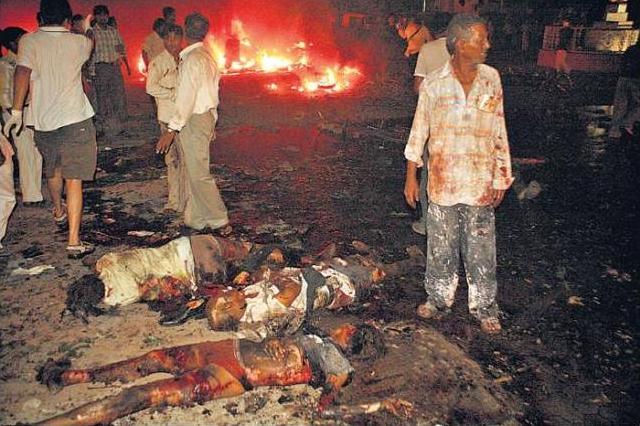
[Visual shows mayhem caused by serial bombings of July 26, 2008 serial bombings in Ahmedabad]

Duplicity and distrust have become the twin hallmarks of the UPA Government, more precisely the Congress which manages key Ministries and takes decisions without consulting either its allies or stake-holders, namely the States, who are directly impacted by firmans issued from New Delhi. Hence, it does not come as a surprise that Union Minister for Home Affairs P Chidambaram, whose boundless arrogance is matched by his limitless capacity for intrigue, should want the State Governments to meekly accept the sweeping powers of the yet-to-be-launched National Counter-Terrorism Centre while refusing to concede their right to strengthen the law and order machinery at their disposal as per the division of powers envisaged in the Constitution.

Mr Chidambaram wants the State Governments, especially those controlled by parties other than the Congress and its allies, to trust the NCTC which has been vested with the extraordinary power to search premises, arrest individuals and prosecute suspects, without taking the local police or law-enforcing agencies, or the State Government concerned for that matter, into confidence. Apart from the fact that it’s a bit thick for him to expect non-Congress Chief Ministers to trust the Congress (nothing good ever came of that), it’s downright disingenuous of him to slyly introduce a new investigative system to tackle ‘federal crimes’, or organised crimes as are committed by foreign and home-grown terrorist organisations and assorted crime syndicates, while disallowing State Governments to put in place laws that will enable them to achieve the same goal without their rights being trampled upon.

A case in point is Mr Chidambaram’s stubborn refusal to allow Gujarat, where the BJP is in power, to have its own anti-organised crime law similar to that which prevails in Maharashtra, where the Congress-NCP alliance is in power. The denial is in sharp contrast to the willingness with which the NDA Government accepted Maharashtra’s demand for what has come to be known by the law’s acronym, MCOCA, or the Maharashtra Control of Organised Crime Act. Chief Minister Narendra Modi wants a similar law, and for good reasons too, but despite all efforts, he has failed to secure the UPA Government’s approval. For the second time, the proposed law, really a Bill passed by the State Assembly, has been spiked by the President on the advice of the Ministry of Home Affairs. Ms Pratibha Patil’s refusal to accord her assent to the Gujarat Control of Organised Crime Bill comes two years after it was sent to her for the necessary ‘mandatory approval’ by the Governor.

The reason why Ms Patil, who is not known to be averse to the bending of rules and violation of conventions when her own interests are involved, has refused to append her signature to the Bill, is because the State Government has not amended key clauses of the proposed law as demanded by the Ministry of Home Affairs through a Cabinet decision in 2009. Amending the relevant clauses, crucial to make the law a powerful weapon against organised crime and no different from what MCOCA provides for, would have defeated the very purpose for which it is meant. That logic is lost on the UPA Government. It insists that Mr Modi must remove Clause 16, which allows the admissibility of confessional statements of the accused made before a police officer, and Clause 20, which provides that those accused of committing an offence punishable under the proposed law will not be released on bail if the prosecutor opposes it. And since Mr Modi has justifiably refused to ensure compliance with this absurd demand, the Bill has been ‘returned’ once again.

The Bill had met a similar fate in 2009. The Gujarat State Assembly had debated and passed the Bill in 2004 and it was subsequently forwarded to the Union Government for the President’s assent. Although law and order is a State subject on which State Governments are competent to enact laws, in this case since the proposed law overrides certain provisions of the Evidence Act, IPC, CrPC and the provision relating to the jurisdiction of various courts, the President’s approval (which in effect is the Union Government’s sanction) is necessary. But the Ministry of Home Affairs sat on the Bill; on repeated prodding by Mr Modi, it was returned in June 2009 with the President’s message that the Assembly should reconsider Clauses 16 and 20. The Bill was cleared once again without any amendments and resubmitted for the President’s assent in November 2009.

Two-and-a-half years later, it has been returned unsigned.

The trickery resorted to with the explicit purpose of refusing to allow Gujarat to have its way is as amazing as the astounding demands made of the State Government by way of amendments. In the first instance, the Government of Gujarat was told it can’t have a MCOCA like law because its clauses were similar to those of the Prevention of Terrorism Act. Since POTA had been repealed by the Congress soon after assuming power in the summer of 2004 in a stunning show of solidarity with those who are appalled by a legal deterrence to terrorism and believe terrorists should have unfettered rights, Gujarat could not have GUJCOCA. The second time round, Gujarat’s Bill has been found to be in conflict with the amended Unlawful Activities Prevention Act of 1967 which is now touted by the Union Government as an ‘anti-terrorist law’.

If we were to accept the argument that UAPA offers the perfect legal deterrence to terrorism and other organised crime, then logically the Government of Maharashtra should be instructed to repeal MCOCA.
That has not been done so far, nor is there any intention to do so. Which, then, raises the question: Why is a law that is good enough for a Congress-ruled State not good enough for a BJP-ruled State? The law in Maharashtra allows for harsh penalties, including death sentence, for committing acts of terror, so does the proposed law for Gujarat. The Gujarat Bill allows the setting up of special courts to deal with cases in a time-bound manner, so does the law in Maharashtra. The Gujarat Bill empowers the State Police to intercept, record and produce as evidence any electronic or verbal communication, as does MCOCA. Interestingly, the provisions of MCOCA are also applicable in Delhi.

The Congress’s assault on federalism, essentially the rights of the States, in the guise of promoting national interest, must be thwarted before serious damage is caused. In every sphere of decision-making by the incumbent regime headed by Prime Minister Manmohan Singh, the emphasis is on how to put down the States, how to impose upon them that which they do not want, how to enforce ridiculous firmans that glorify the Congress’s first family, how to belittle the Chief Ministers and diminish their authority. That’s at once invidious and insidious. Mr Modi and his Government have been successful in keeping terrorists and organised crime syndicates at bay with the outdated tools at their disposal. But that’s more a tribute to the Chief Minister’s administrative acumen than to the Prime Minister’s wisdom. It’s a shame and a pity that Mr Singh has so utterly failed to rise above the petty politics of his party and the low intrigue of his colleagues.

Saturday, March 31, 2012

Armed Forces Modernisation, etc


According to Press Information Bureau, the following information was given March 19, 2012, by Minister for Defence AK Antony and Minister of State for Defence MM Pallam Raju in written replies to Parliament:

MODERNISATION OF ARMED FORCES

Modernization of the Armed Forces including the Coast Guard is a continuous process based on threat perception, operational challenges, technological changes and available resources. The process is based on a 15 year Long Term Integrated Perspective Plan (LTIPP), five year Services Capital Acquisition Plan (SCAP) and Annual Acquisition Plan (AAP). Procurement of equipment and weapon systems is carried out as per the AAP in accordance with the Defence Procurement Procedure.

The budgetary allocations on capital acquisition for modernization of Armed Forces including Army, Navy, Air Force, Joint Staff and Coast Guard during the years 2008-09 to 2011-12 are as under:

Budget Allocations (Rs. in Crore)
• 2008-09: 38,515.24
• 2009-10: 41,671.59
• 2010-11: 44,899.25
• 2011-12: 54,598.02

The budget estimates and revised estimates for modernization of Armed Forces during the year 2011-12 under various heads are as under:

Army:
• 10,740.02
• 4,950.02
• 5,790.00(-)

Navy:
• 13,149.02
• 16,040.27
• 2,891.25(+)

Air Force:
• 28,412.74
• 26,033.92
• 2,378.82(-)

Joint Staff:
• 696.24
• 385.24
• 311.00(-)

Coast Guard:
• 1,600.00
• 1,600.00
• 0.00

Total:
• 54,598.02
• 49,009.45
• 5,588.57(-)

The allocation of funds for modernization has been revised based on funds provided by Ministry of Finance in RE in 2011-12 in the Capital segment of Defence Services estimates. However, additional allocation of Rs.2585 crore has been made for other capital requirements of Army including supply of capital equipment from ordnance factories.

CRASHES OF AIRCRAFT AND HELICOPTERS


During the last three years (2008-09 to 2010-11) and current year 2011-12 (upto 13.3.2012) 33 fighter aircrafts which includes 01 Jaguar, 02 Mirage-2000, 03 Sukhoi-30 and 27 MIG series aircraft (including 16 MIG-21 series) and 10 helicopters of Indian Air Force (IAF) have crashed.

In the above accidents 26 defence personnel including 13 pilots have lost their lives. In addition 06 civilians have also lost their lives.

Majority of the above accidents were on account of Human Error (HE) and Technical Defect (TD). Every IAF aircraft accident is thoroughly investigated by a Court of Inquiry (Col) to ascertain the cause of accident. Remedial measures are taken accordingly to check their recurrence in future.

However, improvement of skills of pilots is a continuous process. Several steps have been taken by the Government in this regard. These include increased use of simulators to practice procedures and emergency actions, focused and realistic training with additional emphasis on the critical aspects of mission, introduction of Crew Resource Management and Operational Risk Management to enable safe mission launches, Aviation Psychology courses and introduction of Aerospace Safety capsules in the ab-initio training of aircrew.

Decision to phase out aircrafts are taken based on various factors including residual life of the aircraft and operational considerations and is reviewed by the Government from time to time. This is a continuous process.

DEFENCE PRODUCTION POLICY


The government has formulated a new Defence Production Policy in order to reduce dependence on the import of defence equipments from other countries. The Defence Production Policy came into effect from 1st January 2011. The policy endeavours to build up a robust indigenous defence industrial base by proactively encouraging larger involvement of the Indian private sector in design, development and manufacture of defence equipment.

The modernization programmes are under implementation in DPSUs&OFB.

In regard to restructuring of DRDO, the two review committees headed by Prof. P. Rama Rao and Defence Secretary respectively had submitted their recommendations. The following recommendations have been accepted by Government:

(i) Formation of Defence Technology Commission (DTC).
(ii) Restructuring of DRDO Management/Re-shaping of R&D Headquarters.
(iii) Administrative decentralization of DRDO.
(iv) Financial decentralisation.
(v) Revamping of HR structure.
(vi) Creation of a Commercial Arm of DRDO.
(vii) Continuation of major ongoing programmes.
(viii) Selection of Industry Partner.

DRDO has initiated the process of implementation of the above recommendations.

While DPP-2011 aims to achieve greater self-reliance in comingyears in continuous manner, no target can be fixed in this regard.

IRREGULARITIES IN PURCHASE OF TATRA TRUCKS

No irregularities in purchase of components of the Tatra Trucks for army have been reported.

LEAKAGE OF CONFIDENTIAL INFORMATION


No Army and defence personnel has been reported to have leaked confidential information on social networking sites such a Facebook. Cyber Security Policy which, inter-alia, includes the policy regarding network connected to internet, as circulated by Ministry of Communications & Information Technology, Department of Information Technology is being enforced in this Ministry and the three Services.

ACQUISITION OF FLEET TANKER

Indian Navy awarded a contract for acquisition of a fleet tanker to foreign shipyard.Steel offered by the shipyard, M/s Fincantieri, in response to Request for Proposal (RFP) for construction of Fleet Tanker, was technically evaluated by a Technical Evaluation Committee (TEC). Based on technical clarifications offered by the shipyard, which were ratified by two classification societies, the steel offered by the shipyard was accepted by the TEC for the stated purpose.

In order to ascertain reasonability of cost, the Contract Negotiation Committee (CNC) undertook costing for the tanker based on two separate costing models. Taking into account both the costing models, the CNC considered the cost quoted by M/s. Fincantieri of Euro 127.26 Million (Rs.747.65 crore) as the basic cost of the ship to be reasonable.

TECHNICAL PROBLEMS IN GUN SYSTEMS

There are no technical problems reported in existing gun system of the Army. However, due to vintage and exploitation of the guns, mechanical problems of routine nature do come up from time to time. These are rectified by the repair/maintenance agencies either in situ or at the workshops established for this purpose.

The government had secured the right of transfer of technology during the purchase of Bofors guns. Though all the technological documents as per the ToT contract were received by OFB from M/s AB Bofors, the Transfer of Technology was not carried forward as the dealings with the technology provider, (M/s AB Bofors) were suspended. Further, no indent was placed by Army on OFB for manufacture and supply of complete gun system.

Capital expenditure of Rs.376.55 crore has been sanctioned by the Government in March, 2012 for creation/augmentation of Large Calibre Weapon manufacturing capacity in Ordnance Factories.

SUBMARINE FLEET OF NAVY


The existing submarine fleet is being constantly upgraded with modern weapons and sensors which has ensured that the underwater combat capacity of the country remains at the desired levels.

Six Scorpene submarines are being constructed under Project-75 at M/s Mazagon Dock Limited (MDL), Mumbai under Transfer of Technology (ToT) from M/s DCNS, France.

Government approval for construction of the six submarines at M/s MDL under Project-75 was accorded in September, 2005 at a total cost of Rs.18,798crore. The contract was signed in October, 2005. The Government approval for revision in cost of the project to Rs.23,562crore was accorded in February, 2010, along with revision in delivery schedule.

The original delivery schedule of the first submarine was December, 2012 and remaining submarines were to be delivered with a gap of one year each. Consequent to the approval of Government for revision is cost and delivery schedule, the delivery schedule of the first submarine has been revised to June, 2015 and that of the last (6th) submarine to September, 2018. The delay in construction of Scorpene submarines is attributable to initial teething problems in absorption of new technology, delay in augmentation of Industrial Infrastructure at MDL and delay in procurement of MPM items by MDL due to their high cost as compared to the earlier indicated cost. Most of the teething problems have been resolved and various plans have been put in place to minimize delays.

As part of the TOT for the six submarines under construction at MDL, Mumbai, a Technical Data Package has been provided by the Collaborator. This will enable attainment of significant indigenous competence in submarine construction, especially in the field of hull fabrication, outfitting, system integration etc. by the end of the programme.

PURCHASE OF TRAINER AIRCRAFT

Consequent upon the grounding of HPT-32 aircraft due to flight safety concerns and shifting of basic flying training to Kiran Mk-I/IA aircraft, the syllabus for basic flying training has been reduced, keeping the available resources in mind. However, flying hours have been increased in other stages of flying to ensure wholesome training.

A proposal is being progressed for the procurement of 75 Basic Trainer Aircraft from M/s Pilatus Aircraft Limited, Switzerland.

There has been no delay in acquiring Advanced Jet Trainers (AJTs).

The Hawk-132 Advanced Jet Trainer has been selected for the Indian Air Force. A total of 106 Advanced Jet Trainer aircraft are being inducted into the Indian Air Force.

The delivery of the basic trainer aircraft from M/s Pilatus Aircraft Limited, Switzerland is scheduled to commence 15 months from signing of the contract.

ORDERS FOR LCA TEJAS

IAF has placed orders for 40 aircraft for LCA Tejas on HAL. The deliveries of aircraft are scheduled in the 12th plan period. Necessary funds for investment have been provided by the Government of India.

MILITARY ASSISTANCE TO VIETNAM

Government is pursuing defence cooperation activities with a number of foreign countries, including Vietnam, based on mutual interests of both sides and keeping in view all relevant aspects.

Defence cooperation activities with foreign countries include high level visits, training exchanges and other interactions between the armed forces of both sides.

PIRACY IN INTERNATIONAL WATERS

No pact has been signed between India and China to tackle piracy. However, India, China and Japan have recently agreed for better coordination amongst their Naval ships deployed for escort of Merchant ships in the Gulf of Aden.

There are no plans to sign such pacts. Nevertheless, the security and surveillance apparatus for coastal defence has been enhanced over the years. Further, strengthening of the coastal security apparatus is an ongoing process considering the needs and changing security scenario as well as the threat perception.

* * *

According to Press Information Bureau, the following information was given March 14, 2012 by Minister for Defence AK Antony and Minister of State for Defence MM Pallam Raju in written replies to Parliament:

INDO-CHINA MARITIME COOPERATION

India, China & Japan have recently agreed for better coordination amongst their Naval ships deployed for anti-piracy operations in the Gulf of Aden. As per the convoy coordination plan implemented with effect from 1st January, 2012, one of the Navies is designated as a "Reference Navy" for a period of three months, which first proposes its escort schedule for a three months period. The other Navies then de-conflict their escorts schedules with the dates of Reference Navy. The Reference Navy is rotated every three months in alphabetical orders.

INDUCTION OF DRONES IN IAF


In order to meet its operational requirements the Indian Air Force (IAF) plans to increase the strength of Remotely Piloted Aircraft (RPA) in a phased manner. These include Micro and Medium Altitude Long Endurance Remotely Piloted Aircraft.

The Remotely Piloted Aircraft are employed for surveillance, reconnaissance and intelligence gathering tasks and not for filling gaps in our Air Defence capability.

PROBE IN PROCUREMENT OF 12 VVIP HELICOPTERS


There was a media report stating that the scope of a probe by Italian prosecutors into allegations against unethical dealings by M/s Finmeccanica, Italy has widened to include the Indian contract signed with M/s Agusta Westland for purchase of 12 helicopters. Ministry of Defence asked for a report in the matter from the Indian Embassy in Rome. The report received indicates that Italian magistrate/prosecutors are conducting preliminary investigation about allegations of financial mal-practices occurring within M/s Finmeccanica, Italy and its subsidiaries in general and there is no specific probe being conducted about India related transactions.

CAG REPORT ON ACQUISITION OF ARTILLERY GUNS

The CAG report for the year 2011-12 (Defence Services) has made certain observations that modern technology Artillery Guns could not be made available to Artillery troops for certain reasons as explained in its Report.

As part of modernization, the Regiment of Artillery has been equipped with PINAKA Rocket Systems, Smerch Rocket Systems and BrahMos Missile Systems in the past 7-8 years. Nine Regiments of 130mm guns have already been upgraded in keeping with Artillery profile 2027. Various other gun systems are also at different stages of procurement. The modernization of Artillery is a continuous process and is being given priority to ensure that Artillery remains equipped with modern weapon systems.

DELAY IN DEFENCE PURCHASES


Acquisition of weapons and equipment for defence forces is a complex activity and is carried out in accordance with the provisions of Defence Procurement Procedure (DPP). As per broad timeframe given in DPP, it takes about 80-137 weeks to complete the various stages of procurement and conclude the contract. However, delays sometimes occur in procurement cases due to several reasons, such as insufficient and limited vendor base, non¬conformity of the offers to the Request of Proposal (RFP) conditions, field trials, complexities in contract negotiations and long lead time for indigenization etc. Defence acquisitions are normally based on fixed price contracts. There are contractual provisions for penalties including imposition of liquidated damages for delay in execution of contracts.

To counter systemic and institutional delays, procedures are continuously reviewed and refined on the basis of experience gained during the procurement process.

AVAILABILITY OF HELICOPTERS FOR HIGH ALTITUDE AREAS


The air logistics including casualty evacuation in emergent situations of Indian Army is being met by Indian Air Force (IAF) helicopters. The Army's rotary wing assets also assist the IAF.

A Request for Proposal (RFP) / for hiring of civil helicopters for movement of maintenance supplies in high altitude areas was issued in October 2011, which included details of dispatch and receiving helipads.

The security situation is reviewed by the Government from time to time, keeping in view the threat perception. This is a continuous process.

DEVELOPMENT OF TEJAS LCA

The Initial Operational Clearance-1 (IOC-1) for the Tejas Light Combat Aircraft has been achieve on 10th January, 2011. Presently, LCA development activities leading to final operational clearance are in progress. Action for induction of Tejas into IAF has been initiated. IAF has placed orders for 40 aircraft with HAL.

Tejas Mark-I is planned at present for 40 aircraft only. Tejas Mark-II aircraft is under development with an alternate higher powered engine with considerable improvements. Final cost assessment will be available only after the development phase of Mark II is completed. Scope for cost reduction of Tejas Mk-I has been examined and the same is assessed as not feasible in view of limited quantities.

Aeronautical Development Agency (ADA) is the nodal organization for the development of Tejas.

Rs.11845.20 Crores have been sanctioned by the government of India to ADA for the development of Tejas till date and the total expenditure incurred so far is Rs.5051.46 Crores.

IAF plans to induct six LCA squadrons by the end of the 13th Plan.

HELICOPTERS EMPLOYED IN FOREIGN COUNTRIES

The Indian Air Force helicopters are assisting in providing logistics support in aid of Ministry of Home Affairs anti-naxal operations.

Details of helicopters pressed in service in the foreign countries cannot be divulged in the interest of friendly relations with foreign countries and strategic concerns.

PURCHASE OF LUHS


There is a proposal of procurement of 187 Light Utility Helicopters (LUHs) under design and development project undertaken by Hindustan Aeronautics Limited (HAL). The project was sanctioned by Government of India in February 2009. The project is proceeding as per approved time lines.

The procurement of quantity 145 Ultra Light Field Guns (Ultra Light Howitzers) was initially progressed concurrently as a Single Vendor Case from M/s ST Kinetics and through Foreign Military Sales (FMS) route with Government of United States of America. However, the permission for trials was not granted to M/s ST Kinetics as the Firm is named in an FIR filed by CBI. The matter is presently sub-judice.

The field evaluation of Ultra Light Howitzer comprises three parts, viz. user trials, DGQA trials and Maintainability trials. Out of these, user trials of the gun proposed to be procured through US Government have been completed. The performance of the gun can be ascertained only after evaluation of all three trial reports.

INCREASE IN CONSTRUCTION ACTIVITIES IN THE BORDER REGION BY PAKISTAN


The Government is aware through intelligence inputs that Pakistan has constructed and carried our repairs of bunkers, morchas and towers as per the following details (Period:2004 to 2011):

• Bunkers: 886
• Morcha: 261
• Towers: 398
• Post/Border Out Posts (BOPs): 143

Protests have been lodged with Pakistan Rangers and Flag Meetings of Field Commanders are held in all cases. The matter is also taken up by BSF with Pakistan Rangers during scheduled meetings at various levels.

Adequate troops are suitably supplemented by appropriate surveillance and technical intelligence resources to ensure the sanctity of the border.

Friday, March 02, 2012

Incredible ignorance


A response to Salil Tripathi - II

Facts are sacred; comment is free.


In his column ‘Here, There, Everywhere’, published in Mint under the headline “Incredible impunity” on February 29, 2012, Mr Salil Tripathi displays incredible ignorance (I sincerely mean no offence for he is a writer gifted with incredible intelligence) of Gujarat’s incredible economic growth and incredible prosperity, both of which are the envy of every State in the country.

The economic development and growth, and the consequent prosperity, witnessed in Gujarat have whetted the aspirations of Indians from Kashmir to Kanyakumari. They have brought about a paradigm shift in the people’s expectations from their Government – in their respective States; at the Centre. All this, of course, is inconsequential to Mr Tripathi who is neither impressed nor moved by Gujarat’s giant strides!

Reluctant to use the term ‘Modi Model’ for reasons that do not merit elaboration, a senior CPI(M) leader of West Bengal, reflecting on what went wrong with the Left Front that led to its decimation in the 2011 Assembly election, ruefully told me: “If only we had worked towards adopting the Gujarat Model…”

Those who are determined to demonise Mr Narendra Modi and deny him any credit for the ‘Gujarat Model’ of remarkable growth and prosperity are welcome to live in cussed denial, but that won’t change the ground reality – Gujarat’s economy has grown; Gujaratis (both Hindus and Muslims) have prospered. Nor will it influence the manner in which investors at home and abroad view the State.

Vibrant Gujarat has set new standards for other States to emulate. That entrepreneurs from other States, including Jammu & Kashmir, want to set up their businesses in Gujarat explains what sets this State apart from others. That difference is on account of the political leadership of the day.

Comparisons, as the adage goes, can be odious. Hence they are best avoided. But since Mr Tripathi has compared Gujarat to Maharashtra in a strenuous effort to belittle the former’s achievements, it would be in order to not only suggest that he and other critics of Mr Narendra Modi should revisit the socio-economic profiles of the two States for a closer scrutiny of details, but to also point out that a vast gulf separates these two States.

That gulf is about probity in public life; it’s about the integrity of those who are in charge of the Government; it’s about, to put it in two words, good governance.

Mr Tripathi is right when he says Gujaratis are an enterprising lot and that they have always done better than other Indians, even in trying circumstances – for instance, when Chimanbhai was Chief Minister of the State, the man who was known as “Chiman Chor”. Gujarat’s economic growth and prosperity over the past decade has been accompanied by a thorough cleansing of the system. Mr Narendra Modi can justly claim: “Na khata hoon na khilata hoon.”

That, understandably, leaves many disconsolate.

Stray statistics, confusing and plucked at random, find mention in Mr Tripathi’s column: They have been quoted to put down Gujarat. I can only cite from official documents a set of statistics that I have cross-checked with friends in the Planning Commission:

Gross Domestic Product: At current prices, Gujarat’s share at Rs 5,13,173 crore is 7.17 per cent of India’s GDP. At constant prices (2004-05), it’s Rs 3,65,295 crore, or 7.48 per cent of India’s GDP.

Net Domestic Product: At current prices, Gujarat’s share at Rs 4,40,942 crore is 6.89 per cent of India’s NDP. At constant prices (2004-05), it’s Rs 3,09,409 crore, or 7.16 per cent of India’s NDP.

Per Capita Income: At current prices, it is Rs 75,115 compared to the national average of Rs 53,331. At constant prices (2004-05), it’s Rs 52,708 compared to the national average of Rs 35,993.

Monthly Per Capita Consumer Expenditure (NSS 2009-10): In rural areas of Gujarat it is Rs 1,065 compared to the national average of Rs 953. In urban areas it is Rs 1,914 compared to the national average of Rs 1,856.

While the manufacturing sector and agriculture have suffered huge reversals across the country in the recent years under the UPA’s tutelage, Gujarat has bucked the trend. Manufacturing and agriculture continue to register impressive growth in the State. In 2002-03, ports in Gujarat were handling 841 lakh tonnes of goods; in 2010-11, that figure had grown to 2,309 lakh tonnes.

Mr Tripathi mocks at Mr Narendra Modi’s claim that Gujarat will soon be in a position to provide power to power-starved States. He overlooks the fact that Gujarat is the only State which can today boast of 24x7 power supply to industry, farms and homes. It’s absurd to compare Gujarat’s power generation capacity (GSEB alone produces 4,996 MW) to that of north-eastern States. The former has heavy industrial and agricultural demand for power; the latter has virtually none.

I wish Mr Tripathi had compared the power situation in Gujarat with that which prevails in Maharashtra or Uttar Pradesh (where I live and hence am acquainted with the reality) or India's capital city, Delhi (where I work and hence am also acquainted with the reality).

The comparison reminds me of how Jyoti Basu had once proudly proclaimed that Calcutta, as Kolkata was then known, had left behind its terrible days and nights of relentless ‘load-shedding’. What he forgot to mention is that West Bengal had left behind its glory days as the industrial hub of the eastern hinterland.

I could go on citing statistical details, but the list is far too long. Those who are interested in the specifics will find them in the latest Socio-Economic Review of Gujarat. A patient reading will tell you why it’s incorrect (and grossly unfair) to try and diminish Gujarat’s spectacular social and economic achievements.

“So many things work properly in Gujarat that it hardly feels like India,” the Economist said in a review of Gujarat’s economy. The report was telling published under the headline, “India's Guangdong: A north-western State offers a glimpse of a possible industrial future for India.” The report can be read here.

Mr Tripathi has chosen to play fast and loose while discussing Gujarat’s commitment to fiscal responsibility. It’s possible he is not aware of the minutiae of the FRBM Act and the fact that the 13th Finance Commission has set targets for each State Government and every State has to periodically report progress which is documented. Compared to other States, Gujarat has been well ahead of meeting the targets that were set for its compliance to fiscal responsibility. The details are available over here for those who are interested in the specifics.

Admittedly, nobody is perfect. If Mr Narendra Modi is guilty of anything, it is of pursuing purposeful policies of enablement and empowerment of all, irrespective of gender, caste and faith, while eschewing wasteful policies of entitlement. That’s where the 'Modi Model', or call it the 'Gujarat Model' if you wish, stands out in stark contrast to the 'NAC Model'.

That, understandably, leaves many incandescent with rage.

(To be continued.)

Wednesday, February 29, 2012

Here, There, Nowhere...


A response to Salil Tripathi - I

1984 and 2002 are not comparable.


Rarely, if ever, have I commented on an article penned by a fellow writer. That’s not because I do not react to what they have to say or I hold views with which I disagree as not worthy of comment. It’s largely because writers must be allowed to have their say (and space) and partly on account of the fact that I try not to bruise feelings. I am known for not bothering with vacuous niceties; it makes sense not to compound that shortcoming by penning my opinion on the views of other writers.

Yet, I feel compelled to react, in writing, to Mr Salil Tripathi’s column, ‘Here, There, Everywhere’, which appears in Mint, a Delhi-based newspaper, that has been published under the headline “Incredible impunity” on February 29, 2012. The strap line reads: “Of all the potential and credible contenders to be the next Prime Minister, the one least deserving is Narendra Modi.” It’s a free world and this country is still a democracy where freedom of thought, expression and speech, though circumscribed by restrictive laws, is not entirely absent from the public domain.

Hence, Mr Tripathi has the right to not only believe that it is his burden to decide for more than a billion resident Indians who is the most and least deserving contender to be the next Prime Minister but also express that belief in suitable words, which he has done in his column. My response to his views is not an attempt to shout him down or point out why he is wrong in saying what he says, but to posit a set of counter-views. I have no intention to play evangelist to a heathen or convert a non-believer; such lofty tasks are best left to those who mistake their writing desk for a pulpit and their chair as a pedestal.

Mr Tripathi is outraged that those who cannot stop raging over the retaliatory violence which followed the arson attack on coach S-6 of Sabarmati Express on February 27, 2002, at Godhra, in which 58 Hindu men, women and children were killed, should be reminded of the anti-Sikh pogrom (it was definitely not a ‘riot’) of 1984 by those who are not impressed by the ceaseless cant of the self-righteous and sanctimonious army of the good and the virtuous. He sees this as a “despicable” attempt to equate the two unfortunate events (my words, not his) of our recent history. I would agree with him.

The hideous blood-letting by Congress goons that we witnessed in Delhi and several cities even before Mrs Indira Gandhi’s mortal remains were consigned to the flames cannot, by any stretch of the imagination, be equated with the ghastly violence that gripped parts of Gujarat after the torching of coach S-6 of Sabarmati Express by a Muslim mob. There are three reasons why any attempt at comparing the two tragic events would be immoral and wrong.

First, the scale of violence is incomparable, as is the loss of lives and property. With the help of documentary evidence and those who fought (and are still fighting, although with receding hope) for justice for the victims of the anti-Sikh pogrom, I had computed the death toll to be not less than 4,733. Most of the deaths occurred in Delhi. In the post-Godhra riots, 1,044 people (not “thousands” as Mr Tripathi says) were killed: 790 Muslims and 254 Hindus. Lest I be accused of being callous, let me hasten to add that I believe every life matters and even one death is one too many.

Second, the Government of India, which was then (and still remains) responsible for maintaining law and order in Delhi, refused to lift a finger in admonition, leave alone crack down on mobs of Congress hoodlums led by Congress cronies of the party’s first family, for 72 hours. The Congress, and the Government which was then headed by Rajiv Gandhi (whom Mr Tripathi is keen to exonerate) wanted to “teach the Sikhs a lesson” -- the crime of a few individuals was converted into a collective crime deserving of collective retribution. As Rajiv Gandhi was to later declare, without the slightest trace of contrition or remorse, “When a giant tree falls, the earth below shakes.”

In contrast, Mr Narendra Modi decided to call in the Army when it became clear that the State police were incapable of controlling the rioting mobs. Nearly all the 254 Hindus who died in the violence were killed in police or Army firing. Not a single tormentor of Sikhs suffered so much as a lathi-blow in 1984. But let that pass. Could Mr Narendra Modi have done better? Could he have stamped out the riots before they exacted a terrible toll? Could he have ensured absolute peace and calm despite the provocation of the arson attack at Godhra?

These are questions that can be debated till the cows come home (the reference to cows, Mr Tripathi, is idiomatic and not an attempt to push what you would derisively call the ‘Hindutva agenda’) without reaching a conclusion that is acceptable to all. I’d say he tried his best; others like Mr Tripathi would say he didn’t. I would stand by my truth just as others would stand by their perceived truth. A cock fight of truths does not excite me.

We could, however, look at how ‘successful’ other Chief Ministers have been in controlling riots. For instance, we could look at riots in Uttar Pradesh, in Bihar, in Andhra Pradesh, in Maharashtra, in West Bengal, in Assam, in Tamil Nadu, in Kerala, in Karnataka, in Rajasthan, in Madhya Pradesh, in Odisha -- virtually every State of the Union. Each one of these riots is well documented. Each one of them resulted in a terrible loss of lives and property -- well, not really because often the victims were too poor to own any property.

I don’t know if Mr Tripathi has ever found himself trapped in a riot; I have seen the Jamshedpur riot of 1979 from close quarters. When blood-lust grips people, when insanity takes over, even shoot-at-sight orders don’t have the desired result. In Jamshedpur I saw tribal Christians looting the homes of Hindus and Muslims while they battled in the streets: What does that tell us of a riot?

In Maliana, the PAC was accused of playing a partisan role. Shall we then hold Vir Bahadur Singh, the then Congress Chief Minister of Uttar Pradesh, personally responsible for that massacre? Nellie wouldn’t have happened had Mrs Indira Gandhi not insisted on holding a disputed election in Assam. Should we then blame her for the massacre of 2,191 people, a vast number of them suckling infants? We could go further back in history and blame Jawaharlal Nehru for the Great Calcutta Killing of August 1946, for it could be argued, and convincingly so, that had it not been for his cussedness Mohammed Ali Jinnah wouldn't have called for Direct Action.

Third, no two incidents of communal violence are comparable. The causative factors differ as do local political, social and cultural dynamics. How can we then compare 1984 to 2002? More so when 1984 was a state-sponsored pogrom endorsed by the then Prime Minister of India, an endorsement that reverberated in his infamous declaration that the earth is bound to shake when a giant tree falls?

It would, then, be asked, why is 1984 mentioned at all in the context of 2002? Here’s the reason why: Intolerant ‘secularists’, sanctimonious leftists and self-righteous liberals who are unsparing in their criticism of Mr Narendra Modi take extraordinary care in steering clear of even remotely accusing the Congress, let alone Rajiv Gandhi, of complicity in the mind-numbing brutalities of 1984.

I hold Mr Tripathi in high esteem. Had I not done so I’d have been appalled by his exertions to exonerate Rajiv Gandhi who knew what was happening in Delhi and made it a point to turn a deaf ear to pitiful cries for help and groveling appeals by noted Sikh personalities.

Did he do so because he was in mourning?

Rajiv Gandhi’s grief and anguish did not quite stand in the way of his decision to take oath as Prime Minister the same day his mother was assassinated. That swearing in ceremony could have waited till the last rites were performed. But he chose not to wait lest the crown be snatched from him. Mr Pranab Mukherjee still pays the price for an indiscrete comment made earlier that day. So let’s not say with disarming certitude that “presumably Rajiv Gandhi had other things on his mind (like grief) than planning a pogrom”.

(To be continued.)

Monday, January 23, 2012

The tragedy of exile


It can be a punishment worse than death

The ancient Greeks, who were otherwise sensibly cynical about suffering and pain in love and war, would become insufferably maudlin when it came to the plight of someone forced into exile. To be banished from your land and not be able to live among your people was considered a fate worse than death.

Euripedes crafted his tales around the theme of exile, each utterance of his exiled men and women drafted to tug at the strings of the reader's heart. Death was melancholic; exile was tragic. There must have been something universal about that perception.

For kings and emperors, dictators and tyrants, usurpers and pretenders who followed the demise of ancient Greece are known to have turned a deaf ear to pitiful cries of mercy while punishing those guilty of real and imaginary crimes by sending them into exile. Being fed to the lions, it would seem, was preferable to living in a foreign land among alien people.

But exile wasn't always a punishment that fetched individual sighs of horror. It was also the only option for those persecuted for their faith and belief. The Jews went into exile after the destruction of their Second Temple and till the birth of Israel wandered the world, waiting for the day they could return to Jerusalem and claim it as their own. The Zoroastrians fled Persia and sought shelter in India to keep the fire of their faith burning. In more recent times, the Dalai Lama led his people into exile after China grabbed Tibet through force.

The Parsis, having lost their home and hearth in the land of Zarathustra forever, became an integral part of Indian society. The Tibetans, on the other hand, believe Tibet shall be free once again. They live as exiles in India and around the world in anticipation of the day when they can claim Tibet as their land and drive the Han Chinese out. That may never happen, just as Napolean died dreaming of his country.

It's not that everybody who leaves his or her homeland to set up home somewhere else grieves for that which has been left behind. Southall may remind visitors of Punjab but Punjabis who live there don't see it as a reminder of their past. Those who weep into their whiskey and beer at Glassy Junction are not necessarily haunted by memories. Nor do those who have changed their names to Andy and Wendy after swapping their Indian passports with American citizenship feel either remorse or guilt for disowning their motherland.

Yet there are millions who feel an umbilical attachment to India, though they have never visited the land their forefathers left, or were forced to leave. These are the descendants of east Indians who, having offered to become indentured labourers for a pittance, crossed the kala pani, never to return again. Chutney music will no doubt be sneered at here in India, but for most east Indians in the Caribbean, it keeps them rooted to their culture and identity.

In Mauritius and Trinidad and Tobago, separated by sea and continents, indentured immigrant Indians clung on to ideas of caste and community, notions of kith and kin; if those were eroded with time, they re-invented them, but never abandoned what they thought was, and still think is, unique to their identity in the land of their exile. Like the wandering Jews they wove facts into faith so that new generations would remember and not forget.

Yet, for many exiles forgetting and not remembering makes it easier to cope with the reality. This is especially true for those who can't return home even if they wish to. Bangladeshi poet Daud Haider had to leave his country after being accused of blasphemy in 1974. He sought shelter in Kolkata, a city that adopted him as one of its own. In 1986 he was asked to leave India as his presence was deemed to be detrimental to relations with Bangladesh. Celebrated German writer Gunter Grass brought him to Berlin where he has lived ever since.

Till recently Daud would petition anybody and everybody in Bangladesh to let him visit the land of his birth just once so that he could meet his family, see the house he grew up in, talk to his childhood friends, smell the soil and taste the water that were once so familiar. Promises were made and broken. Hope that once burned bright is now a dying, flickering flame.

It's only when your country disowns you that you realise what exile means. Euripedes was right. Nothing can be more tragic than that. Ask the Kashmiri Pandits, they will tell you what it means to be exiled from the land of your ancestors.

[My weekly column in MidDay published on January 21, 2012.]

Friday, January 20, 2012

Pity the nation that can't defend liberty


Congress's no-limit, interest-free, Minority Card

(It's the world's best credit card, issued by Vote Bank of India!)

Nothing could be more telling about the tarnished and tattered state of our secular republic than the Darul Uloom Deoband vice-chancellor, Maulana Abul Qasim, describing Rajasthan Chief Minister Ashok Gehlot petitioning the Union government to stop Salman Rushdie from visiting India as "a victory for democracy".

According to Maulana Qasim, "democracy is alive in India" because Gehlot has painted a grim picture of how mobs will run riot and law and order shall collapse if Rushdie were to attend the Jaipur Literary Festival; hence, he should be barred from entering the country of his origin.

Deoband’s chief maulana wants Rushdie’s entry ‘prohibited forever’ as demanded ‘by so many people.’ That’s balderdash. The ‘so many people’ he refers to are mullahs and those who are prone to running riot over bogus grievances and spurious issues. The vast majority of Indians, irrespective of faith, is not in the least bothered and would, if asked, wholeheartedly support the idea of Rushdie visiting this country whenever he wishes.

Not so the Congress. It can’t resist the temptation of seizing an opportunity to indulge in crass Muslim vote-bank politics when it senses one. In fact, there’s reason to believe that the Congress has a hand in manufacturing this mullah-led demand and the threat of violence to keep Rushdie away from India. It’s of a piece with the party’s electoral strategy in Uttar Pradesh premised on the cynical belief that pandering to the belligerence of mullahs and their ilk will fetch the party a rich harvest of Muslim votes.

First we had senior Congress leader and law minister Salman Khurshid brazenly promising that his party will increase the minority quota, which is euphemism for Muslim reservation, from 4.5% to 9%. That pledge fetched the Election Commission’s ire but the message has not been lost. Then we had Congress general secretary Digvijay Singh seeking to reopen the bogus debate over the Batla House encounter of 2008, blaming the prime minister and the home minister for not ordering a judicial inquiry as demanded by the malcontent of Azamgarh who are either SIMI or IM supporters if not closet activists.

Simultaneously, the mullahs of Deoband suddenly remembered Salman Rushdie — all these years they were not offended by his many visits to India, including his attending the Jaipur Literary Festival in 2007, but have discovered merit in blocking it now as Uttar Pradesh prepares to go to polls. Not surprisingly, the refrain was taken up by fanatics in Rajasthan where the Congress is in power. We haven’t heard a whimper from anywhere else in the country.

For the Congress, the minority card is the most powerful credit card in the world. It has no upper limit; it does not bounce; and it comes interest-free. Little wonder that the party has been using this card for the past six decades, encashing votes by pretending to be the sole protector of Muslim sentiments and sensitivities.

Sadly, there’s little realisation that, in the process, India’s Muslims have been further ghettoised, left to wallow in imagined slight and all-consuming denial. It should be of no comfort to the community that threats of violence generate fear, not respect; nor should it mistake the Congress’s cynical politics of appeasement as the route to social development and economic progress of Muslims.

The reality, tragically, is to the contrary. And so we have mullahs threatening violence and the Congress capitulating to their demands in pursuit of its policy of limitless appeasement. Rajiv Gandhi’s government banned The Satanic Verses even before Ayatollah Khomeini issued his infamous fatwa. The Shah Bano judgment was subverted by abusing the Congress’s parliamentary majority. In more recent times, Denmark’s prime minister was asked to call off his scheduled visit to India lest it upset Muslim sensitivities allegedly inflamed over cartoons nobody had seen in this country. And Shimon Peres was ‘discouraged’ from attending the annual HT Summit lest the presence of Israel’s President on India’s soil upset Muslims.

Salman Rushdie may yet visit India and make an appearance at the Jaipur Literary Festival. But that’s really inconsequential. What is of consequence is the amazing audacity of mullahs who now want to have a say on who gets to visit India and who doesn’t, who should live here and who shouldn’t, and the astounding willingness of the Congress to comply to their outrageously vile demands. That way lies the path to disaster.

This is no longer about Salman Rushdie or his Satanic Verses. It’s about what remains of our secular republic.

[Column in DNA, January 20, 2012.]

Wednesday, January 18, 2012

19/01/90: When Kashmiri Pandits fled Islamic terror


First they came for the Communists, and I didn't speak out because I wasn't a Communist.
Then they came for the trade unionists, and I didn't speak out because I wasn't a trade unionist.
Then they came for the Jews, and I didn't speak out because I wasn't a Jew.
Then they came for me, and there was no one left to speak out for me.

-- Martin Niemöller on German intellectuals who failed to stand up to Nazi terror. Applies to our intellectuals too who have spectacularly failed to raise their voice against Islamic terror.


'Be One With Us, Run, or Die...'

Srinagar, January 4, 1990. Aftab, a local Urdu newspaper, publishes a press release issued by Hizb-ul Mujahideen, set up by the Jamaat-e-Islami in 1989 to wage jihad for Jammu & Kashmir's secession from India and accession to Pakistan, asking all Hindus to pack up and leave. Another local paper, Al Safa, repeats this expulsion order.

In the following days, there is near chaos in the Kashmir Valley with Chief Minister Farooq Abdullah and his National Conference Government abdicating all responsibilities of the state. Masked men run amok, waving Kalashnikovs, shooting to kill and shouting anti-India slogans.

Reports of killing of Hindus, invariably Kashmiri Pandits, begin to trickle in; there are explosions; inflammatory speeches are made from the pulpits of mosques, using public address systems meant for calling the faithful to prayers. A terrifying fear psychosis begins to take grip of Kashmiri Pandits.

Walls are plastered with posters and handbills, summarily ordering all Kashmiris to strictly follow the Islamic dress code, prohibiting the sale and consumption of alcoholic drinks and imposing a ban on video parlours and cinemas. The masked men with Kalashnikovs force people to re-set their watches and clocks to Pakistan Standard Time.

Shops, business establishments and homes of Kashmiri Pandits, the original inhabitants of the Kashmir Valley with a recorded cultural and civilisational history dating back 5,000 years, are marked out. Notices are pasted on doors of Pandit houses, peremptorily asking the occupants to leave Kashmir within 24 hours or face death and worse. Some are more lucid: "Be one with us, run, or die!"

'Asi Gachchi Pakistan, Batao Roas te Batanev San...'

Srinagar, January 19, 1990. Jagmohan arrives to take charge as Governor of Jammu & Kashmir. Farooq Abdullah, whose pathetic, whimpering, snivelling Government has all but ceased to exist and has gone into hiding, resigns and goes into a sulk. Curfew is imposed as a first measure to restore some semblance of law and order. But it fails to have a deterrent effect.

Throughout the day, Jammu & Kashmir Liberation Front and Hizbul Mujahideen terrorists use public address systems at mosques to exhort people to defy curfew and take to the streets. Masked men, firing from their Kalashnikovs, march up and down, terrorising cowering Pandits who, by then, have locked themselves in their homes.

As evening falls, the exhortations become louder and shriller. Three taped slogans are repeatedly played the whole night from mosques: "Kashmir mei agar rehna hai, Allah-O-Akbar kehna hai" (If you want to stay in Kashmir, you have to say Allah-O-Akbar); "Yahan kya chalega, Nizam-e-Mustafa" (What do we want here? Rule of Islam); "Asi gachchi Pakistan, Batao roas te Batanev san" (We want Pakistan along with Hindu women but without their men).

In the preceding months, 300 Hindu men and women, nearly all of them Kashmiri Pandits, had been slaughtered ever since the brutal murder of Pandit Tika Lal Taploo, noted lawyer and BJP national executive member, by the JKLF in Srinagar on September 14, 1989. Soon after that, Justice N K Ganju of the Srinagar High Court was shot dead. Pandit Sarwanand Premi, 80-year-old poet, and his son were kidnapped, tortured, their eyes gouged out, and hanged to death. A Kashmiri Pandit nurse working at the Soura Medical College Hospital in Srinagar was gang-raped and then beaten to death. Another woman was abducted, raped and sliced into bits and pieces at a sawmill.

In villages and towns across Kashmir Valley, terrorist hit lists have been floating about. All the names are of Kashmiri Pandits. With no Government worth its name, the administration having collapsed and disappeared, the police nowhere to be seen, despondency sets in. As the night of January 19, 1990, wears itself out, despondency gives way to desperation.

And tens of thousands of Kashmiri Pandits across the Valley take a painful decision: To flee their homeland to save their lives from rabid jihadis. Thus takes place a 20th century Exodus.

Pandits don't live here anymore, the Valley has been cleansed of Hindus...


Srinagar, January 19, 2012. There are no Kashmiri Pandits in Srinagar, or, for that matter, anywhere else in Kashmir Valley; they don't live here anymore. You can find them in squalid refugee camps in Jammu and Delhi. At least 300,000 Kashmiri Pandits who fled their home and hearth in 1990 have been reduced to living the lives of refugees in their own country; many have since migrated to foreign shores.

Of those who remain in India, two-thirds are camping in Jammu. The rest are in Delhi and in other cities. Many of them, once prosperous and proud of their rich heritage, now live in grovelling poverty, dependent on Government dole and charity. In these 22 years, an entire generation of exiled Kashmiri Pandits has grown up, without seeing the land from where their parents fled to escape the brutalities of Islamic terrorism, a land they dare not return to, although that land still remains a part of their country.

A large number of them are suffering from a variety of stress and depression related diseases. A group of doctors who surveyed the mental and physical health of the Kashmiri Pandits living in refugee camps, found high incidence of 'economic distress, stress induced diabetes, partial lunacy, hypertension and mental retardation.' Statistics reflect high death rate and low birth rate among the Kashmiri Pandit refugees.

And thereby hangs a tragic tale that has been all but wiped out from public memory.
An entire people have been uprooted from the land of their ancestors and left to fend for themselves as a weak-kneed Indian state shamelessly panders to Islamic terrorists and separatists who claim they are the final arbiters of Jammu & Kashmir's destiny. A part of India's cultural heritage has been destroyed; a chapter of India's civilisational history has been erased.

Had this tragedy occurred elsewhere in Hindu majority India, and had the victims been Muslims, we would have described it as 'ethnic cleansing' and 'genocide.' We would have made films with horror-inducing titles. We would have filed cases in the Supreme Court of India. Our media would have marshalled remarkable rage in reporting the smallest detail.

But, this tragedy has occurred in Muslim majority Kashmir valley, and the victims are all Hindus, that too Pandits. What has been lost is part of India's Hindu culture, what has been erased is integral to India's Hindu civilisation.

Therefore, the Government makes bold to record that the Kashmiri Pandits have "migrated on their own" and their "displacement (is) self-imposed"; the National Human Rights Commission, after a perfunctory inquiry, refuses to concede that what has happened is 'genocide' or 'ethnic cleansing,' though facts add up to no less than that, never mind that at least 300,000 lives have been destroyed.

And, our jholawallah brigade of secular activists rudely turn up their noses to the plight of Kashmiri Pandits: Hindu sorrow, inflicted by Islamic terror, stinks.

Today, on January 19, the 22nd anniversary of the forced flight of Kashmiri Pandits, look back at India's wretched history of secular politics and consider the terrible price the nation has paid at the altar of appeasement because the Indian state has, and continues to, toe the line of least resistance.

(This is a slightly modified/updated version of the first of a two-part essay that appeared on Rediff.com on January 19, 2005.)