Saturday, March 19, 2011

Singh is King! Really?


Cash helped him win trust vote!
(A spoof poster that did the rounds after Congress won July 22, 2008 vote.)
The standard operating procedure which Indian politicians follow is tailored for our polity with its ugly underbelly. For instance, a politician’s ‘aide’ could be anyone who facilitates his or her activities in public view or behind the shuttered doors of the bungalows in Lutyens’ Delhi. Pimping for politicians is one of the most lucrative jobs in the nation’s capital and comes without an appointment letter or a paper trail: If things ever go wrong for our cynical politicians, there’s always plausible deniability. That option has been exercised by Captain Satish Sharma who has stoutly denied that he ever had an ‘aide’ called Nachiketa Kapur, leave alone using his services to bribe MPs in the last Lok Sabha to enable the UPA to win the crucial trust vote on July 22, 2008 after the Left withdrew its support over the India-US civil nuclear deal.

But neither Capt Sharma nor his party can deny that there was a person called Nachiketa Kapur or that he had access to the inner courtyard of the PWD-built haveli that has come to substitute Bahadur Shah Zafar’s court in amoral, if not grossly immoral, Delhi where issues of ethics are of least concern for those who claim to rule India. That Mr Kapur, whoever he may be, wielded considerable power (without accountability) and was politically well-connected is borne out by the fact that the American Embassy in New Delhi was sufficiently impressed to send him on a junket under the State Department’s ‘I-Vote 2008’ programme as an observer for the US presidential election.

It, therefore, stands to reason that the contents of the ‘Secret’ US Embassy cable of July 17, 2008, filed by its then Charge d’Affaires Steven White, are not without substance. The cable mentions, among other things, how the Congress mobilised funds to buy votes to win the confidence motion and the manner in which the funds were distributed and to whom. The ‘price’ for a ‘Yes’ vote was Rs 10 crore; the political counsellor of the Embassy was shown chests containing between Rs 50 crore and Rs 60 crore to be used for purchasing votes. The cable also mentions Capt Sharma providing details of how he was trying to target MPs within the BJP and its allies, for instance, the Akali Dal. He owed this much to the party which had bailed him out in 15 cases of corruption filed by the CBI.

Senior leaders of the BJP will confirm that during the week before the vote they were desperately scrambling to keep their flock together. The lure of lucre is not easy to overcome. In any event, few MPs wanted an early election -- if that could be avoided and easy money pocketed, where was the harm? Some back-benchers in the BJP had begun to question the wisdom of opposing the nuclear deal as a cover for their imminent act of disloyalty. The Akali Dal, not too sure of preventing its MPs from straying, wondered whether opposing the deal was the right move as there was a large Sikh community in the US and they wouldn’t take kindly to America-bashing. It may sound laughable in retrospect, but that’s exactly what was conveyed to the BJP. The BJP’s apprehensions came true when cash was actually handed over to some of its MPs by an ‘aide’ of Mr Amar Singh, who had also offered his services and resources to prop up the UPA regime.

Political parties are known to try till the last minute to avoid a mid-term exit from power. The NDA Government would not have fallen by a single vote in 1999 if its political managers had been alert to the Congress’s strategy of getting Mr Giridhar Gomango to participate in the voting despite his having taken charge as Chief Minister of Odisha. He still remained a member of the Lok Sabha and exercised his privilege, although it was both immoral and unethical to do so. Nor should we forget that JMM MPs were bribed to ensure the survival of the Government headed by PV Narasimha Rao. Such subversion of the ethical foundations of democracy comes naturally to the Congress.

That said, two points should bother us more than anything else. First, the Americans had a remarkably accurate sense of the voting pattern five days before the vote. According to their estimate, there would be 273 votes in favour and 251 ahttp://www.blogger.com/img/blank.gifgainst the trust motion, with 19 abstentions. After the vote, the tally stood at 275 votes in favour and 256 against the motion, with 10 abstentions. Who briefed the US Embassy? Second, Prime Minister Manmohan Singh was all smiles when he was greeted with cheers of “Singh is King” after he won the vote. The king today looks no different from the emperor without clothes.

(This appeared as my column in DNA.)

Thursday, March 17, 2011

Dirty tricks by Congress


Spiteful act, deplorable deed
The Congress is just not reconciled to the idea of Gujarat, more specifically Narendra Modi, showing the way to rapid development and inclusive growth through good governance. Hence, every effort is made by the Congress, through the UPA Government, to harass Modi and stall Gujarat's progress. Having failed to deliver anything that even remotely resembles the Gujarat model in the States where the Congress is in power, the party leadership has responded with limitless hate and spite. The CBI has played hand maiden to the Congress in its deplorable endeavour.

The latest object of Congress envy is Vibrant Gujarat, the hugely successful investors conference hosted by the Gujarat Government and a brainchild of Narendra http://www.blogger.com/img/blank.gifModi, which has played a significant role in fuelling Gujarat's success story. At this year's Vibrant Gujarat, MoUs for projects worth Rs 1237570.48 crore were signed. This despite the Congress instructing the Union Ministry of Finance to warn public sector banks against participating in the investor summit in any manner. Complaisant babus in the Ministry eagerly conveyed the message to bank chairmen; that didn't quite do the trick. Nor did the campaign by 'friendly' media to run down the initiative help the Congress.

So now the Congress, once again through the Union Ministry of Finance, has instructed the Income Tax Department to make life difficult for the Modi Government by scaring away investors who signed MoUs. The Income Tax Department hahttp://www.blogger.com/img/blank.gifs http://www.blogger.com/img/blank.gifdhttp://www.blogger.com/img/blank.gifutifully
obliged its political masters of the day by issuing a notice on February 17 to Gujarat’s Industries Commissioner, demanding details of Memoranda of Understanding signed during Vibrant Gujarat earlier this year. Never before has something so extraordinary happened.

As I have said in the editorial I wrote for The Pioneer, a State Government is at liberty to raise funds and invite investments to further development and propel growth. That the Government of Gujarat has raced past others is a tribute to the quality of governance under Narendra Modi’s tutelage which no Congress leader can ever achieve — either in New Delhi or in State capitals. To try and scuttle the efforts of the Government of Gujarat and arm-twist potential investors into staying away from the State is tantamount to disallowing States to function freely.It's a crudehttp://www.blogger.com/img/blank.gif assault on federalism.http://www.blogger.com/img/blank.gif

As my friend and commentator on the INI blog,Nitin Pai, tweeted on Thursday: "So now the UPA govt is using the Income Tax department to bully/threaten investors in Gujarat. Anti-national fascism on display."

If the intention behind the notice had not been mala fide, the Income Tax Department, or for that matter the Union Finance Ministry, need not have served a notice. All that they needed to do was get the details from the Vibrant Gujarat website. For all those who are interested, you can access full details of the MoUs here.

Wednesday, March 02, 2011

Shahbaz Bhatti, RIP


Another voice is silenced with jihadi guns
Pakistan’s Minister for Religious Minorities Shahbaz Bhatti was assassinated on Wednesday, March 2, a short distance from his home in Islamabad. His killers, three men armed with Kalashnikovs, riddled his body with bullets. One report said the autopsy showed he had been shot 35 times, another put the figure at 25.

That number is really irrelevant. What is relevant is that his assassins are members of the Tehrik-e-Taliban Pakistan. Pakistan’s largest daily, Dawn, in a report attributed to ‘Agencies’ and not a staff writer or reporter, says:
The Pakistani Taliban claimed responsibility for the killing, saying the minister had been “punished” for being a blasphemer.
Witnesses said the attackers scattered leaflets signed by “The Qaeda and the Taliban of Punjab” at the attack scene, which read: “This is the punishment of this cursed man.”
Taliban militants had called for Bhatti’s death because of his attempts to amend the blasphemy law.
“He was a blasphemer like Salman Taseer,” spokesman Sajjad Mohmand said by telephone from an undisclosed location.
Prime Minister Yousuf Raza Gilani (said) “Such acts will not deter the government’s resolve to fight terrorism and extremism,” adding that the killers would not go unpunished.
Salman Taseer, Governor of Punjab, was assassinated by his bodyguard, an elite force personnel, Malik Mumtaz Hussain. The killer was showered with rose petals by lawyers when he was produced in court.

The attacks on those seeking amendments to Pakistan’s inhuman and harsh anti-blasphemy law began ever since voices of protest were raised against a poor and illiterate Christian woman, Aasia Bibi, being sentenced to death for blasphemy.
As after Taseer’s assassination, the Left-liberal commentariat in India has been vociferous in denouncing the murder of Bhatti and shedding copious crocodile tears.

The libbers’ grief would have been touching but for the fact it is so much bunk.
Here’s why. The Left-liberal commentariat remained stunningly silent when Bangladeshi dissident writer Taslima Nasreen was being hounded by mullahs and their storm-troopers. There were no voices of protest when Majlis-e-Ittehadul Muslimeen goons assaulted her in Hyderabad. There was undisguised glee when the CPI(M) used manufactured mullah rage against Taslima Nasreen to chase her out of Kolkata.

I know it for a fact that many of those who are waxing eloquent on the “assault on freedom of expression and liberalism” in Pakistan had ‘advised’ the Government of India not to extend Taslima Nasreen’s residence permit.

The Left-lib commentariat has been vicious while lashing out at those who have dared criticise the abuse of sharia’h and Muslim Personal Law in India, or sought a uniform civil code to protect the rights of Muslim women. They pitilessly mock at those who denounce the burqa, insisting it’s a matter of “individual choice” which is of course not true. They gloss over the most regressive actions and utterances of the mullahs and accuse their critics of indulging in Islamophobia.

Their hearts bleed for Pakistan’s assassinated Minister for Religious Minorities yet they cold-heartedly denounce those who seek the protection of rights of religious minorities in Muslim-majority Kashmir Valley. They are frauds and charlatans.
To see them ‘mourning’ over the killing of Taseer and Bhatti is laughable.

The point is simple. Left-liberal intellectuals who preach tolerance are the most intolerant lot when confronted with contrarian views. For them tolerance means to meekly accept their bunkum.

As for Pakistan, it’s a state that continues to crumble, bit by bit. Jinnah’s dream has turned into a frightening nightmare. But, and tragically so, Pakistanis refuse to acknowledge this simple fact.

Blinded by their hate-India agenda, Pakistan and its citizenry can’t see the terrible reality. The monster they have lovingly nurtured and nourished has turned on them. This is the 21st century version of Frankenstein’s Monster. As in the story, both monster and its master shall die in the end.

Not all the nuclear bombs in Pakistan’s arsenal can save it from its fate. If at all anything can yet rescue the country, it’s the people if they take a stand. But that seems unlikely. Why else would Jamaat-e-Islami blame the CIA for Bhatti’s murder and mainstream newspapers offer space for this amazing allegation? (This question has been dealt with in a post Pak Journalists: Conspiracy Theories and Willful Ignorance on Pakistan Media Watch, to which my attention was drawn by Raza Rumi.)

Pakistan’s enemy is within. Not without.

Friday, February 25, 2011

Odisha capitulates before Maoists


Surrendering before terror

Events of a quarter century ago are rarely remembered, especially in a country like India where the masses have a poor sense of history and the classes have a loathing for the past. Yet, at times it is necessary to recall events, if only to highlight how our national resolve has weakened in direct proportion to the strengthening of our economy. It would be facetious to suggest an inevitable correlation between the two, but it could be argued that while the rise of our self-seeking middle classes may have led to the creation of a bazaar which is the world’s envy, they have also sapped the nation of its national spirit to a great extent. A pusillanimous Government, whether in New Delhi or in State capitals, is a natural corollary of this phenomenon. Politically convenient and socially fashionable bunkum about India as a soft power has left the Indian state looking vulnerable as never before.

This is most evident from the response of both society and authority to terrorism, irrespective of the colour of the terrorists’ ideology. Instead of standing up and daring those who use guns and bombs to terrorise people, we meekly surrender, thus exposing ourselves to further violence. But it wasn’t always like this. In February 1984, an Indian diplomat, Ravindra Mhatre, posted at our mission in Birmingham, was kidnapped while returning home by members of the then UK-based Jammu & Kashmir Liberation Front. The Government of India had till then faced other hostage situations -- Indian Airlines flights had been hijacked to Pakistan -- but nothing quite similar. The British authorities were nonplussed; officials in New Delhi were stunned.

Within hours of the kidnapping, the abductors issued their list of demands, which included one million pounds in cash and the release of Maqbool Butt, co-founder of the JKLF, who was lodged in Delhi’s Tihar Jail after being sentenced to death for killing personnel of Indian security forces. For two days there were hectic attempts to goad Mrs Indira Gandhi, then Prime Minister, into agreeing to negotiate a deal with Mhatre’s abductors. But Mrs Gandhi remained unmoved and her message was unambiguous: No talks, no deal. On February 6, Mhatre’s body was found in a lane. He had been shot dead after the JKLF realised it was futile to expect Mrs Gandhi to agree to a swap. There were no 24x7 television news channels those days but newspaper reports were sufficient to generate national outrage. A grim-faced Mrs Gandhi struck back. Maqbool Butt was executed five days later on February 11 after President Zail Singh was told to spurn his mercy petition. The JKLF leaders in Birmingham panicked and fled Britain; it’s another matter that British courts failed to fetch justice to Mhatre.

Cynics would suggest that Mrs Gandhi’s audacious tit-for-tat policy did not yield long-term results. That, however, is a fallacious argument, not the least because it overlooks certain crucial facts. Between 1984 and the winter of 1989, the cadre of the JKLF, which was then the sole terrorist organisation demanding azadi, were on the run and their top leaders were in jail. Mrs Gandhi had based her decision on the simple principle that a country as large as India could absorb the loss of one official but it couldn’t countenance the threat posed by terrorists. It worked -- till VP Singh came to power and appointed Mufti Mohammed Sayeed as his Home Minister.

On December 8, 1989, Rubaiya Sayeed, the Mufti’s daughter, was kidnapped in Kashmir by JKLF gunmen who demanded the release of five senior ‘commanders’ of the organisation from prison. VP Singh capitulated and Jammu & Kashmir has never been the same again; nor has the Government been able to stand firm before terrorist demands after that spectacular submission of the authority of the state to fear induced by terrorism. It irreparably broke the national spirit and the will of the Government, as was demonstrated during the week-long saga of shame that followed the hijacking of IC-814 to Kandahar which ended with our setting free three Pakistani terrorists who have since acquired greater infamy through their murderous jihad.

The reason why these events from the past are important to recall and remember is to contextualise the astonishingly timid surrender by the Government of Orissa before the Maoists who abducted the Collector of Malkangiri district R Vineel Krishna and a junior engineer, Pabitra Majhi, 26 years to the month after Mhatre’s kidnapping by terrorists of another ideological persuasion. The Maoists initially made 14 demands, including the immediate halt to counter-insurgency operations, withdrawal of all Central paramilitary forces from areas infested by Red terrorists, release of five of their senior comrades wanted for scores of crimes and cancellation of agreements with multinational corporations.

The Maoists also named their own choice of negotiators to strike a deal with the Government, which meekly complied without even bothering to look into the strategic implications of grovelling before Maoists whose depredations the Prime Minister has repeatedly described as the “biggest threat to India’s national security”. On Wednesday Majhi was set free by the Maoists after one of their most wanted comrades, Ganti Prasadam, accused of more than 100 crimes, was “granted bail”; they next upped the ante and asked for the release of four other jailed comrades, taking the total to nine.

It is immaterial how the Malkangiri story ends. It is equally irrelevant whether the Government later claims that it had to act in a pragmatic, responsible manner. Any justification of the shameful and shaming surrender by the state is so much poppycock and nothing more than that. Chief Minister Naveen Patnaik need not have hastened to appease those waging war on the state. He could have taken a cue from the Governments of Bihar and Chhattisgarh which dared the Maoists to kill abducted policemen rather than give in; used negotiations as tactics to locate the abductors and threaten them with an overwhelming response; and, secured the freedom of the hostages without surrendering. Even if that tactical ploy had failed in Orissa, surely India could have absorbed the loss of two men to secure the safety of more than a billion people?

Sadly, the message from Bihar and Chhattisgarh, as also from West Bengal where the Left Front is waging a determined war against Maoists in Lalgarh, admittedly using means that may not be entirely fair or legal, will now be overtaken by the pathetic whimper from Orissa. The memory of 277 men in uniform killed by Maoists in 2010 stands pitilessly ridiculed. Strangely the Union Government refused to step in and prevent the Orissa Government from causing lasting damage to India’s war on terror. Are we then preparing for a grand surrender? Is this 1989 all over again?

[The abducted Collector was freed on Thursday, February 25, 2011 evening.]

[An abridged version of this appeared as my fortnightly column in DNA.]

Thursday, February 17, 2011

Arab world won't be the same again!


The Arab palace has begun to fear the Arab street. And the Arab street has begun to sense that fear.

The Arab palace will never be the same ever again. Events over the past month, first in the Tunisian Republic and then in the Arab Republic of Egypt, have radically altered the power equation across Arabia from the North Atlantic coast to the Persian Gulf. It may not be immediately, palpably evident in most of the 22 Arab states in the Maghreb and the Mashreq, but the pulse of Arabia now beats in the Arab street. Tunisia’s ‘Jasmine Revolution’ and Egypt’s ‘Lotus Revolution’, both triggered by hectic campaigning by tech-savvy young men and women on Facebook and Twitter, often armed with nothing more than a smart phone, have sent out shockwaves that have rattled the palaces of Kings, Presidents and Emirs and show no signs of abating even as the uprising by Misris reached its denouement on Friday with President Hosni Mubarak resigning from the office he held for 30 years and handing over power to the Supreme Council of the Egyptian military headed by General Mohamed Hussein Tantawi.

Take a look at the map of Arabia. At the far end, west of Suez, is the Islamic Republic of Mauritania. It had a civilian Government of sorts, hugely corrupt, till August 2008 when it was felled by a military coup led by General Mohamed Ould Abdel Aziz. A year later, Gen Aziz stepped down as the chief of Army and called presidential elections in April 2009. Predictably, he swept the polls and has since transmogrified into a dictator. Beneath the deceptive calm festers poverty amid illiteracy; together, coupled with the absence of space for political dissent, they make the ground fertile for radical Islamism to strike roots and flourish.

The Kingdom of Morocco has been fortunate enough to have an enlightened constitutional monarchy with an elected Parliament. But King Mohammed VI, who assumed the throne in 1999, wields enormous executive power and can issue diktats that are treated as law. In brief, real executive authority vests with the King. Morocco’s society is pock-marked by widespread poverty and illiteracy; women have few rights. President Abdelaziz Bouteflika, hand-picked by the Army in 1999, heads a military-backed regime in the Democratic and Popular Republic of Algeria with a one-party system that disallows — and ruthlessly puts down — opposition in any form. Algeria, too, faces widespread poverty though literacy rates are high, which has added to the number of educated unemployed raging against the regime. Young Algerians are seething in anger; the absence of a free Press only serves to fuel it further.

In the Great Socialist People’s Libyan Arab Jamahiriya, Col Muammar Gaddafi remains firmly in power which he seized in 1969. His dictatorship brooks neither dissent nor opposition. Gaddafi’s flamboyant and lavish lifestyle is often in the news abroad; at home, it’s grinding poverty for most Libyans. In the Republic of Sudan, Omar Al Bashir presides over a single-party regime notorious for committing gross violations of human rights and a country torn apart by civil war. After a recent referendum, Sudan is likely to split into two countries. This, in turn, has led to street protests in Khartoum, with most of the protesters owing allegiance to radical Islamist groups.

In the Syrian Arab Republic, President Bashar al-Assad rules with a mailed fist. Its one-party system automatically rules out the presence of other contenders for power. The ‘presidential democracy’ in the Republic of Yemen is a sham that has kept Ali Abdullah Saleh in power since 1978 and pushed the country deeper into poverty, social unrest and radical Islamism-inspired terrorism.

The House of Saud has ruled the Kingdom of Saudi Arabia since 1931. It has neither the inclination nor the time for parliamentary democracy or individual rights and freedom. Leave alone political parties, there are no organisations or unions in this country which lies at the heart of Arabia. And then there are the smaller kingdoms and emirates, ranging from Qatar to the UAE. One country that stands out is the Sultanate of Oman, ruled by Sultan Qaboos al Said who has been on the throne since 1970. He is enlightened, looks after his people, is well-loved and has built an economy that is strong and resilient although rising inflation is beginning to cause resentment among the less privileged.

Now let us look at what is common between these countries, apart from entrenched ageing rulers, who variously describe themselves as Presidents, Kings and Emirs, and the elite who live in opulent luxury while the masses wallow in appalling poverty. From the Arab palace, the world beyond perfumed gardens looks like a glittering fairytale land. From the Arab street, the world looks shabby and grey: Deprivation and denial are the twin leitmotifs. Each of the Arab states has a sizeable population aged below 30; many of them are unemployed; and, most were born after their rulers came to power. They are impatient for change, they want to participate in free and fair elections and access to the World Wide Web has helped them transcend the limits on information imposed by state-controlled media. The young are from the Arab street and hate the Arab palace, identified with limitless corruption and criminal suppression of the masses, with a passion never seen before. The socio-economic pyramid is being sought to be toppled. The base refuses to bear the burden of the tip any longer.

Another common feature shared by these sham republics and bogus kingdoms is the sudden, rapid collapse of a welfare system that was devised and patronised by the Arab palace to keep the masses on the Arab street satisfied, if not happy. Heavily subsidised food, inexpensive services, easy access to public sector jobs that paid subsistence wages and old age pensions were meant to generate a sense of gratitude towards the rais. It was a strategy that worked so long as there was money in the coffers. With Arab regimes, like Governments elsewhere in the world, running out of money, subsidies, jobs and pensions are fast disappearing or are being severely pruned. The clumsy attempt by these regimes to graft economic liberalisation on a system that till recently abhorred anything but the public sector which was either owned by the palace or the state has recoiled horribly. Job cuts and freeze on employment by Governments, such as they are, have added to the plight of the masses, especially the young, and food inflation has added to their woes. For instance, in Egypt, where defiant young men and women have forced the collapse of the Mubarak regime, unemployment is as high as 25 per cent; food inflation is running at 19 per cent; and, rising income disparity has made poverty even starker.

It is against this background that we should view the uprisings in Tunisia and Egypt. President Zine El Abidine Ben Ali of Tunisia chose not to put up a fight: He fled his country (in an aircraft laden with accumulated gold) and an interim Government has taken charge. President Hosni Mubarak, on the other hand, dug in his heels and refused to budge from either his post or his palace till Friday. Before the day was over, his tottering regime collapsed. And that could trigger a domino effect whose consequences would be deeply unsettling for the region and the world, not least because the status quo would no longer obtain.

Already we are witnessing street protests in Jordan and Yemen where thousands have been turning out to demand political reforms. In Jordan, King Abdullah has been spared popular anger till now but in Yemen the masses want Ali Abdullah Saleh out. Abdelaziz Bouteflika is gearing up to face massive rallies: 25,000 policemen were deployed to restrain protesters in Algiers on Saturday. There are reports that Bahrain is in ferment and protests there could take a nasty turn with Shias, who constitute the majority, demanding the ouster of a Sunni minority regime. A massive protest march is planned for Monday. Iraq, yet to attain any degree of political, economic and social stability, could erupt in street protests too with opponents of the incumbent Government seizing upon this opportunity to try and dislodge it, possibly through violent means, and usher a radical Islamist, pro-Iran regime.

It’s not for nothing that the Arab rulers are alarmed by the developments in Tunisia and more so in Egypt. The ‘Jasmine Revolution’ in Tunisia, with an eighth of Egypt’s population, could have been waved away as an aberration, but the roar from Tahrir Square is too deafening to be ignored. The response has been at three levels.

Alert and intelligent rulers have responded with promises of political reforms: Jordan’s King Abdullah has sacked his Prime Minister and appointed a new team to address popular grievances; Kuwait’s Al Sabbah family has let it be known it is not averse to more freedom and democracy but, as a precautionary measure, has banned all gatherings, rallies and marches after Friday prayers. Bashar al-Assad, who instructed his security forces to crush an incipient copy-cat protest in Damascus earlier this month, has now ordered the ban on Facebook and YouTube to be lifted, making what would be considered in Syria a significant concession. Ali Abdullah Saleh has promised protesters in Yemen that he will neither contest the 2013 elections, nor field his son as a candidate.

Second, the rulers seem to have suddenly realised that perhaps turning the welfare tap off and cutting down on entitlements were not such good ideas; liberalisation and market economy may attract investors but a slothful system ensures that benefits don’t immediately follow. Arab socialism was about patronage; Arab capitalism is about cronyism — the first at least helped silence critics; the latter has made critics shriller. So, as if on cue, the regimes have promptly decided to enhance social welfare spending, regardless of the long-term impact on their near-empty treasuries. For instance, Jordan’s Budget could end up funding higher salaries and pensions, leaving little for anything else. On Friday, hours before Cairo fell to protesters, the ruler of Bahrain, King Hamad bin Isa Al Khalifa announced a $2,700 dole for each family, hoping to placate his subjects. Saudi Arabia, where a group of reformists has written to King Abdullah bin Abdul Aziz seeking his permission to set up a political party, is no doubt flush with oil money, but it also has more people clamouring for dole than it did a decade ago: Two-thirds of its population is aged 30 and below; unemployment is at an alarming 10 per cent in a country with nine million expatriate workers; shooting inflation and falling incomes have shrunk its middle class base. Jordan, Bahrain, Kuwait and others could see their money running out fast if the enhanced payouts continue for too long.

Third, the Arab rulers are making efforts, no matter how feeble and ineffective they may be, to reach out to the Twitter and Facebook generation of bloggers. Prince Khalid al Faisal, the Governor of Mecca Province, did something extraordinary recently after heavy rains flooded Jeddah, leaving many dead and eliciting accusations of inefficiency on part of the city administration which was openly accused of being corrupt. He invited a group of five young men, including a blogger who had been sent to jail two years ago for raging against the palace, and briefed them about the ‘sincere measures’ taken by authorities, admitted lapses in tackling the situation and promised action against errant officials. Meeting over, he smiled and told the men: Do send our royal regards to the young people on Twitter.

At the same time, the men who rule Arabia are clever enough to realise that if push comes to shove, their palaces will collapse like castles built of sand. Hence, they want to keep both push and shove at bay, at least till such time they have put in place mechanisms to deal with uprisings similar to the one witnessed in Egypt. The best way to do so, they believed, would be to ensure the Mubarak regime did not fall. This was based on the assumption that if the man who had ruled Egypt for 30 years could somehow hang on to power and ride the storm, the collapse of the old order could be prevented and the domino effect stalled. So the Kings and Presidents, Sultans and Emirs rallied round to Mubarak’s aid. King Abdullah bin Abdul Aziz grandly declared, “In case the US withdraws its financial support to Cairo, my kingdom will prop up Egyptian President Hosni Mubarak’s regime.” That was as much a declaration of support for Mubarak as a taunt to America for abandoning its staunch ally in his moment of crisis. In the end, neither solidarity nor support helped Mubarak retain power. As Egypt burst into celebrations, a bitter realisation began to sink in: If the US could abandon Mubarak, it could also say goodbye to others without allowing friendships of the past to weigh too heavily on its conscience.

Ironically, it is this perceived callous indifference of the US towards a beleaguered Mubarak in his last days in office that has left many flummoxed in Arabia. Egypt under the Mubarak dispensation, backed by the Army, was the best bet for peace in the region, especially in regard to Israel. It was also the best defence against the rise of radical Islamism whose practitioners see themselves as the alternative to incumbent Arab regimes. With Mubarak gone, the Muslim Brotherhood is preparing to make a dramatic appearance either through collaboration or alone in Egyptian politics; through Hamas, an offshoot of the Muslim Brotherhood, Islamists have seized power in Gaza; in Lebanon, the Hizbullah, which has toppled the Hariri Government and put into place a regime controlled by Islamists, increasingly and frighteningly calls the shots; in Tunisia, dormant Islamism has come alive after the long-exiled leader of the till recently outlawed Islamist party Ennahdha, Rachid Ghanouchi, made a triumphant return home; in Jordan, the Friday street protests are being led by Islamists sustained by the Ikhwan’s ideology; in Yemen, Islamists are waiting for the palace to fall under their assault; in Qatar, Bahrain and Kuwait, a deep undercurrent of radical Islamism is waiting to burst forth.

A gleeful Ayatollah Ali Khamenei has described the Egyptian uprising as the unleashing of an “Islamic wave”. His protégé and Iran’s President Mahmoud Ahmadinejad has described the Egyptian uprising and the collapse of the Mubarak regime exactly 32 years to the day of the fall of Shah Mohammed Reza Pahlavi on February 11, 1979, as the “emergence of a new Middle East that will doom Israel and break free of American interference”. The Islamic Republic of Iran has reason to rejoice. Despite it being a Shia country and not an Arab state, Iran sees itself as emerging as the most important player in Arabia by striking alliances with Islamists in the Maghreb and the Mashreq waiting in the wings to seize power: First through the ballot and then by aping the Iranian model of Islamic republicanism which is theocracy by another name and suppresses protest with the help of the notorious Revolutionary Guards and the gallows in state prisons as it did the massive demonstrations, as large, if not larger, than those in Egypt, against Mahmoud Ahmadinejad’s brazen vote fraud in the last election. The Hamas and Hizbullah, the first Sunni and the second Shia, are heavily funded by Iran via Syria and this enables Tehran to wield considerable clout with both organisations. It also fetches Tehran considerable influence in Damascus.

In what the Americans refer to as the ‘Extended Middle East’, Sunni Arab states have long ceased to play a key role. The three countries that have emerged as major players are neither Arab nor Sunni. At one end we have Iran. There is Israel, a Jewish state, in the middle. And there is Turkey at the other end where the Islamist AKP has silently, slyly fashioned Atatürk ’s secular republic to increasingly reflect its faith-driven ideology. If the fall of the last pharaoh is followed by regimes toppling over in other Arab states, then the identity of West Asia will change forever — whether for better or worse is at the moment a matter of guess and conjecture. But Sunni Arabia, loosely tied by Arab nationalism, will virtually cease to exist; what will emerge is a pan-Islamist region with a near common political agenda driven by religious dogma and theocratic fanaticism. That’s a possibility the world must prepare to deal with in whichever way and form. Democracy, in the end, could lead to the legitimisation of cruel theocracy as an alternative to brutal autocracy. That’s an inbuilt risk which is often overlooked, if not ignored.

Ironically, rulers who have ruled in the name of Islam fear Islamism the most. That could be either because radicalism scares those who are wedded to the idea of stability, often enforced ruthlessly, or because it would reverse the long-established order with the ruled dominating the rulers. Till now the Arab palace loathed the Arab street and held it in contempt. Suddenly, the Arab palace has begun to fear the Arab street. And the Arab street has begun to sense that fear.

(The writer spent three years in Cairo and has travelled extensively in the Maghreb and the Mashreq)

Wednesday, February 02, 2011

The Pharaoh sends his horsemen in


Regime mounts counter-assault
Amazing scenes were witnessed on Wednesday at Tehrir Square when hundreds of ‘supporters’ of President Hosni Mubarak streamed in – some on foot, some in cars and others riding horses and camels. They clashed with the anti-Mubarak protesters camping at Midan-e-Tahrir, and what followed were frightening, scary sequence of violence unleashed by Hosni’s men.

The counter-offensive came less than 12 hours after the beleaguered President of Egypt who has been in power for 30 years and whose immediate ouster is being demanded by thousands of protesting Egyptians since January 25, went on state television, declaring he would not contest the September presidential poll but neither would he exit office immediately.

In brief, he let it be known that he was no Ben Ali; he would not leave Egypt; he would oversee political reforms, including amendments to the Constitution limiting the terms of future Presidents. Pro-changers rejected his offer. “He must go now,” they chanted.

On Wednesday late afternoon as bloodied anti-regime protesters were carried off the ‘battlefield’, others ran helter-skelter. Hosni’s ‘supporters’ moved with military precision, in a phalanx. They took over rooftops and rained a variety of missiles including Molotov cocktails on the protesters demanding Hosni Mubarak’s immediate ouster.

Army soldiers stood by, their tanks parked on the periphery of Tehrir Square, and did not intervene – as they haven’t this past week.

By late evening, Tahrir Square looked less crowded than earlier in the day. Obviously, most had fled the violence unleashed by Hosni’s supporters.

Is the protest going to peter out this point onward? Or will the anti-regime protesters regroup and rally afresh again? Friday could see an upsurge. Last Friday their numbers swelled enormously and they ran riot, burning down the ruling NDP’s headquarters in downtown Cairo.

Three points to consider:
. The problems of a mass protest without a clearly defined leadership are now coming to the fore. It is increasingly obvious that Facebook and Twitter – social media tools that were used to mobilize protesters – are no substitute for organized politics and opposition movements.
. The Army remains firmly with Mubarak. But it is playing a clever game. Were the thousands of Hosni supporters who descended on Tahrir Square today soldiers in mufti?
. The regime may have calculated that a counter-push and counter-violence would be effective in containing and rolling back the anti-Hosni protests. But it could backfire horribly.
Where does the Muslim Brotherhood fit into the emerging scenario? Did the Ikhwan plan for a situation where there would be a political vacuum – Hosni Mubarak leaves Egypt like Ben Ali fled Tunisia, there’s no interim arrangement, there’s chaos and anarchy – for it to step in and assume power? And use the appeal of Islam to a) legitimize its rule; b) mute dissent; c) discredit the ‘secular’ opposition? If it did, its game has been, it would appear, checkmated by Hosni Mubarak and the Army.

As for the US, it labours under the delusion that it can still influence events to its advantage. In my opinion, the Obama Administration erred grievously in publicizing, through CNN, that it had persuaded Hosni Mubarak to make his offer of not contesting the September presidential election and not fielding his son Gamal as a candidate either.

By blaring to the world that President Barack Hussein Obama’s special envoy Frank Wisner spoke to Mubarak and brokered the deal robbed it of all credibility: America is no longer viewed favourably in Egypt’s streets.

Nor will America’s veiled threat to cut aid to Egypt -- $1.5 billion a year – work: Not with the Hosni regime nor with the opposition, especially the Ikhwan. Similar threats by the US issued to other countries, asking them to behave or else, have miserably failed. Most notably with Pakistan.

Obama had threatened to cut off aid to Pakistan if it did not put down jihadi terrorism and help exterminate the Taliban and Al Qaeda. In the event, Obama has hugely increased aid to Pakistan and cravenly conceded to its every demand, including Islamabad will not be asked to submit accounts.

Jimmy Carter lost Iran for America; Obama will lose Egypt. America should reconcile itself to the fact that it’s fast getting pushed to the margins in Arabia and has ceased to matter in the Arab street.

Tuesday, February 01, 2011

The Pharaoh speaks to his people


What now?
A week after protesters took to the streets of Cairo, Alexandria and Suez demanding President Hosni Mubarak's ouster, the man who has ruled Egypt with an iron fist for the last 30 years addressed Egyptians over state television late Tuesday / early Wednesday morning (2.45 am India time).
Mubarak, 82, made the following points:
.He does not intend to contest September's presidential election.
.He will ask the new Government appointed by him to take up political reforms and address key 'legitimate' issues agitating the people.
.He will initiate amendments to the Constitution -- including setting a limit to presidential terms.
.He will call on Parliament to hold early elections.
.His Government has begun 'dialogue' with political parties but some have refused to join talks as "they have their agenda".
.He will instruct police to ensure freedom and dignity of people.
.He is a "man of the Army" and will not abdicate his responsibility of ensuring peaceful transition.
.He is proud of the years he has spent in service of Egypt and Egyptian people.
.He is an Egyptian, Egypt is his land and he will die in Egypt.
Mubarak's address follows talks with US President Barack Hussein Obama's special envoy Frank Wisner.

Will Mubarak's 'offer' help put an end to the protests? Will the protesters disperse?
The immediate response of the protesters has not been very positive. Many chanted: We won't go! You must go!" They clearly want Mubarak to step down now.

But it is also true that a vast majority of Egyptians do not want the country to descend into chaos and anarchy and would prefer an orderly transfer of power -- a 'safe transition' -- from the Mubarak regime to an interim arrangement. The looting and arson have heightened fears among common Egyptians.

Interestingly, voices in support of Mubarak or in favour of a smooth, orderly transition are now being heard. Business owners and those dependent on the services sector are beginning to lash out at the protesters.

Change yes, but few Egyptians are in favour of radical change. Let's not forget that the protesters -- the highest turnout was on Tuesday, pegged at a quarter million -- are a fraction of Egypt's 80 million population.

At the same time, many are insisting that they "want the state cleaned" although they don't know what to replace the existing system with.

Imponderables: Where does the Army figure in all of this? Can a loose coalition of protesters mobilised via Facebook and Twitter without a command and control system exercised by an acknowledged leadership maintain the momentum or will it now lose the edge and energy? Will a division emerge between those who are willing to go along with the timeframe proposed by Mubarak to usher orderly transition and those who want change now?

So, is it now a battle of wits? Who blinks first?

Wednesday will provide some indicative answers. Meanwhile, here's my editorial comment in The Pioneer on the larger implications of the Egyptian and Tunisian uprisings for the Arab states.

Saturday, December 18, 2010

Uncle Sam would love this nephew


An elusive contact becomes a key interlocutor for Americans!

Contrary to media reports and popular perception, the ‘secret’ cable despatched from the US Embassy in New Delhi on August 3, 2009 was not only about Mr Rahul Gandhi’s views on Hindu terror. A close reading of the cable, marked for the State Department and signed by US Ambassador to India Timothy J Roemer, would show that it was a report on efforts by the American mission aimed at “reaching out to Rahul Gandhi and other young parliamentarians”. The cable’s summary says: “In a review of the career and potential of Rahul Gandhi, 40-year-old heir apparent to the leadership of India’s ruling Congress party, the US Ambassador reports conversations with the young politician, speaking appreciatively of recent statements and potential for the future.” The key words, lest you miss them, are “reaching out”, “career and potential”, “heir apparent”, “appreciatively” and “future”. The man who represents American interests in India was keen on establishing ‘contact’ with the second most important person in the current, US-friendly dispensation in New Delhi; and it’s a hurrah! note to headquarters from him after having established that contact. As Mr Roemer highlights in his cable, “(Rahul) Gandhi… could become a key interlocutor… as we pursue a strategic dialogue with India.” Diplomats know who matters how much in which regime and which ‘key interlocutor’ can help push their country’s agenda. In this case, the agenda of the US, as it would like to see implemented in its newly discovered outpost in South Asia.

The cable mentions that Mr Roemer met Mr Gandhi at a lunch hosted by the Prime Minister “in honour of the Secretary” — his reference is to US Secretary of State Hillary Clinton. “Among the invitees was Indian Congress Party General Secretary Rahul Gandhi, as well as other prominent figures from politics, business and civil society.” But notwithstanding their ‘prominence’, these worthies do not merit mention by name in the cable. Mr Gandhi does — he “was seated next to the Ambassador” and “shared his views on a range of political topics, social challenges and electoral issues for the Congress in the next five years”. Since the discussion took place three months after the UPA won a second term in office, we can assume that Mr Gandhi had by then worked out everything for the Congress till 2014; he had charted the course for the party, so to say, to a third, and spectacular, victory in a row, thus enabling his transition from heir apparent to ruler.


[Massacre at CST: Mumbai's -- and India's -- night of terror, November 26, 2008, when Pakistani LeT terrorists launched multiple attacks on the city.]

In between pointing out that the Congress, or the UPA if you wish, had a rather short honeymoon in its second term and detailing his plans to “find younger party members who would not carry some of the baggage of older Congress candidates” to contest and win elections, he commented on “the tensions created by some of the more polarising figures in the BJP such as Gujarat Chief Minister Narendra Modi” (these words have been used by Mr Roemer, we can’t be sure whether Mr Gandhi used them in his conversation). It is in this context that Mr Roemer asked Mr Gandhi about the “Lashkar-e-Tayyeba’s activities in the region and immediate threat to India”. It would be in order to mention here that another US Embassy cable mentions that the LeT’s threat to India is real, has not diminished since 26/11 and the Pakistan-based group is planning high profile strikes, including a plot to assassinate Mr Narendra Modi.

We can only speculate on whether Mr Roemer’s query was in the context of that cable or he was subtly provoking a political response to a security issue to gauge any shift in the Government’s policy. It would be absurd to believe that the American Ambassador was unaware of hostilities between the Congress Dynasty and the Congress Destroyer in Gujarat. Be that as it may, Mr Gandhi’s response provides a glimpse into the intellectual abilities of the Prince who would be King one day. “(Rahul) Gandhi said there was evidence of some support for the group among certain elements in India’s indigenous Muslim community. However, Gandhi warned, the bigger threat may be the growth of radicalised Hindu groups, which create religious tensions and political confrontations with the Muslim community… The risk of a ‘home-grown’ extremist front, reacting to terror attacks coming from Pakistan or from Islamist groups in India, was a growing concern and one that demanded constant attention.” (The emphasis is that of Mr Roemer’s and not this writer’s.)


[The two-year-old girl who was injured in the Varanasi ghat bombing by Indian Mujahideen on December 7, 2010. She lost the battle to stay alive.]

The US Ambassador’s conclusion, based on the lunch table conversation, tells its own story: “Over the last four years, he was an elusive contact, but he could be interested in reaching out to the United States, given a thoughtful, politically sensitive and strategic approach on our part. We will seek other opportunities to engage with him…” It’s natural that there should be some amount of concern in Washington, DC about policy after the Regent vacates the masnad of Delhi for the Prince. If there’s one thing the American establishment is mindful of, it is that continuity is of the essence to promote and push national interest in foreign lands; regime change can have disastrous consequences. As for what the US mission really (emphasis added by this writer) thinks of Mr Gandhi, readers should look up the ‘secret’ cable tagged ‘Delhi Diary, January 30-February 19, 2010’, in which “A US diplomat romps through three weeks of Indian politics, from the chauvinism of the Shiv Sena to a new law allowing gay couples to celebrate Valentine’s Day.”

In keeping with the style of the cables that have been ‘leaked’ into the public domain, here’s a summary: Outrage over Mr Gandhi’s frivolous analysis of the internal security scenario of India and his ill-informed commentary on terrorism is fine, but only up to a point. What is of greater import is the ease with which the proverbial ‘Quiet American’ can co-opt those who desire to rule India through “a thoughtful, politically sensitive and strategic approach”. Somewhere out there, Mrs Indira Gandhi’s soul would be most distressed following the disclosure of this particular cable, but then, when alive she carried the “baggage of older Congress candidates” as her grandson disparagingly describes those who have served the party (and presumably the country) for decades.

[This appears as my Sunday column Coffee Break in The Pioneer on December 19, 2010.]

Saturday, November 20, 2010

Yatha praja tatha Raja


We The People Are Corrupt!

It’s virtually impossible to check the veracity of AIADMK leader J Jayalalithaa’s assertion that the loss to the public exchequer on account of l’affaire Raja is more than the cumulative loot of India by its colonial masters during the days of John Company and later the British Raj. We could try and compute the official gains of the Empire from records in India House, but the value of the loot, in the strictest sense of the term, would be anybody’s guess. It is possible that the profits, both legitimate and illegitimate, that filled coffers in Britain over 200 years of its colonial enterprise in this part of the world added up to less than `1.76 lakh crore. Or, it is equally possible that it far exceeded the net worth of the Empire of Greed that A Raja built during his tenure as Telecom Minister under the tutelage of Prime Minister Manmohan Singh. Politicians are given to exaggeration and Ms Jayalalithaa is no exception.

Yet, the enormity of Raja’s loot can be minimised only at the risk of aping spokespersons of the Congress who refuse to accept that spectrum was sold for a song to firms many of which came into being only to grab a slice of the 2G pie. There is the additional risk of being seen as justifying the Prime Minister’s refusal to prevent the ‘Great 2G Spectrum Robbery’ since not to do so would be to repudiate the dharma of coalition politics. Needless to say, there was nothing dharmic about either Raja’s stunningly bald-faced defiance of all norms of probity or the Prime Minister’s resounding silence over the plunder that took place under his watch. By no stretch of the imagination does coalition politics mean allowing allies to denude the nation of its wealth: Rs 1.76 lakh crore is not exactly small change even in these days of rampaging inflation.

The outpouring of moral outrage over Raja’s crime may have served the purpose of forcing one of the most corrupt Ministers (by no means was he the lone wolf in the Cabinet) in the present regime to quit office in disgrace although he remains defiant as ever. But it has also swamped a revealing report on Global Financial Integrity that was released last week. The details of the report indicate the extent of corruption in India and confirm what we refuse to accept: We are a corrupt society with a corrupt system; a nation that silently indulges in corruption while raucously protesting against it, as is being witnessed at the moment.

The GFI report says, “From 1948 through 2008, India lost a total of $213 billion in illicit financial flows (or illegal capital flight). These illicit financial flows were generally the product of corruption, bribery and kickbacks, and criminal activities.” Illicit financial flows pertain to the “cross-border movement (or transfer) of money earned through illegal activities such as corruption, transactions involving contraband goods, criminal activities, and efforts to shelter wealth from a country’s tax authorities”. The total of $213 billion is a misleading figure because “the present value of India’s illicit financial flows is at least $462 billion,” the GFI report explains, adding, “This is based on the short-term US Treasury bill rate as a proxy for the rate of return on assets.”

What we are looking at is illicit financial flows of Rs 20.85 lakh crore over 60 years. This, however, is not the sum total of all illicit gains through corrupt practices. “This estimate is conservative,” the GFI report says, adding by way of a cautionary note, “as it does not include several major forms of value drainages out of poorer countries not represented by money”. Among these ‘major forms of value drainages’, the report says, are trade mispricing that is handled by collusion between importers and exporters within the same invoice; the proceeds of criminal and commercial smuggling such as drugs, minerals and contraband goods; and, mispriced asset swaps where ownership of commodities, shares and properties are traded without a cash flow. All this should sound very familiar to Indian ears.

The GFI report points out that the “total capital flight represents approximately 16.6 per cent of India’s GDP as of year-end 2008”; that “illicit financial flows out of India grew at 11.5 per cent per year”; and, that “India lost $16 billion per year between 2002-2006”. Who are responsible for this huge outflow of illicit funds? High net-worth individuals and private companies were found to be the “primary drivers of illicit flows”. India’s “underground economy is also a significant driver of illicit financial flows”.

The report explains that from 1948 through 2008, “the Indian private sector shifted away from deposits into developed country banks and towards increased deposits in offshore financial centres”, also known as ‘tax havens’ from where money was accessed by many of the fly-by-night operators who benefited from Raja’s largesse. The fact that deposits in tax havens have increased from 36.4 per cent of illicit financial flows in 1995 to 54.2 per cent in 2009 tells its own story.

The GFI report provides some other interesting insights. For instance, contrary to the claims of successive Governments, more vociferously by the UPA regime, India’s underground economy, which is “closely tied to illicit financial outflows”, continues to expand with each passing day. The present value of illicit assets held abroad ($462 billion) “accounts for approximately 72 per cent of India’s underground economy — which has been estimated to account for 50 per cent of India’s GDP ($640 billion at the end of 2008)”. Just above a quarter of illicit assets are held domestically.

Champions of unrestricted free market economics and liberalisation insist that these will help fight the menace of corruption and the acquisition of illicit wealth. But this is what the GFI report says: “In the post-reform period of 1991-2008, deregulation and trade liberalisation accelerated the outflow of illicit money from the Indian economy. Opportunities for trade mispricing grew and expansion of the global shadow financial system — particularly island tax havens — accommodate the increased outflow of India’s illicit capital flight.” What should also cause concern is the statistical correlation between increasing illicit financial flows and deteriorating income distribution.

A country where lobbyists have Ministers wrapped around their little fingers and can get policy tweaked to suit the interests of unscrupulous corporates, a society which sees nothing wrong with greasing the palms of babus, policemen and politicians to access services to which people are entitled, a nation whose people believe it is perfectly alright to jump the queue by paying middlemen and bribing the crook at the counter, and a people inure to the crime of all-round corruption should not feign anger and outrage over Raja emptying the till of the store he was supposed to look after and manage while cocking a snook at one and all, including a Prime Minister too effete to protest. A severely compromised media only highlights the rot within.

We are what we are, and so are those whom we elect to office.

[This appears as my Sunday column Coffee Break in The Pioneer on November 21, 2010.]

Tuesday, November 16, 2010

Corrupt system, corrupt society


66 die in Delhi house collapse. Does anybody care?

On Monday night a five-storey illegally constructed residential building in east Delhi came crashing down like a house of cards. By Tuesday, the death toll had mounted to 66.

The disaster occurred in the congested, filthy trans-Yamuna area of India's national capital. The parliamentary constituency of East Delhi is represented by Delhi Chief Minister Sheila Dikshit's son, Sandeep Dikshit, of the Congress.

Most residents are immigrants, a majority from Bihar. East Delhi 'colonies', which are large, sprawling urban slums with poor sanitation, near non-existent civic amenities, prolonged power cuts, poor water supply, offer cheap accommodation. Vast stretches of east Delhi have become a ghetto with over-flowing open drains, piles of festering garbage and potholed roads, for immigrants.

The building that collapsed stood a short distance from the 'world class' CWG Games Village. Lakshmi Nagar, and not the tinsel-and-glitter CWG facilities, presents the true face of Delhi.

Sheila Dikshit has washed her hands of any responsibility and slyly passed on the buck to the Municipal Corporation of Delhi where the BJP has a majority. What is not mentioned is that councillors have no executive authority which is vested with the Commissioner who reports to the Lt-Governor of Delhi.

MCD is a den of vice where corrupt babus and venal 'engineers' rule the roast. It's a babu-engineer-land mafia-developer-politician nexus at work. They are a law unto themselves. MCD exemplifies the cash-and-carry culture of Delhi.

But political parties are not free of blame either. Before elections, politicians promise to 'regularise' unauthorised colonies. The Congress, which for long has flourished on 'jhuggi-jhonpri' votes in Delhi, has mastered the art of 'regularising' unauthorised colonies. So its promise carries greater weight.

Before last year's Assembly election, Sheila Dikshit had promised to 'regularise' 1,200 of Delhi's 1,600 unauthorised colonies with illegally constructed buildings violating basic norms required for MCD sanction. The so-called 'Residents Welfare Associations' of these unauthorised colonies were given 'provisional certificates'. After the election, which the Congress won, the list was trimmed to 622.

Every time questions are asked as to why action is not being initiated against unauthorised colonies with illegal buildings, a counter-question is posed: Where will the residents go? That's a neat trick. Grab land, build houses which are death traps, rent them out to immigrants looking for cheap accommodation or sell floors to those looking for cheap housing or benami property, and voila, nobody can touch you.

Human life in India has no value attached to it. Nobody will be held accountable for these terrible deaths. To use a cliche, no heads will roll.

Those who pretend concern over corruption would do well to ponder over this: The loot at the top -- 2G Spectrum scam, Adarsh Housing Society scam, CWG scam -- symbolise the rotten icing on a rotten cake. As a nation, as a society, we are thoroughly corrupt. Or else the sprawling slums of east Delhi, which are loftily described as 'colonies', would not have existed.

Saturday, November 13, 2010

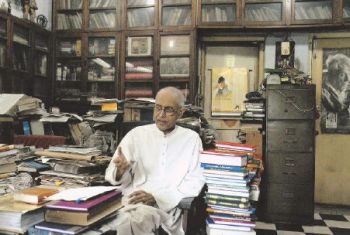
Prof P Lal, in memoriam


He inspired me to seek a living from the written word

Poet-translator-teacher. That’s how newspapers described Professor Purushottam Lal — better known as Professor P Lal — who died in his beloved city, Kolkata, on November 3. Readers were also informed he was 81. Those who knew Prof Lal also knew that he was not given to maudlin sentimentality — he often described Indians as “naively sentimental”. But perhaps he would have preferred to leave for the hereafter surrounded by shelves laden with books, framed prints of poets, hand-written manuscripts and his family in his crammed though spacious study at his house in Lake Gardens. That was not to be. He had been unwell for some time and required frequent hospitalisation; this time he did not return home. Death stalks us every day and night of our lives; when it finally catches up with us, it is usually without notice. That’s how we are destined to live and die. After the last prayer has been said and the final tribute paid, the passage of time begins to dull the fondest of memories. The cycle of life doesn’t stop turning; it maintains its own steady pace.

Prof Lal will be remembered by many of his admirers as a poet who had crafted a style of his own, very Indian, very desi, not dissimilar to the notes of Hindustani classical music, yet tantalisingly, just so, modern and European. Others will remember him as a publisher who had an eye for spotting young talent and gave budding writers the break they were looking for. That’s how Vikram Seth, Jayanta Mahapatra, Kamala Das and many others embarked on their journey to literary stardom. Then there are those who believe he was a gifted translator. His mammoth, 18-volume, sloka by sloka, rendition of Mahabharat in English shall continue to bear testimony to his remarkable ability as a translator. Prof Lal chose to use the word ‘transcreation’ and not ‘translation’; he wasn’t simply looking for words to replace words, but creating a new text based on the original.

He will also be remembered for his publishing house, Writers Workshop, which he ran single-handedly, well almost. For he never forgot to mention, in the opening pages of every book he ever published, that the volume of prose or poetry had reached the reader’s hands via the hands of a typesetter (who was partial towards the Times Roman typeface, possibly because there never was enough money to buy or cast new typefaces), a printer (who operated an antiquated though made in India treadle machine) and a binder (who used cotton handloom sari cloth woven in India). In his lifetime Tulamiah Mohiudden became as much an institution with his imaginative use of Sambalpuri fabric as Writers Workshop. Prof Lal’s son, Ananda, whom I have known as a friend for more years than I can remember, tells me Tulamiah’s children have continued with the tradition made fashionable by the binder of Writers Workshop books. As for the covers, they were invariably designed by Prof Lal: The title and the author’s name, hand-written in his inimitable calligraphy with a Sheaffer fountain pen, would be embossed on the hand-woven fabric in gold. Prof Lal was inconsolable when the nib of his pen broke after decades of use. That particular model was no longer available in stores. He wrote a letter to Sheaffer, wondering whether they could help him locate a nib. They sent him a new pen, with a similar nib specially made for his use. I will never forget the childlike delight with which he told me the story, showing off the pen as a priceless trophy. Yet, no two books ever looked similar. Ananda says Writers Workshop has till date published at least a thousand titles, but as always, and in many ways like his father, he is self-effacing. I am told the Writers Workshop list covers more than 3,000 books.

Pritish Nandy, the radical poet of the 1960s who went on to become a typewriter guerrilla and now produces Bollywood films, would remember Prof Lal as the publisher of his first, slim volume of poems. I was neither a budding writer nor an aspiring poet when I first met Prof Lal in 1981; so I have never had the privilege of being published by him. The only time my name featured in a Writers Workshop title was when Prof Lal wrote a book on his near-death experience in the late-1980s when he was struck by a strange bug while on a lecture tour in the US. In his dedication, he included my name. That was his way of expressing affection for a student who lazed on the back benches, rarely if ever turned in his assignments, but never forgot to attend his class. And that’s how I have always known Prof Lal — as a teacher for whom I had, and shall always have, the highest regard and utmost respect.

Prof Lal’s lectures were invariably scheduled in the afternoon when silence would descend on St Xavier’s College. His mellifluous voice, which he would never raise, would add to the sense of post-lunch lassitude. Unlike the other teachers, he never came armed with tattered, yellowing sheets of paper scribbled with notes. He would just stroll in, perch his elbow on the table and, after the customary greeting, gently initiate more of a conversation than launch into a prepared lecture. He would use metaphors that were magical, words that knocked on the doors of imagination. Perhaps it was practiced ease; years of teaching undergraduate students of English literature abroad had given him a certain sophistication lacking in the other teachers of the department who followed the strait and the narrow of the university syllabus, insisting we scribble down their words, learn the notes by rote and prepare for examinations in which we were expected to get a first. For Prof Lal, a third was as good as a first, provided the mind was not stuck in a groove and roved free, seeking pleasure in prose and poetry, essays and novels beyond the texts prescribed by Calcutta University. He would never bother about marking classroom attendance — presumably he found it repugnant that students should attend his lectures merely to mark attendance and not to learn.

I was a back-bencher and would listen to him in rapt attention, my legs sprawled, eyes half closed. One day, after the bell rang, he waited for me to pick up my bag and walk towards the door. He called me over to where he was standing and said, “I won’t ask you why you never hand in your assignments, but for that alone I will invite you home for tea. Come over this Sunday.” And so it was that I set foot into the famed study where writers would meet for scintillating conversation and manuscripts would be carefully read to spot that special talent which needed a helping hand. Prof Lal was in his favourite armchair, reading a book. He put it aside as I entered the cavernous room on the first floor, the late afternoon sun pouring in through the open windows. I had expected him to rebuke me for not taking my assignments seriously. Instead, what followed was a long conversation that stretched late into the evening. That was the first of many such conversations, and the beginning of a guru-sishya relationship that endured over the years. An added benefit was the friendship I struck with Ananda, then at a loose end and now a professor of English at Jadavpur University.

Kolkata will miss an intellectual who made the city his home, far away from Kapurthala where he was born. While others, including his students, left Kolkata looking for greener pastures, Prof Lal stayed on, resolute in his belief that this was his karmabhumi. In his death, I have lost an affectionate teacher and someone who inspired me to seek a living from the written word. Meanwhile, the queue ahead gets shorter.

[This appears as my Sunday column, Coffee Break, in The Pioneer on November 14, 2010.]

Saturday, November 06, 2010

Obama comes job-shopping


Are we mindful of our concerns?

A friend on Twitter, @naveenks, made the most profound comment on US President Barack Hussein Obama’s visit to India, which officially begins tomorrow morning: “There was a time when Indian Prime Ministers used to visit the US looking for food to feed hungry Indians. Now US Presidents visit India looking for jobs for Americans.” There couldn’t have been a more apt comment as Mr Obama makes his first halt on a job-shopping trip to Asia. To Mr Obama’s credit, as also to his advisers’, no false claims of furthering ‘strategic relations’ have been made; hence, expectations should not soar in Lutyens’s Delhi or elsewhere in India. To that extent, it was unfair to expect him to name Pakistan — or its ‘non-state actors’ — as the perpetrator/s of the November 26, 2008 bloodbath while reading out his treacly message for the victims and survivors of Mumbai’s unending night of horror. This is not the first time people have pretended the fidayeen came from outer space and Kasab is an extra-terrestrial alien. His immediate predecessors, Mr Bill Clinton and Mr George W Bush, were keen on striking a strategic alliance between the US and India as part of a realignment of geostrategic interests designed to fetch mutual long-term benefits; Mr Obama does not need to toe their line and is at liberty to aggressively seek for America a ‘strategic relationship’ with Pakistan. The ongoing US-Pakistan ‘strategic dialogue’, which involves the active participation of Gen Ashfaq Parvez Kayani, speaks for itself and where India stands in the changed circumstances. Whiners do not make winners; a country that does not fight to protect its interests should not expect others to join an imaginary battle.

That does not necessarily detract from the importance of Mr Obama’s visit. An American President knocking on our doors for jobs to sustain his presidency back home is not an everyday occurrence. If only Mrs Indira Gandhi had been alive today, she would have relished this moment of triumph: India’s sweet revenge on the US for treating her so shabbily. Mrs Gandhi was not in Washington, DC with a begging bowl to feed her hungry millions, but to plead the case of Bangladesh and seek American support for a just war of liberation. MV Kamath, who was posted in Washington those days, recalls, “The United States, under President Richard Nixon, was strongly on the side of Pakistan. Nixon hated India with the intensity of a burning Sun. His unprincipled Secretary of State, a real chamcha and an unscrupulous one at that, was ever-willing to back his boss to the hilt. If Nixon showed anger against India, Kissinger would happily fan it. If Nixon abused India, Kissinger was willing to go all the way to insult it … The plane in which she (Mrs Indira Gandhi) travelled was ordered to come a halt at New York’s Kennedy Airport close to a stinking urinal deliberately. One had to hold one’s nose while passing by. According to the lowest level of protocol, she was received by a junior State Department official. I was one of those present on the occasion … The first meeting between her and Nixon was fixed. Punctual to the point, Mrs Gandhi presented herself but Nixon deliberately made her wait for some 40 minutes to show his contempt for his visitor ... It was bad manners at their worst…”

No matter how lofty the cause, Mrs Gandhi was a supplicant in Nixon’s court and he was loath to let this fact go unnoticed. That does not, however, require us to be boorish as Mr Obama comes looking for jobs to bail out Americans from an economic crisis that continues to get worse, causing unemployment to rise to a level that has forced his ‘coalition of voters’ — the college-educated, the suburbanites, the politically uncommitted — to disown their ‘Apostle of Change’ and make Tea Party a fashionable political term of grassroots resistance to what is increasingly being perceived in the US as bad governance and which has fetched the Democrats a walloping in last week’s mid-term elections the like of which has not been witnessed in 72 years. Mr Obama’s approval rating, let us not forget, hovers at 45 per cent, and he is not even in the last year of his term.

So here are the bare facts. Mr Obama arrives in India not as the world’s most powerful person (that honour now goes to Mr Hu Jintao, President of China), an American President who can assert his authority and swing congressional approval for long-term strategic deals. The mid-term elections have left him severely bruised and his presidency hobbled. Republicans now have a majority in the House; the Democrats’ lead in the Senate is too narrow to over-ride opposition to presidential initiatives. The reversals are far worse than those suffered by Mr Clinton and Mr Bush. Unlike Mr Obama, neither Mr Clinton nor Mr Bush was isolated within his party. The Democrats are increasingly reluctant to either endorse him or be seen to be endorsing him. Few candidates wanted him to campaign for them and the party is already divided on renominating him for 2012, although these are early days for the race which begins late next year.

Domestic issues, especially the American economy, will preoccupy Mr Obama through 2011 to shore up his ratings. It’s unlikely he will focus on foreign relations and policy unless they are directly linked to domestic concerns. Hence his honest admission that his Asia visit is meant to ‘shop for jobs’: Any big ticket agreement that is arrived at while he is in New Delhi is likely to be linked to job-creation in America. That’s why Mr Obama is pushing hard for Government-to-Government defence purchases by India. It obviates procurement norms, fast tracks contracts, and advantage accrues to the supplier Government: The Obama Administration can boast to have created that many more jobs.

India has agreed to purchase 10 C17 transport planes for the IAF. The deal would fetch the US $ 5 billion. More importantly, it would save up to 30,000 jobs. Mr Obama now wants India to place its order for 126 multirole aircraft for the IAF with Lockheed Martin or Boeing, or both. That would save and generate as many as 27,000 to 31,000 jobs. If India agrees, we would be underwriting Mr Obama’s job-creation programme and funding the recovery of the US’s badly hit economy to the tune of more than $10 billion. Curiously, as soon as India agreed to the purchase of the C17s, Mr Obama announced an additional military aid package of $ 2.037 billion (over and above the $ 7.5 billion ongoing aid) for Pakistan. So, by placing orders for American merchandise, India not only creates jobs in the US but also defrays part of the mounting cost of American civil and military aid to Pakistan. For the record, since 9/11, American aid to Pakistan has surpassed $ 25 billion; nearly all of it in military assistance.

India Inc has made two points in response to Mr Obama’s job-shopping agenda. First, with India emerging as one the fastest growing source of FDI in the US, thousands of jobs have been created and secured by us in that country. Second, notwithstanding this fact, Mr Obama has become increasingly protectionist. For example, tax breaks for companies that outsource business or employ non-Americans are being withdrawn; H1B visa fees have been raised astronomically; and, it’s more difficult to get business visas than ever before while many Indians with business visas are being refused entry at port of arrival.

It is against this backdrop that we should judge the outcome of Mr Obama’s visit to India, not imagined slights and grievances which have no place in hard-headed diplomacy.

[This appears as my Sunday column, Coffee Break, in The Pioneer on November 7, 2010.]

Tuesday, October 26, 2010

Free speech? Clever cover for India bashing


Hypocrisy of Left-liberal commentariat

Activist-author-anarchist Arundhati Roy remains recalcitrant. On Tuesday she issued a statement, in which, among other things, she “the people of Kashmir live under one of the most brutal military occupations in the world”, “the Indian poor pay the price of this occupation in material ways and who are now learning to live in the terror of what is becoming a police state”, “pity the nation that has to silence its writers for speaking their minds”. Curiously, or perhaps not, she claimed “Dalit soldiers” are getting killed in Jammu & Kashmir.

On Sunday, speaking at a seminar on ‘Wither Kashmir: Freedom or Enslavement’ in Srinagar, Arundhati Roy said, “Kashmir has never been an integral part of India. It is a historical fact.” She said she was proud to associate herself with “resistance movements” across India and counselled Kashmiris to “consolidate the gains” of the recent four months of anti-India agitation. “The power concedes nothing unless it is forced to,” she said, and demanded demilitarisation of Jammu & Kashmir. Then she went on to urge Kashmiris not to join the State police and the Central Reserve Police Force.

Strangely, Arundhati Roy questioned the legitimacy of Kashmiris electing their own Government: “You (Kashmiris) should think how the elections were used against you.” In the same breath she added, “The Prime Minister of the world’s largest democracy has not been elected.” Does she then, at least, admit India is the “world’s largest democracy”? Of course not! “India is behaving like a colonial power and suppressing one community at the hands of the other … They are sending Nagas to Kashmir and Punjabis to Manipur.”

The Union Ministry for Home Affairs believes there is sufficient evidence by way of Arundhati Roy’s seditious utterances to prosecute her under Section 124 A of the Indian Penal Code. This section says:

Whoever, by words, either spoken or written, or by signs, or by visible representation, or otherwise, brings or attempts to bring into hatred or contempt, or excites or attempts to excite disaffection towards the Government established by law in India, shall be punished with imprisonment for life, to which fine may be added, or with imprisonment which may extend to three years, to which fine may be added, or with fine.

Explanation 1-The expression "disaffection" includes disloyalty and all feelings of enmity.
Explanation 2-Comments expressing disapprobation of the measures of the attempting to excite hatred, contempt or disaffection, do not constitute an offence under this section.
Explanation 3-Comments expressing disapprobation of the administrative or other action of the Government without exciting or attempting to excite hatred, contempt or disaffection, do not constitute an offence under this section.

The Home Ministry is said to be waiting for “political clearance”. The Congress is believed to be of the view that while a case should be filed against her and she should be prosecuted, Arundhati Roy should not be arrested to avoid “negative publicity abroad”. And what if the courts hold her guilty and send her to jail? What then? Or is the Congress banking on the decrepit criminal justice system to drag the case for years and decades, by when it will be inconsequential whether she is punished or not.

Over the weekend, three distinct viewpoints have emerged. First, Arundhati Roy should be prosecuted. Second, we should ignore her just as others on the lunatic fringe are ignored. Third, she should be allowed to have her say because “freedom of speech is guaranteed” by the Constitution of India. I have already expressed my opinion on the first two points. The last view merits further comment.

Contrary to popular belief, popularised no doubt by illiterate and ill-informed members of south Delhi’s Left-liberal commentariat that rules ‘national media’, freedom of speech is not unrestrained in India.

The Constitution provides for "the right to freedom of speech and expression" [Article 19(1) a]. However this right is subject to restrictions under sub-clause (2), whereby this freedom can be restricted for reasons of "sovereignty and integrity of India, the security of the state, friendly relations with foreign states, public order, preserving decency, preserving morality, in relation to contempt, court, defamation, or incitement to an offence”.

Arundhati Roy is clearly in breach of these restrictions. Anybody else violating sub-clause 2 would have faced the ire of the state. Second, by slyly referring to “Dalit soldiers” and urging Kashmiris not to join the police and CRPF, she is prima facie guilty of far worse.

That apart, for the Left-liberals to argue in support of free speech is disingenuous. The same freedom is rudely curbed when the Right wants to exercise this right.

As my friend and one of the leading scholars of West Asia, Barry Rubin, recently wrote, albeit in a different context, “Leftist attacks are designed to demonise, destroy and silence … Conservatives have been often demonised and, given liberal suspicion toward that side of the political spectrum, many liberals have believed whatever they’ve been told by often highly partisan and dishonest sources, failing to insist on fair play. Ridicule conservatives and moderate, traditional liberals will accept it without checking quotes, listening to responses, and demanding accuracy”.

In justification of their intolerance, bigotry and belligerence, the Left-liberals say, “We must draw a distinction between ‘hate speech’ and ‘free speech’.” Really? When does ‘free speech’ become ‘hate speech’? When it bruises bogus Left-liberal sensitivities? And, what if I were to insist, for good reason, that Arundhati Roy’s ‘free speech’ is ‘hate speech’ disguised in cockamamie jargon?

We could also ask whether those who have suddenly become vocal in protecting unrestricted 'free speech', which rests on the principle of absolute freedom to say anything, irrespective of consequences, had been equally vocal in protecting Varun Gandhi's right to say what he is alleged to have said (he says the tape was doctored; the issue is in court) during last summer's election campaign.

Arundhati Roy claims to be speaking for ‘justice’. There can be no justice till such time India is burdened with a flawed system based on the notion of laws being equal for all but privileges being different. The laws which she is accused of having violated shall never be applied to her because she belongs to the ‘intellectual elite’, the club of English-speaking professional dissenters who thrive on media publicity, who are feted by the commentariat, who are promoted by foreign media keen to portray India as a banana republic. Yet, the same laws are applied to others who are less privileged than Arundhati Roy and her gang of cheer leaders.

There is merit in the argument that nothing should be done to help Arundhati Roy achieve her goal of being seen as India’s Liu Xiaobo. There’s nothing she would love more than that and the adulation which would follow.

Yet, it rankles that she should listen to the grasshoppers sing while others serve time for offences far less serious. This is neither just nor fair. It’s definitely not my idea of justice.

What do you think?