Monday, October 31, 2011

When a big tree fell...


Recalling the terrifying pogrom of November 1984 that left thousands of Sikh men, women and children dead -- killed by Congress thugs

At 9.30 am on October 31, 1984, Mrs Indira Gandhi, iron-willed and iron-fisted Prime Minister of India, famously described by her aunt Vijayalakshmi Pandit as “the only man in her Cabinet”, was assassinated at her 1, Safdarjung Road residence. The assassins, both Sikhs, were Satwant Singh and Beant Singh, two of the guards who were meant to protect her. Satwant Singh was arrested; Beant Singh was shot dead by the other guards.

Satwant Singh later told investigators that he and Beant Singh had assassinated Mrs Gandhi to avenge the desecration of Harmandir Saheb and destruction of the Akal Takht in ‘Operation Bluestar’, the Army action of June 5-7, 1984. Mrs Gandhi had ordered the military operation to flush out Khalistani terrorists, including Jarnail Singh Bhindranwale, who had made the Golden Temple complex in Amritsar into their headquarters.

‘Operation Bluestar’ was a military success but a political disaster. The objective of ‘flushing out’ the Khalistanis was achieved, but at a huge price. According to the White Paper published by the Government of India, 493 people, including terrorists (200 in the Akal Takht alone), were killed. The official toll was far less than what foreign agencies and newspapers reported: 1,000. BBC journalist Mark Tully, in his book ‘Amritsar – Mrs Gandhi’s Last Battle’, placed the death toll at 2,093. Eyewitnesses said at least 8,000 were killed. The ‘White Paper’ said 83 soldiers had died in the three-day-long action. This figure, too, remains disputed.

The backlash was enormous, and beyond what had been anticipated, alienating the Sikh masses at home and abroad (Khalistanis in Canada plotted and executed the bombing of Emperor Kanishka, Air India’s Montreal-London-Delhi Flight 182, killing all 329 people aboard the aircraft on June 23, 1985) and fuelling the Khalistani movement which was finally crushed in the early-1990s, thanks to the then Punjab Police chief KPS Gill. But the restoration of peace in Punjab is another story. On January 6, 1989, Satwant Singh and Kehar Singh, who had been held guilty of conspiracy in the crime but pleaded his innocence till the end, were executed at Tihar Jail.
That, in brief, is the story of Mrs Gandhi’s assassination. But there’s a longer story to be told – that of what followed the deed.

Twenty-seven years is a long time. Public memory is notoriously short and it is unlikely those who have come of age in these 27 years would know of the terrible pogrom that left 4,733 Sikhs dead, most of them slaughtered in Delhi, retribution massacres carried out by Congress thugs led by Congress leaders, among them Jagdish Tytler and Sajjan Kumar.

It would, therefore, be in order to recall the chain of events lest we be persuaded to believe that nothing of consequence happened by a Prime Minister who spends sleepless nights worrying about a terror suspect held in distant Australia but blithely disowns responsibility for the shocking attempt to whitewash the crimes of his party and its 'leaders' committed against thousands at home.

So, here is the story of how thousands of Sikh men, women and children were slaughtered; in Delhi alone, 2,733 Sikhs were burned alive, butchered or beaten to death. Women were raped while their terrified families pleaded for mercy, little or none of which was shown by the Congress goons. In one of the numerous such incidents, a woman was gang-raped in front of her 17-year-old son; before leaving, the marauders torched the boy.

For three days and four nights the killing and pillaging continued without the police, the civil administration and the Union Government, which was then in direct charge of Delhi, lifting a finger in admonishment. The Congress was in power and could have prevented the violence, but the then Prime Minister, his Home Minister, indeed the entire Council of Ministers, twiddled their thumbs.

Even as stray dogs gorged on charred corpses and wailing women, clutching children too frightened to cry, fled mobs armed with iron rods, staves and gallons of kerosene, AIR and Doordarshan kept on broadcasting blood-curdling slogans like 'Khoon ka badla khoon se lenge' (We shall avenge blood with blood) raised by Congress workers grieving over their dear departed leader.

Mrs Gandhi was assassinated at 9.30 am, but her death was 'officially' confirmed at 6 pm, after due diligence had been exercised to ensure Rajiv Gandhi's succession. By then, reports of stray incidents of violence against Sikhs, including the stoning of President Zail Singh's car, had started trickling in at various police stations.

By the morning of November 1, hordes of men were on the rampage in south, east and west Delhi. They were armed with iron rods and carried old tyres and jerry cans filled with kerosene and petrol. Owners of petrol pumps and kerosene stores, beneficiaries of Congress largesse, provided petrol and kerosene free of cost. Some of the men went around on scooters and motorcycles, marking Sikh houses and business establishments with chalk for easy identification. They had been provided with electoral rolls to make their task easier.

By late afternoon that day, hundreds of taxis, trucks and shops owned by Sikhs had been set ablaze. By early evening, the murder, loot and rape began in right earnest. The worst butchery took place in Block 32 of Trilokpuri, a resettlement colony in east Delhi. The police either participated in the violence or merely watched from the sidelines.

Curfew was declared in south and central Delhi at 4 pm, and in east and west Delhi at 6 pm on November 1. But there was no attempt to enforce it. PV Narasimha Rao, the then Home Minister, remained unmoved by cries for help. In his affidavit to the Nanavati Commission of Inquiry, Lt-Gen Jagjit Singh Aurora, decorated hero of the 1971 India-Pakistan war, said, "The Home Minister was grossly negligent in his approach, which clearly reflected his connivance with perpetrators of the heinous crimes being committed against the Sikhs."

The first deployment of the Army took place around 6 pm on November 1 in south and central Delhi, which were comparatively unaffected, but in the absence of navigators, which should have been provided by the police and the civil authorities, the jawans found themselves lost in unfamiliar roads and avenues.

The Army was deployed in east and west Delhi in the afternoon of November 2, more than 24 hours after the killings began. But, here, too, the jawans were at a loss because there were no navigators to show them the way through byzantine lanes.
In any event, there was little the Army could have done: Magistrates were 'not available' to give permission to fire on the mobs. This mandatory requirement was kept pending till Mrs Gandhi's funeral was over. By then, 1,026 Sikhs had been killed in east Delhi. Jagdish Tytler and Sajjan Kumar were among Congress 'leaders' who, witnesses said, incited and led mobs. Both deny the allegation, but the evidence is overwhelming.

A report on the pogrom, jointly prepared by the PUCL and PUDR and published under the title, Who Are the Guilty? names both of them along with others. The report quotes well-known journalist Sudip Mazumdar:
"The Police Commissioner, SC Tandon was briefing the Press (about 10 Indian reporters and five foreign journalists) in his office on November 6, at 5 pm. A reporter asked him to comment on the large number of complaints about local Congress MPs and lightweights trying to pressure the police to get their men released. The Police Commissioner totally denied the allegation… Just as he finished uttering these words, Jagdish Tytler, Congress MP from Sadar constituency, barged into the Police Commissioner's office along with three other followers and on the top of his voice demanded, 'What is this Mr Tandon? You still have not done what I asked you to do?' The reporters were amused, the Police Commissioner embarrassed. Tytler kept on shouting and a reporter asked the Police Commissioner to ask that 'shouting man' to wait outside since a Press conference was on. Tytler shouted at the reporter, 'This is more important.' The reporter told the Police Commissioner that if Tytler wanted to sit in the office he would be welcome, but a lot of questions regarding his involvement would also be asked and he was welcome to hear them. Tytler was fuming…"

The slaughter was not limited to Delhi, though. Sikhs were killed in Gurgaon, Kanpur, Bokaro, Indore and many other towns and cities in States ruled by the Congress. In a replay of the mayhem in Delhi, 26 Sikh soldiers were pulled out of trains and killed.

After quenching their thirst for blood, the mobs retreated to savour their 'revenge'. The flames died and the winter air blew away the stench of death. Rajiv Gandhi's Government issued a statement placing the death toll at 425!

Rajiv Gandhi had no qualms about justifying the carnage. "Some riots took place in the country following the murder of Indiraji," Rajiv Gandhi said on November 19, 1984, even as thousands of families grieved for their loved ones killed by Congress hoodlums, "We know the people were very angry and for a few days it seemed India had been shaken. But when a mighty tree falls, it is only natural that the earth around it does shake a little."

Some riots? Only natural? Shake a little?

Demands for a judicial inquiry were stonewalled by Rajiv Gandhi. Human rights organisations petitioned the courts; the Government said courts were not empowered to order inquiries. Meanwhile, Rajiv Gandhi dissolved the Lok Sabha and went for an early election, which the Congress swept by using the 'sympathy card' and launching a vitriolic hate campaign.

Once in office, Rajiv Gandhi was desperate for a breakthrough in Punjab. He mollycoddled Akali leader Sant Harchand Singh Longowal into agreeing to sign a peace accord with him. Sant Longowal listed a set of pre-conditions; one of them was the setting up of a judicial commission to inquire into the pogrom.

Thus was born the Ranganath Misra Commission of Inquiry, which took on the job of crafting a report that would suggest extra-terrestrials were to be blamed for whatever had happened. Worse, submissions and affidavits were passed on to those accused of leading the mobs; some of these documents were later recovered from the house of Sajjan Kumar. Gag orders were issued, preventing the Press from reporting in-camera proceedings of the Commission.

For full six months, Rajiv Gandhi refused to make public the Ranganath Misra Commission's report. When it was tabled in Parliament, the report was found to be an amazing travesty of the truth; neither were the guilty men of 1984 named, nor was responsibility fixed.

Subsequently, nine commissions and committees were set up to get to the truth, but they were either disbanded midway or not allowed access to documents and evidence. India had to wait for the report of the Nanavati Commission for an approximate version of the real story.

Justice Nanavati's report said, "The Commission considers it safe to record its finding that there is credible evidence against Jagdish Tytler to the effect that very probably he had a hand in organising attacks on Sikhs." This is not an indictment, Mr Manmohan Singh and his Government decided, so why bother about it? Four years later they remain unrepentant, their attitude remains unchanged.

Two thousand seven hundred and thirty-three men, women and children killed in Delhi, another 2,000 killed elsewhere, scores of women raped, property worth crores of rupees looted or sacked. Families devastated forever, survivors scarred for the rest of their lives.

But the Congress doesn't care!

(This is a revised version of my article which originally appeared in The Pioneer in 2009.)

Also read my article for Rediff, Light a candle for 4,733 Sikhs slaughtered by Congress hoods, for more details of the pogrom.

Thursday, October 06, 2011

The magic man of technology


“No one wants to die. Even people who want to go to heaven don’t want to die to get there. And yet death is the destination we all share. No one has ever escaped it. And that is as it should be, because Death is very likely the single best invention of Life. It is Life’s change agent. It clears out the old to make way for the new,” Steven Paul Jobs. (February 24, 1955 – October 5, 2011.)

But for the humble apple Earth would have been a desolate planet, our understanding of gravity would have resembled that of Chief Vitalstatistix and the alphabet ‘i’ would never have achieved iconic status. Eve offered Adam a luscious apple, tempting him to surrender to the serpent of desire and commit the original sin. An over-ripe apple fell on Newton’s head on a lazy Cambridge afternoon, jolting him to the reality of gravity. And then came Steve Jobs’s Apple in rainbow colours, heralding the arrival of technology.

Few would remember it today, or care to recall, that the first logo of Apple Computer Co, set up by Jobs and his school friend Steve Wozniak on April Fool’s Day in 1976, was a black-and-white label that showed Isaac Newton reading a book under the famous apple tree of Cambridge. It was a copied lithograph and understandably didn’t meet Jobs’s exacting standards of aesthetics. That logo was dropped a year later for the ‘Apple’ which now has become a cult symbol. The rainbow colours were swapped for a translucent expanse in 1998. Very Buddhist, very minimalist, very Jobs.

Contrary to popular notion, Jobs never designed a computer, or any other product from the Apple stable, in his life. He conceived ideas, and then had them transformed into minimal machines with maximal performance. As a grieving fan tweeted after hearing of Jobs’s death on Thursday morning, “Jobs was an artist. He put himself in your shoes and looked at the world through your eyes. And gave you what you wanted. That was his magic.”

Jobs was technology’s magic man, connecting individuals, societies and the world in a manner nobody could have ever imagined. Bill Gates and his Microsoft may have made the PC popular, but his machines and software lacked the chutzpah of Apple. To Jobs (and Wozniak) goes the credit of putting the first personal computer in the market and set the trend with Macintosh. Microsoft followed. Jobs was ever mindful of this fact and once famously retorted: “I wish Bill Gates well. I only wish that at some time in his life he had dropped acid or spent time at an ashram.”

Hallucinating drugs, possibly acid, did play a role in Jobs’s early life. His acute sense of aesthetics — reflected in the grace of every Apple product, from MacBooks to MacAir to iPods, iPhones and iPads, and their flawless operating systems — may have come from the days when he experimented with flower power and Indian mysticism, although it never endeared him to India or Indians. After dropping out of college he hippie-d around for a while, making a ‘living’ returning Coke bottles which fetched him five cents apiece. On Sunday nights he would “walk the seven miles across town … to get one good meal a week at the Hare Krishna temple. I loved it.”

Many American dropouts, in flowing robes and long hair, came looking for moksha in India during the mid-1960s and early-1970s. So did Jobs along with his friend Kottke. Apparently, he wanted to seek enlightenment from Neem Karori Baba. That encounter between the worshipper of Hanuman and a callow American searching for the higher truth never took place as Baba left this world of mortals before Jobs reached his ashram.

Little is known about what transpired thereafter. But Jobs did not leave India with either happy memories or an enlightened mind. What we do know is that he found India “intense and disturbing”. His biographer records: “We weren’t going to find a place where we could go for a month to be enlightened. It was one of the first times that I started to realise that maybe Thomas Edison did a lot more to improve the world than Karl Marx and Neem Karori Baba put together.” Jobs never looked back at India. In fact, he never looked at India. He simply ignored this country, its expertise in technology and its vast, virtually insatiable, market.

Yet, had it not been for that presumably disastrous trip to India, that realisation would perhaps have eluded Jobs and technology would have been deprived of a brilliant, if arrogant and rude, innovator. We would think of Adam and Eve having a roll in the Garden of Eden or a bored Newton dozing over a book whenever we saw an apple, but we would have never connected it with the music we hear, the computers we use and the phones that have made life that much easier.

(The Pioneer, October 7, 2011.)

Friday, September 23, 2011

Madman on the loose


Ahmadinejad repeats his rant!

On Thursday, Iran's Islamofascist President Mahmoud Ahmadinejad was in full flow at the UN General Assembly which is currently in session.

Misusing the platform that is provided to all member-states of the UN, Ahmadinejad delivered, what can only be described as a hate-laden speech, spitting venom at the Christian West, Jewish Israel and 'non-believers' belonging to all other faiths.

He was not speaking on behalf of the Islamic Republic of Iran alone, but the entire ummah when he

. charged Americans with stage-managing 9/11
. accused the US of conniving with Osama bin Laden
. questioned the veracity of the Holocaust
. blamed 'Zionists' for the woes of the world
. virtually called for the extermination of all those he listed as foes.


A madman on the loose is a threat to the world. A madman who could soon have nuclear weapons in his arsenal is a danger to humankind and human civilisation.

Only those given to unmentionable perversions of the mind and body would find merit in Ahmadinejad's bilious speech which epitomises Islamofascism.

Those nations which value democracy, freedom, liberty and peace would shame and shun a rabid pariah like Mahmoud Ahmadinejad.

Iran is welcome to have him as its President. The mullahs of Iran are welcome to their favourite boy.

But the world, including India, must deny him -- and those who support him or endorse his rant -- both legitimacy and space.

[Official version of Mahmoud Ahmadinejad's speech in the UN General Assembly.]

Thursday, September 22, 2011

So, what will America do?


The fact remains that the Quetta Shura and the Haqqani Network operate from Pakistan with impunity...

Pakistan’s military and political establishment, one often indistinguishable from the other, have for long been disingenuous if not outright deceitful while claiming to dismantle the sprawling jihad complex which is the mainstay of that country’s established policy of using terrorism to further its ‘strategic objectives’.

Those ‘strategic objectives’ range from “inflicting a thousand cuts” on India to gaining control over Afghanistan; from blackmailing Western donor countries, especially the USA, to simply terrorising the world.

That in the process thousands of Pakistani citizens have fallen victim to the insatiable appetite for flesh and blood of the monster the Pakistani state has bred is of no consequence to the Generals in Rawalpindi and their handmaidens in Islamabad.

Strangely, or perhaps not so, Pakistanis continue to live in denial of this reality. The Pakistani military and the Government, or what passes for it, deny any links with terrorist organisations. If confronted with evidence, they either brazen it out or slyly ask for more dole to do what is expected of them.

The world is aware of how Pakistan has emerged as the epicentre of global terrorism. The US, which is the principal benefactor of Pakistan, knows that the hand which reaches out for civilian and military aid is also the hand which loving rocks the cradle of jihad’s nursery.

But that has not stopped the US from writing out billion-dollar cheques to Pakistan. Nor has it made Washington, DC demand answers to some tough questions.

On the contrary, the US continues to describe Pakistan as its ‘staunch ally’, its ‘frontline ally’ in the war on terror. Pakistan remains the US’s ‘most-favoured non-Nato ally’. Pakistan has America wrapped around its little finger.

In a sense, if Pakistanis are living in denial, so are the Americans.

That Osama bin Laden was found living in a ‘safe house’ at Abbottabad, obviously protected by the Pakistani military and its terror-sponsoring agency, the ISI, has not shaken America’s faith in Pakistan.

That other Al Qaeda leaders have been traced – and killed through targeted drone attacks – in Pakistan has not deterred Washington from standing by Islamabad.

That Pakistan continues to flout UN Security Council resolutions and sanctions aimed at defanging terrorist organisations like the Lashkar-e-Tayyeba is of no seeming relevance to the US Administration.

Occasionally we are told that the US has read out the riot act to Pakistan, that senior Pakistani politicians and Generals have been admonished, that Islamabad has been sternly told thus far and no further. That’s so much finger-wagging amounting to nothing.

For instance, we are told that US Secretary of State Hillary Clinton was less than pleasant with Pakistan’s Foreign Minister Hina Rabbani Khar (of Birkin bag fame) who did look discomfited in the customary photo of the recent meeting in Washington that was released to media. Hillary is supposed to have told Hina that the Pakistani military-political establishment was working hand-in-glove with the Haqqani network to unleash terror in Afghanistan.

In response, Pakistan’s Interior Minister Rehman Malik (who is partial towards flashy ties) has, in his characteristically belligerent style, demanded, “Where is the evidence?” That’s not the first time Pakistan has sought ‘evidence’ of its misdeeds.

Interestingly, in separate testimonies before the US Senate Armed Forces Committee on September 22, 2011, Admiral Mike Mullen, Chairman of the Joint Chiefs of Staff, and Secretary of Defence Leon Panetta have spoken in great detail of the nexus between jihadi terror and the Pakistani state.

Mike Mullen says in his testimony:

“The fact remains that the Quetta Shura and the Haqqani Network operate from Pakistan with impunity. Extremist organizations serving as proxies of the government of Pakistan are attacking Afghan troops and civilians as well as US soldiers. For example, we believe the Haqqani Network — which has long enjoyed the support and protection of the Pakistani government and is, in many ways, a strategic arm of Pakistan’s Inter-Services Intelligence Agency — is responsible for the September 13th attacks against the US Embassy in Kabul. There is ample evidence confirming that the Haqqanis were behind the June 28th attack against the Inter-Continental Hotel in Kabul and the September 10th truck bomb attack that killed five Afghans and injured another 96 individuals, 77 of whom were US soldiers. History teaches us that it is difficult to defeat an insurgency when fighters enjoy a sanctuary outside national boundaries, and we are seeing this again today. The Quetta Shura and the Haqqani Network are hampering efforts to improve security in Afghanistan, spoiling possibilities for broader reconciliation, and frustrating US-Pakistan relations. The actions by the Pakistani government to support them — actively and passively — represent a growing problem that is undermining US interests and may violate international norms, potentially warranting sanction…”

The full text of Mullen’s testimony can be read here.

Leon Panetta was understandably more tactful:

"We have a difficult campaign ahead of us in the east, where the topography, cultural geography, and continuing presence of safe havens in Pakistan give the insurgents advantages they have lost elsewhere in the country. Additionally, as relations with Pakistan have become strained over the past year, and as we have met Pakistan’s requests to reduce our training and liaison presence in their country, our diminished ability to coordinate respective military operations in the border regions has given insurgents greater freedom of movement along the border. Our forces are working in the east to cut off insurgent lines of communication and deny their ability to threaten Kabul and other population centres. Nonetheless, progress in the east will likely continue to lag what we see elsewhere in the country..."

The full text of Panetta’s testimony can be read here.

So what does the US plan to do? Pretend that its ‘staunch ally’, its ‘frontline ally’, its ‘most-favoured non-Nato ally’ remains committed to waging war on terror?

That’s more than likely. Which prompts the question, after such knowledge, what forgiveness?

Update

On Friday, September 23, Pakistan's Inter-Services Public Relations issued the following statement:

While taking note of the recent statements made by Admiral Mullen, Chairman Joint Chief of Staff United States, Chief of Army Staff General Ashfaq Parvez Kayani, termed these as very unfortunate and not based on facts. This is especially disturbing in view of a rather constructive meeting with Admiral Mullen in Spain.

On the specific question of contacts with Haqqanis, the COAS said that Admiral Mullen knows fully well which all countries are in contact with the Haqqanis. Singling out Pakistan is neither fair nor productive.

Categorically denying the accusations of proxy war and ISI support to Haqqanis, the COAS wished that, the blame game in public statements should give way to a constructive and meaningful engagement for a stable and peaceful Afghanistan, an objective to which Pakistan is fully committed.


It would be interesting to know what "Admiral Mullen knows fully well" as to which all countries are "in contact with the Haqqanis".

Why doesn't Gen Kayani spill the beans? Or, get an ISPR affiliated journalist, of whom there is no dearth, to tell all?


[Time has an interesting story on the massacre of Shias of Balochistan by Pakistan's Sunni militia, Lashkar-e-Jhangvi.]

Tuesday, September 20, 2011

False gods of secularism


Just so that amnesia can't be pretended!

"It is the Congress that has engineered most of the riots... Rajiv Gandhi failed to protect Harijans and Muslims… Geographical boundaries of the country were jeopardised by the Congress and Rajiv Gandhi...”

On reading such harsh accusation, such pitiless pillorying of the Congress and its supreme leader, the last direct descendent of the Nehru-Gandhi dynasty to sit on the masnad of Delhi, the image that comes to mind is that of an irascible foot soldier of the BJP or a malevolent journalist doing what foot soldiers and malevolent journalists do best: Shoot from the hip.

Think again, but it is unlikely that you will be able to guess the identity of the person who tore into the Congress so mercilessly while participating in a debate on the ‘Situation in the Country’ in the Lok Sabha on December 29, 1989. The immediate backdrop to this debate was the series of communal riots in Congress-ruled Bihar -- Hazaribagh, Darbhanga, and the horrendous bloodletting in Bhagalpur during the twilight days of Rajiv Gandhi's Government in the autumn of that year.

The official death count in Bhagalpur was 1,891, with thousands scarred for the rest of their lives. In Logain village, an entire Muslim mohalla was wiped out: The bodies of 120 Muslim men, women and children were dumped in a shallow pond; when the stench became unbearable, the rotting corpses were fished out, buried in a field and planted over with cauliflower saplings. It was a ‘good’ harvest that year.

In Chanderi, another Muslim mohalla, 61 people were massacred. Mallika, a 14-year-old girl, tried to flee the mob that had killed her parents and relatives. She stumbled and fell; the mob chopped off her legs and left her to bleed to death in a hyacinth covered pond. An Army officer found her the next day, drawn by her pitiful sobs, and Mallika survived to live a traumatic life.

But we digress. From December 18 to 29, the newly-elected Lok Sabha, with Prime Minister VP Singh and the Janata Dal occupying the Treasury benches and Rajiv Gandhi and the Congress sitting on the Opposition benches, witnessed a spirited debate over the customary address by the President. Either by design or by default, the President had failed to mention the riots in Bhagalpur.

Congress MPs seized on this omission to berate the Government, alleging that the riots were not mentioned to spare embarrassment to its ally, the BJP, which was accused of fomenting the violence in Bhagalpur and elsewhere. As the debate became increasingly accusatory and the tone and tenor of the attack on the BJP sharpened, the Janata Dal MP from Chapra waded in to battle the Congress.

Responding to the allegation that BJP and VHP activists had ‘provoked’ the violence, he said, “I would like to tell you that there are two groups of Muslims in Bhagalpur, ie, Ansaris and Sallans, who had started riots in the city. A bomb was thrown on the SP (of) Bhagalpur and 11 police personnel were injured. They had thrown that bomb on the occasion of Ram Shila Pujan but these people have not been yet rounded up.”

That MP was Lalu Prasad Yadav, who years later went on to become Minister for Railways in the UPA1 Government and an ardent supporter of 'Madam Soniaji.' He would be the first to jump to her defence in the Lok Sabha and still fondly hopes that she will one day reopen the door that Rahul Gandhi has firmly shut on his face.

But we digress again. On December 29, 1989, Lalu Prasad Yadav was relentless in his assault on the Congress, more so on Rajiv Gandhi, and took vicarious pleasure by slyly mentioning Sonia Gandhi by name now and then, in total disregard of House rules which prohibit the naming of any person who is not present. “It is the Congress party which (has) engineered most of the riots, particularly in Bihar,” he thundered to the thumping of tables. “We shall expose their role in inciting communal riots,” he promised on behalf of the Government.

Listing the failures of the previous regime, he said, “Rajiv Gandhi failed to fulfil the promises which he made in regard to the development, unity and security of the country and protection of the Harijans and Muslims. This resulted in creating a gloomy situation in the country...” And, hence, the people voted (in 1989) for change.

“Change had become necessary because the responsibility of protecting the geographical boundaries of the country (sic)... was jeopardised by the Congress and Rajiv Gandhi,” Lalu Prasad Yadav explained, adding with a rhetorical flourish, “If we fail to safeguard the unity, integrity and the principle of secularism of our country, we cannot save the country from disintegration...”

And then came the full assault.

“Satyendra Narain Sinha became Chief Minister of Bihar, he failed to quell the riots in Hazaribagh... the procession of Ram Navami had passed off peacefully in front of the Jama Masjid of Hazaribagh. No Muslim had opposed the procession,” Lalu Prasad Yadav said, recalling the sequence of event, “Ram shila procession and Ram Navami procession passed off from there, but neither there was any riot nor anybody raised provocative slogans on that day. But later on an incident took place in Hazaribagh which triggered off disturbances in the entire State.”
So who or what was to blame? Read on.

“Rajiv Gandhi, accompanied by his wife Sonia Gandhi, went to participate in the Vaishali festival. They had put on bulletproof vests... Rajiv Gandhi told Sonia Gandhi that he himself would drive the jeep to see the celebrations,” Lalu Prasad Yadav explained with dramatic flourish, before coming to the consequences of that drive from Patna to Vaishali by the former Prime Minister and his wife.

“An announcement was made in regard to their security... Full security force was required all along the 60 km route from Patna to the place of celebrations. Wireless message was sent to the DM of Hazaribagh, wireless message was sent to the Collector also to send all the forces to Vaishali as Rajiv Gandhi and Sonia Gandhi were coming to attend the celebrations,” he recounted, “Forces were picked up from Hazaribagh and sent to Vaishali. After three days riots took place between Hindus and Muslims. But no security forces were there to control the situation.”

And what about Darbhanga?

“They (the Congress) have spared no effort to put Bhagalpur, BJP, RSS and Janata Dal to disrepute,” Lalu Prasad Yadav said, charging the Congress, whose MPs were by then on their feet, with criminal subterfuge, “One thousand workers belonging to the Congress were called to Bahera (an Assembly constituency in Darbhanga) by Maithili Brahmins (a snide reference to Jagannath Mishra and what was then the Congress's core constituency in Bihar) and were asked to wear caps bearing slogans ‘Garv say kaho hum Hindu hain’ and ‘Radhe Shyam Baba ki Jai’.”

After a pause, he added with a condescending flourish, “You try to understand the actual position in Bhagalpur... Shiv Chander Jha, who was the Speaker, was deadly against Bhagwat Jha Azad (another Congress leader). It was due to them and a few of their men that these riots... (interruptions)... they were behind these riots.”

Researching communal violence in India can be a dreary and depressing experience. But it also has its illuminating moments. Reading the records of the debate in the Lok Sabha on December 29, 1989, was one such moment when the true face of ‘secular’ politics in India leapt out with venomous fangs exposed.

But all this, and much more, will not dissuade those who worship false gods of secularism.

(A related essay, Communal truth, secular lies, deals with Congress and its role in the Nellie massacre, the Meerut riots and the Maliana killings.)

[This is adapted from my article originally published by Rediff in 2005.]

Monday, September 19, 2011

Our intellectual Cossacks!


Non-stop rant against Narendra Modi!

The Left-liberal commentariat has gone to extraordinary length to prove Narendra Modi's three-day fast as part of his 'Sadbhavana Mission' was "meaningless" and "lacked credibility". In a democracy, opinion is free (though facts remain sacred) and we must learn to live with such outpouring of vitriol by those who claim to be 'unbiased' and 'bipartisan' but are exactly what they say they are not.

True, the hate-steeped commentary denouncing Narendra Modi is anything but fair criticism. It is hate speech aimed at vilifying, defaming and maligning a visionary leader who has changed the face of Gujarat and, if given the opportunity, will change the face of India by putting the country on the path of rapid development and equitable growth. But our commentariat thinks crass abuse is criticism. So be it.

Narendra Modi believes in India, he is proud of the nation and enthuses the country's youth. That rankles with the commentariat and activists, and understandably so.

But if Narendra Modi's three-day fast, which ended on Monday evening, was truly "meaningless" and of "no consequence", why did his critics, especially in the 'secular' media, expend so much time and energy in denouncing it? Logically, they should have just ignored the event.

The fact of the matter, as the cliche goes, is that the louder their criticism, the shriller their denunciation, the greater is their alarm and panic. The raucous cacophony of voices we have heard in media these past three days is a measure of the frustration among the self-righteous, sanctimonious critics of Narendra Modi.

Why else would they quote Ramvilas Paswan in their defence?

In my Sunday column, Coffee Break, of January 22, 2011, headlined 'India awaits the NaMo model', I had recalled a Cossack folktale while commenting on Narendra Modi's critics who can see nothing good or right about him:

A young Cossack, who was a gifted horseman, dreamed of owning the best steed in the village where he lived. So he toiled and saved money to buy his dream horse, and eagerly waited for the annual animal fair that was held in a nearby village. At last, the big day came and our young Cossack set off for the fair, dressed in his Sunday best. He inspected all the horses on sale and finally found a stallion with a flowing mane, flaring nostrils, rippling muscles and a glistening white fleece. This was the horse he had dreamt of and toiled for! The owner asked for a huge sum, our young Cossack paid the money without even bothering to haggle over the price. Horse bought, its proud new owner mounted the steed and cantered home. He rode straight to the village square where his fellow Cossacks gathered every Sunday evening for raucous drunken revelry, dismounted and called them over to show off his new horse. A collective gasp was heard as the Cossacks gathered around: None had seen a more handsome stallion than this. One of them patted the horse and praised his strength; another counted his teeth and declared he couldn’t be more than a year old; a third ran his fingers through the mane and sighed. The village elder was so impressed that he declared the stallion the official stud of the village horse collective and ordered a fresh round of vodka for everybody. Then along came the village cynic, who was also the local correspondent of Pravda and the designated Cossack ‘intellectual’. He walked around the horse, went back to where he had been sitting sipping vodka, struck a pose similar to Rodin’s Thinker, got up after a while, walked back to the horse, lifted its tail, sniffed and declared, in a stentorian voice similar to that in which judges give their final verdict, “The horse stinks.”
The non-stop rant in newspapers and on news telly these past three days shows the comparison between the Cossack in the folktale and our intellectual-activist Cossacks was not misplaced.

But as I said, we live in a democracy with plural voices. Freedom of speech is integral to our liberty. And the right of Narendra Modi's critics to make fools of themselves is their inalienable right.

Do let me know what you think.

Wednesday, September 14, 2011

PLO pushes for judenrein


Fresh crisis brewing!
Back to the past in West Asia?


West Asia could be rapidly hurtling towards a fresh spell of violent upheaval centred around Israel whose impact would be felt in far corners of the world.

Among the manufactured grievances cited in justification of jihadi terrorism is the ‘Palestinian issue’ – any recrudescence of violence in the Palestinian territories of the Gaza Strip and the West Bank on account of belligerent brinkmanship in the name of statehood would be seized upon by Islamists of all shades in all countries.

The attack on the Embassy of Israel in Cairo which resulted in the Israeli Ambassador and other diplomatic staff of the mission being evacuated and flown to Israel was a precursor to the unfolding drama at the UN whose General Assembly begins its annual session on September 19.

The PLO is pushing for recognition as a full member state by the UN with Turkey furiously lobbying support for the move. This could be Turkey’s Islamist Prime Minister Recep Tayyip ErdoÄŸan’s moment to seize the leadership of West Asia which till now rested with Egypt and Saudi Arabia.

Erdogan has lashed out at Israel at the Arab League, choosing to remain silent about the upheaval and its brutal suppression in Syria. If Erdogan succeeds, it would stymie Shia Iran’s efforts to emerge as the leader of Sunni Arabia.

Either way, Arabs seem to be surrendering the right to decide their destiny to the Turks and the Iranians. Meanwhile, the space for American intervention is disappearing rapidly.

Israel is understandably keen to prevent the PLO from going ahead with its move to secure the General Assembly’s recognition as a full state. Such unilateral declaration, if it were to happen, would kill all chances of a negotiated settlement and fan Palestinian adventurism, leading to both sides taking absolutist positions.

That’s undesirable.

A last minute attempt by the Americans to resolve the emerging crisis is unlikely to succeed. The Palestinians are apparently playing for broke.

The PLO’s Ambassador to the UN has gone to the extent of outlining the main feature of the proposed ‘Palestine’: It would not allow any Jew within its territory, making it the first state to officially prohibit Jews since Hitler ordered Germany to be cleansed of Jews and made judenrein.

A flicker of hope of averting a full-blown crisis with global ramifications was offered on Wednesday by Palestinian Authority President Mahmoud Abbas who is said to have reiterated terms for resuming the negotiations that have remained stalled since last year on account of Jewish settlers persisting with building new settlements in the West Bank.

According to the Jerusalem Post:
The Palestinian Authority will agree to return to peace negotiations with Israel if only one of two criteria they had previously set as pre-conditions for talks are reached: An immediate halt to all settlement construction or an Israeli declaration that the borders of the Palestinian state will be based on the pre-1967 lines with mutually agreed upon land swaps, a senior aide to PA President Mahmoud Abbas told Army Radio on Wednesday.
Will Israel, which has demonstrated wisdom in the face of Islamist belligerence in Egypt and declared that it remains committed to the Israel-Egypt Peace Accord, rise to the occasion and reach out to Abu Mazen? He still remains the best bet for achieving long-term peace through a negotiated settlement of a dispute that has festered too long and which needs to be prevented from being hijacked by Turkish and Iranian carpetbaggers.

Tuesday, August 30, 2011

The Pakistani Connection!

This audio recording, courtesy Al Jazeera, reminds us of Kargil, 26/11 and the perfidy of the Pakistani military-jihadi Establishment.

Recording reveals Afghan attack plot

Intercepted calls show Taliban and Pakistan-based group planning June attack on Kabul hotel.


Afghan security officials have released a recording of intercepted phone calls between a Pakistan-based group and Taliban fighters planning an attack on a Kabul hotel.

Twenty-one people died when eight suicide bombers stormed the hotel in a nighttime raid in late June.

Al Jazeera's Bernard Smith reports from Kabul.

Dealing with corruption


How about a moral society?

My opposition to Anna Hazare's agitation to force his version of the Jan Lokpal Bill on the Government without bothering about Parliament and its law-making process has been misconstrued by many as support for politicians denuded of scruples and ethics. Contesting such bunkum is meaningless as critics more often than not have pre-conceived notions.

Most Anna fans are blind to reason and logic; sadly, they are also ignorant of how Parliament functions; tragically, they are disdainful of the parliamentary system of governance; ironically, they claim to uphold democracy while repudiating the very basis of our democracy: Our electoral system.

I firmly believe that a Lokpal Bill, call it Jan Lokpal if you must, will not cure our Government and society of the debilitating ailment called 'corruption'. Yet another law will at best serve as a palliative -- it will provide us with a sense of relief rather than kill the virus that is eating away at the innards of our nation.

What we need are reforms, radical and sweeping, to remove the reasons and incentives for giving and accepting bribes. We need to move towards minimum government, maximum governance. We need to take away discretionary powers from politicians and babus. We need to make Government transparent to the extent that the RTI becomes redundant.

We must not countenance any suggestion to maintain the status quo, or gloss over what are often described as sins of omission and commission but are in reality the pocketing of commission by those in power and authority.

Yet, we must not lose sight of the fact that our politics and bureaucracy are an accurate reflection of our society; after all, neither politicians nor bureaucrats come from an alien planet, they are elected and selected from amidst us.

Can we then, as a society, look within? And force fundamental changes in our outlook? Can we demand, and mobilise masses in support of that demand, radical reforms without even a day’s delay?

More importantly, can we strive to build a moral society which is strong and can resist the temptation of succumbing to the amorality that we now witness?

These are some of the issues I have raised in Vacuous morality and low cunning. Your views and comments, as always, are welcome.

Thursday, August 25, 2011

Palestinian Ambassador to India hails terrorists


Killers praised as 'shahids'!

Palestinian terrorists, armed with rifles and bombs, carried out a series of coordinated attacks last Thursday (August 18) near the southern Israeli city of Eilat, on the country’s border with Egypt, killing six civilians, a soldier and a security officer. More than 30 Israelis were injured in the attacks. [Video] It now transpires that three of the terrorists may have been Egyptians.

The terrorists shot at a bus and two cars, and targetted a military patrol with bombs. A suicide-bomber blew up a bus, killing the driver and himself. Israeli Army personnel took on the terrorists, killing seven of them.

In a swift (and admirable) retaliatory response, the IDF targetted leaders of the Popular Resistance Committees, responsible for the terror attacks. In the targeted airstrikes, five members of this terrorist organisation were killed in Gaza. Among those killed is Ismail Asmar of Rafiah in the Gaza Strip, a 'senior commander' in the Islamic Jihad, who financed and planned the terrorist attacks in Eilat. Unfortunately, collateral damage included a child who died.

The following day, on August 19, the Palestinian National Authority Ambassador to India, Adli Sadeq, wrote an article in Al-Hayat al-Jadida, the official daily newspaper of the PNA, praising the terrorists and hailing their attacks on Israeli civilians. The article was published with the headline: “A great operation, regardless of anything”.

In that article, Adli Sadeq writes:

"May Allah have mercy upon the shahids (martyrs) who fell during Ramadan, those of them who went out to confront the occupation forces and did not return, and those of them who were bombed in the home of Khaled Shaath (commander of the Popular Resistance Committees unit manufacturing rockets and bombs) and died a shahid's death... What happened yesterday (August 18) may be considered one of the most successful infiltration operations, for it is clear that the preparation of the routes for the men to reach their target was done some time ago, took much time, and required great effort. What this means is that this was a quality operation that will be difficult to repeat.”

[Al-Hayat Al-Jadida, August 19, 2011]

There are three issues for consideration.

First, the praise that Adli Sadeq has showered on the Popular Resistance Committees terrorists and the honour he has bestowed upon killers of innocent civilians is remarkably similar to the praise that is showered routinely by Lashkar-e-Tayyeba, Jaish-e-Mohammed, Tehrik-e-Taliban Pakistan, Taliban, Al Qaeda, and other similar terrorist organisations on their killers and the honour that they bestow upon their ‘shahids’.

Second, the Ministry of External Affairs, indeed, the Government of India, should not only take serious note of the statement endorsing terrorism by an accredited Ambassador based in New Delhi who enjoys diplomatic privileges and immunity but also summon him for an explanation before declaring him persona non grata. Not to do so would be tantamount to the Government of India shutting its eyes and ears to incitement of terrorism from Indian soil.

Third, as is the wont of our Left-liberal commentariat which dominates media and controls content, it has blithely glossed over Adli Sadeq’s statement. Is this simply because the perpetrators of these terror attacks were Muslims and their victims were Jews? Do our commentariat and the media it dominates find it politically incorrect to call out killers of civilians who happen to be Muslims?

Responses to all three points raised here are welcome.


Do also read Egypt’s Brotherhood Declares War on the Bikini: What the 'Revolution' really means.
"More zealous Muslims demand cover-up of pharaonic monuments, too

Sunbathing in Alexandria may soon be a thing of the past, at least if some Egyptian Islamist politicians have their way.

Egypt's tourism industry has suffered a severe blow since the outburst of anti-regime demonstrations in January. But that did not stop the Freedom and Justice Party, the political wing of the Muslim Brotherhood, from demanding stricter regulations over what tourists can do and wear while visiting the country. The party is urging officials to ban skimpy swimwear and the consumption of alcohol on Egyptian streets..."


My column Coffee Break on Israel, India and terrorism makes the point What tiny Israel can, giant India can't!

Tuesday, August 23, 2011

Reforms alone can halt corruption


Slogans are no solution

Last Sunday, in my weekly column, Coffee Break, I argued the case for radical reforms over an all-powerful super babu called Jan Lokpal as is being demanded by Anna Hazare and his team of self-appointed representatives of 'civil society', to tackle the menace of corruption. I concluded with this comment:

Strait is the gate and narrow the path to redemption. If legislation and the creation of bureaucratic institutions could alone redeem us as a nation, we wouldn’t find ourselves in such a sorry mess. Populism has brought us to where we are today; populism of the kind being witnessed at Midan-e-Ramlila (and before that at Tihar Square) will only leave us stuck deeper in the mire of hopelessness. Anna Hazare is right up to a point. India does need a second freedom movement, but not to recreate the Inspector Raj of our socialist past. We need a second freedom movement to secure economic freedom and freedom from a system that intrudes into every aspect of our lives. That’s how democracies have dealt with the menace of corruption elsewhere in the world.

I have long held that till the reasons for corruption at various levels of Government are removed, or, to put it another way, the 'incentives' to demand and accept bribes are negated, corruption will continue to exist in one form or the other. A Lokpal (or Jan Lokpal) can act only on the basis of complaints. It is doubtful if most bribe-givers will ever lodge a complaint.

For instance, the Great 2G Spectrum Robbery did not come to light because any of the beneficiaries of A Raja's largesse-for-a-price 'policy' lodged a complaint with the CVC or the CBI. The scam came to light on account of two reasons: Sustained reportage by The Pioneer which persisted with the story, the audit report of the CAG and the interventionist role played by the Supreme Court.

Now look at it this way. If we were to opt for reforms that removed the discretionary power of Ministers and vested independent regulatory bodies with the requisite authority, such abuse of power would not happen. Either at the Centre or in the States.

The idea is to make Government responsible for its primary task: Governance. This would be possible if we were to opt for the principle of Minimum Government, Maximum Governance. As I have argued in my column, we need economic freedom, and freedom from Government's needless controls that serve as incentives for bribe-taking.

I would like to mention one specific reform that can go a long way in fighting corruption: Judicial reforms.

A hobbled judiciary that is short of staff and infrastructure means a ramshackle criminal justice system. This is felt in two ways: Cases pile up, delaying verdicts and appeals; and, some judges are tempted to convert the situation to their advantage and lining their pockets.

Just how ramshackle the justice system is can be gauged from what Justice VV Rao of Andhra Pradesh High Court had to say in March 2010 while delivering the keynote address on e-governance in judiciary:

Indian judiciary would take 320 years to clear the backlog of 31.28 million cases pending in various courts, including High Courts in the country.

"If one considers the total pendency of cases in the Indian judicial system, every judge in the country will have an average load of about 2,147 cases."

India has 14,576 judges as against the sanctioned strength of 17,641, including 630 High Court judges. This works out to a ratio of 10.5 judges per million population.

What we need are more judges with unimpeachable integrity, especially at lower levels of the judiciary -- that is, in the trial courts. We need trained staff and better infrastructure. We need to adopt a system of appointment of judges that ensures tainted persons are not appointed to the higher judiciary. We also need to have in place a mechanism that will ensure the immediate sacking of corrupt judges in the lower judiciary.

Unless we have a judiciary that is free and fair, and is able to deliver justice within a reasonable period of time in all cases, any 'crusade' against corruption will be meaningless.

Will the mere appointment of a Lokpal (or Jan Lokpal) ensure a justice system that works? Or will this merely result in more cases being filed and piling up, adding to the existing backlog?

Do we need a super babu -- or a super cop -- or a system that works?

[You can read my other columns here.]


Thursday, August 04, 2011

Look beyond Bellary


When the Supreme Court’s Forest Bench takes up the issue of illegal mining on Friday (August 5, 2011) it should take a wider view and strike at the root cause of this crime.

Chief Justice of India SH Kapadia and his fellow judges Justice Aftab Alam and Justice Swatanter Kumar were understandably enraged upon reading the report of the Central Empowered Committee, comprising environment experts, on illegal mining in iron ore-rich Bellary district of Karnataka. Even without delving into the details of the extent of illegal mining and the resultant environmental degradation, it would have been fair to call for drastic action to put an end to both. After all, Bellary has been in the news for years, and not always for the shenanigans of the ‘Bellary Brothers’ or the alleged yet-to-be-proven indiscretions of the former Chief Minister of Karnataka, Mr BS Yeddyurappa.

That many of the 124 mining lease-holders in this district have been indulging in rampant illegal excavation of iron ore, either by encroaching into land beyond the leased area or by extracting more than the permissible amount, has been common knowledge for a long time. The Central Empowered Committee’s report has served to bring shocking details to the attention of the Supreme Court, for which it deserves to be lauded. Chief Justice Kapadia and his fellow judges on the Forest Bench also deserve applause for acting in a determined manner to halt illegal mining; action that should have been taken by the executive long ago, but wasn’t, has at last been taken by the judiciary. So once again we are witnessing the judiciary stepping into the breach created by the executive’s inaction, or, to be precise, failure to act.

Having said that, it would be in order to suggest that perhaps the Forest Bench acted in pique while imposing a total ban on mining in Bellary district and ordering reparations to be paid by mining lease-holders for the damage caused to the environment last Friday. Instead of allowing exasperation to get the better of reason, the Bench should have taken a wider view of the problem of illegal mining without limiting it to one district in Karnataka. It should have also looked at the real, unstated reason behind illegal mining — apart from the profit motive — without addressing which the crime of looting the wealth of the Earth and destroying its forest cover cannot be halted. While Bellary has no doubt come to symbolise illegal mining, it is not the only place where natural resources are being extracted in violation of rules and laws.

If a total ban needs to be imposed till the problem is solved and controls firmly put in place, then it should apply to all mining activity across the country. The “systemic failure” which the Bench has highlighted while regretting that “mining regulators failed, forest regulators failed...” does not begin and end with Bellary; that failure’s adverse impact is being felt in every State which is endowed (or, as some would say after seeing the unrestricted loot, cursed) with mineral resources. If the situation in Bellary is frightening, it is equally scary in Odisha, Jharkhand and Goa, to name only a few States where illegal mining thrives at the expense of forests and indigenous people, enriching a few while pauperising millions.

The mining regulators have failed in these States, too, as have forest regulators. That failure, it needs to be stressed, is by design and not by default: Regulators are known to hanker for crumbs thrown their way by mine operators. There exist on paper severe restrictions laid down by the Mines Department of each of the States where ore is mined; so are tough rules framed by the Forest Department. Together, these restrictions and rules control the amount of iron ore that can be extracted and transported.

But the very fact that despite there being such restrictions and rules illegal mining flourishes is ample evidence of corruption at the level of officials who are charged with the responsibility of implementing them. A full and impartial inquiry into how firms that have long ceased to exist are allowed to extract ore from mines for which leases have long expired, how mining lease-holders are allowed to plunder ore after destroying forests on land beyond their leased areas, and how illegally mined ore is legally shipped from ports under the watch of Government officials in Odisha would help understand the extent of the menace.

Hence, little or no purpose would be served by limiting judicial intervention to one district of one State or restricting executive action aimed at imposing penalties on a group of mining lease-holders. If the 124 mining lease-holders of Bellary are to be penalised for the destruction they have caused to forest cover, so should the hundreds of others who ‘operate’ mines across the country. Anything less than that would be unfair and fall short of justice. Which is not to suggest that damage to the environment caused by illegal — as well as legal — mining should not be addressed and reparations imposed, but to appeal for a uniform application of penalties as deemed appropriate by the Supreme Court and implemented by the Government.

Which brings us to the root cause of illegal mining. Much, if not all, of the illegal mining of iron ore that happens is on account of escalation of demand in the international market. For instance, China’s insatiable demand for iron ore to fuel its rapidly increasing production of steel has led to a dramatic rise in the price of this natural resource. A quick estimate would show that the price of iron ore has escalated by leaps and bounds in the last seven years, which coincides with the spurt in China’s demand. Mining lease-holders now find it more profitable to export iron ore than to supply it to local producers of steel. And this shift is more than endorsed, in fact it is encouraged, by the Union Government as it adds fat to lean export earnings. It is of no consequence to the Ministry of Commerce, and presumably also the Ministry of Finance, that higher earnings through exports has created, what one steel factory owner describes as, “pressure on iron ore pricing in India”, thus increasingly placing our domestic steel industry at a disadvantage and stunting its growth, whereas it should really have been the other way round.

Available statistics show that of the total production of iron ore, nearly half of it is exported. If this trend were to continue, a time would soon come when domestic steel manufacturers would be hard put to keep their furnaces going. India’s crude iron production in 2010-11 was 70 million tonnes which needed 112 million tonnes of iron ore. Over the next five years steel production in India is likely to reach 120 million tonnes per year which would require 175 to 180 million tonnes of iron ore. A limited or extended ban on mining may meet the demands of activism, but it would cause enormous damage to our steel industry.

The solution to the problem, therefore, does not lie in imposing a ban on mining, but regulating it in a manner that India’s national interest is protected. Countries around the world now think in terms of securing their future by expanding the scope of security strategies to cover natural resources, including water and minerals. Unfortunately, the Government of India thinks in terms of somehow or the other increasing its export earnings to balance the books of a badly managed economy. India’s steel industry has long been demanding that iron ore exports should be either banned or made less lucrative through the imposition of heavy export duties. That would not only make illegal mining an unprofitable venture and protect forests from ruthless buccaneers but also ensure that domestic steel manufacturers are not faced with a situation where their principal strength, abundant availability of indigenous iron ore, will be diminished.

As the Supreme Court takes up the issue of illegal mining today, perhaps the Chief Justice and his fellow judges on the Forest Bench would want to look beyond Bellary. If the judiciary must intervene, let it force the executive to do what should have been done long ago: Either impose a ban on the export of iron ore or introduce an export duty that is so high that China and others will look elsewhere to fuel their steel industry. That way lies the path to solving a problem that has come to haunt all of India, not just Bellary district in Karnataka.

[This appeared as the main Editorial Page article in The Pioneer.]

Tuesday, July 12, 2011

Upswing in relations with Israel


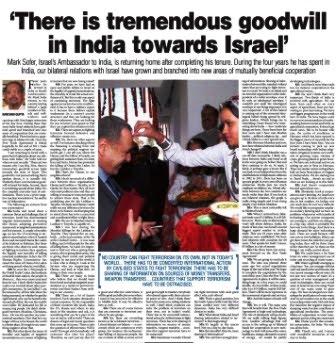
Mark Sofer, Israel’s Ambassador to India, is returning home after completing his tenure. During the four years he has spent in India, our bilateral relations with Israel have grown and branched into new areas of mutually beneficial cooperation

Four years after he arrived in India as Israel’s Ambassador, Mr Mark Sofer returns to his country, leaving behind a large number of friends and well-wishers and carrying with him happy memories of his stay here. During these four years India-Israel relations have gathered speed and branched into new areas of cooperation that are mutually beneficial. There has been a quantum leap in bilateral trade. Once the Free Trade Agreement is inked, hopefully by the end of 2011, trade could treble in a couple of years.

“I am returning to Israel with a great deal of optimism about our relations with India,” Mr Sofer told me when we met recently. “There are two reasons why I say this. First, there is tremendous goodwill across India towards the state of Israel. This goodwill is not just something that is spoken about, it is actually felt. Similarly, there is tremendous goodwill in Israel for India. Second, there is something special about India: It is the complete and utter lack of anti-Semitism. There is no a priori negative reaction towards Jews,” he said by way of elaboration.

To read excerpts from my conversation with Mark Sofer, click here.

Saturday, July 09, 2011

RIP, News of the World


But what about our desi media?

When it was launched in London on October 1, 1843, the promoters of News of the World were absolutely clear about what the paper would not be: A dull, high-brow publication meant for the country squire and his fox-hunting mates to pander to their snobbery and pretentious intellectual superiority. The toffs had their The Daily Universal Register which later metamorphosed into The Times and The Sunday Times and other such newspapers that catered to the posh. What was needed was a Sunday tabloid that would connect with the masses, or more specifically, the neo-literate working classes, and fulfil the need to titillate their imagination and their curiosity about salacious details of the personal lives of those who lived the rollicking high life, as well as stuff that the vicar would rant against during his Sunday sermon and admonish his parishioners about, unfailingly reminding them of the Biblical warning that strait is the gate and narrow is the way. If he knew of the tasteless, ale-sodden jokes that were spun around ‘strait’ and ‘narrow’ and which would raise guffaws of crude laughter during drunken revelry at pubs on Sunday evenings, he preferred to ignore them.

Hence was born the News of the World which grew into Britain’s largest-selling Sunday tabloid, flush with more than raunchy tittle-tattle about the rich and idle and the naughty deeds of ‘street walkers’ and ‘immoral women’ with appetites that would shame both Samson and Delilah. And so it remained till its closure today (July 10,2011), a full 168 years after its launch, in circumstances that either the paper or its owner, the redoubtable media baron Rupert Murdoch, could have ever imagined. The tabloid remained true to its creed till the end — News of the World: The Best for News, Showbiz and Sport Exclusives... Just that there was little or nothing of ‘news’ as most people understand the word, and a lot of ‘showbiz’ — who’s sleeping with whom — and ‘sport exclusives’ — what the footballers’ wives have recently been up to while their husbands chased skirts at Chelsea.

Here’s a sample of headlines from the paper showcasing ‘showbiz’: “Broke star Katona is going back to ex Dan Foden”, “Single parent Elizabeth Pearce made history by having the first IVF tot paid for by NHS — but is it right?”, “Birthday pic proves Cheryl’s taken Ash back; She does sexy lap dance for cheating ex-husband before they disappear to hotel room”. And, not to forget the ‘sport exclusive’ for which the paper’s readers presumably eagerly waited for Sunday to dawn, “Cheeky mates show off Lamps’ Chelsea buns; Footie ace’s pals pull down his swimming trunks while on holiday with fiancee Christine”. Sunanda K Datta-Ray, a columnist with this newspaper and my editor at The Statesman, descended from The Englishman and whose pages were used for wrapping fish-and-chips at the annual Calcutta Rowing Club race in an in-your-face display of inverted snobbery every time the ship carrying the month’s copies of The Times was late, had the perfect description for tabloids like the News of the World and the Sun given to servicing the base urges of the lowest common denominator of the British underclass: He would call it tits-and-bums journalism.

Read the rest of this article here, my Sunday column Coffee Break in The Pioneer…

Thursday, July 07, 2011

India awaits NaMo


The juggernaut moves on

The venerable Economist has finally taken note of what is common knowledge in India: Gujarat is racing ahead of the rest of the country. The credit for Gujarat's booming prosperity which has benefited all communities (Muslims included, lest the point be missed or lost in the cacophony of Left-liberal rant)should go to Gujarati entrepreneurship and Chief Minister Narendra Modi's visionary leadership.

Here are two telling excerpts from the report, headlined "India's Guangdong",published in the latest issue of the Economist:


These days Gujarat accounts for 5% of India’s population but 16% of its industrial output and 22% of its exports. Its growth has outpaced India’s (see chart) and it wins accolades from business people. A recent comparison of Indian states by McKinsey, a consultancy, waxed lyrical about Gujarat. It might yet play the role of industrial locomotive for the country, as Guangdong province did for China in the 1990s. There is lots of excited talk about exporters switching from China to India...

Gujarat could be a vision of India’s future, in which manufacturing flourishes, soaking up rural labour. Its economy is expected to grow by double digits, even as India’s rate slows to 7-8% this year...

The Congress, of course, would brush aside the Economist's assessment, insisting 'poverty in an entitlement-driven India is better than prosperity in a entrepreneurship-driven Gujarat'. Recall how the party and its pseudo-secular drum-beaters, among them the Left-liberal intelligentsia and the intellectually bankrupt Delhi Commentariat, once argued that 'corruption is better than BJP' while propping up the Jungle Raj of Laloo Prasad Yadav in Bihar.

I can almost hear Teesta Setalvad and Arundhati Roy ranting -- the first in television studio debates which increasingly look like WWF matches, the second through 10,000-word essays in Outlook and Frontline -- that it's all a Right-wing conspiracy. What would the poor (and I don't mean so literally) sods do if India were to say goodbye to all that is wretched with our economy, and hence our society and polity?

[Narendra Modi at India Today Conclave 2011. Watch 2:44 onwards.]

It's a pity that the Delhi4 are yet to recognise what the world has begun to hail as India's biggest (and only) success story since 2004: NaMo's leadership and its consequent bounty of riches for Gujarat. And reconcile themselves with the reality. But then again, D4's reading habits are restricted to Times of India, possibly Hindustan Times, and Dainik Jagran. These publications provide stimulating fodder for their addled minds.

Meanwhile, our 'economist' Prime Minister should check out the latest issue of the Economist for a reality check on which way is India headed under the NAC's tutelage and which way is Gujarat headed under NaMo's leadership.

[Also see 'Gujarat shows astounding growth in female literacy': NaMo leads from the front to educate the girl child. By Ashiya Parveen.]

Monday, July 04, 2011

Radical Islamism Down Under


Muslims must resist democracy, says Hizb ut Tahrir

The various statements and speeches made at the ‘Uprising in the Muslim World’ conference organised by Hizb ut Tahrir in Sydney on July 3, 2011, provide an insight into the radical Islamist mind that has come to dominate community discourse ever since this year’s ‘Arab Spring’. Clearly, the dislodging of long-time rulers in Tunisia and Egypt, and the effort to squeeze out the Presidents of Syria, Yemen and Libya, are not seen as the first step towards establishing democracy, but the restoration of ‘Khilafat’.

Community leaders aligned with Hizb ut Tahrir spoke on ''The Muslim World in the 20th century: Totalitarian Western oppression'' and ''Western endeavours to frustrate the Islamic revival''. The official statement issued by Hizb ut Tahrir says among others, the following point was ‘established’:

“The Muslim World wants Islam, not secular liberalism. The spin to the contrary is persistent yet hollow. Calls for ‘democracy’ have been misconstrued by some and hijacked by others as being calls for liberal democracy as we know it in the West. They may be such for the small minority of secular elite in the Muslim World, but for the vast majority of Muslims they merely represent calls against dictatorship and for representative and accountable governance. Public opinion in the Muslim World on the role of Islam in society is not a controversial matter at all. All those who are politically active on the grassroots level, as we are across the entire Muslim World, know that the people en masse are in favour of change on the basis of Islam.”

Hizb ut Tahrir is proscribed in Germany for preaching and practising anti-Semitism. Russia declared it a criminal organisation in 1999. The group rejects democracy and urges Muslims in Australia to boycott elections. A similar stance is adopted by the group in Britain.

A perusal of what was said at the Sydney conference will show how utterly wrong the Left-liberal commentariat is in its assessment of the Arab street. But the Left-libbers won’t admit that they have got it all horribly wrong. As is their wont, they will insist that they are right, never mind the evidence to the contrary.

Ironically, it is the Left-liberal intelligentsia’s adoring indulgence of their excesses that has emboldened radical Islamists around the world, including in Australia. The Left-libbers’ urge to rationalise Islamist extremities and justify their outrageous utterances as well as deeds has led us to a situation where we can only watch in horror as the vitriolic campaign of hate of groups like Hizb ut Tahrir gather momentum and gain traction.

Australia is not alien to such provocative Islamist utterances. The former ‘Grand Mufti of Australia’, Sheikh Taj al-din al-Hilali, wanted for inciting terrorism in the country of his origin, Egypt, is given to describing women who do not wear the burqa as “uncovered meat” and blaming them for “enticing rapists”.

On one occasion, while addressing the faithful after Friday prayers at Lakemba Mosque in Sydney, Sheikh Taj al-din al-Hilali rose to the defence of a serial rapist, Bilal Skaf, asserting, “If I come across a crime of rape, kidnap and violation of honour, I would discipline the man and teach him a lesson in morals and I would order the woman to be arrested and jailed for life. Why? Because, if she hadn’t left the meat uncovered, the cat wouldn’t have snatched it... If one puts uncovered meat out on the street or the footpath or the garden or the backyard without a cover, then the cats come and eat it. Is it the fault of the cat or the uncovered meat?”

[Related article: Like 'uncovered meat']

Also see my earlier post: Veil of darkness

Monday, May 30, 2011

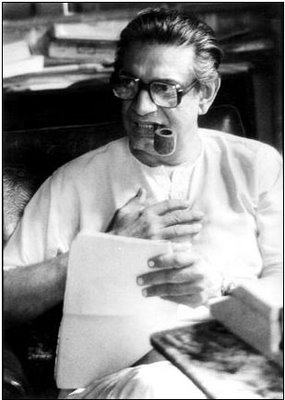
Satyajit Ray, Cinema and Marxism


Years ago I used to regularly write a column for Rediff which would be published under the tag 'Agent Provocateur', from which this Blog derives its name. One of the columns I wrote was headlined "Satyajit Ray, Marxism and my other self". My views on Satyajit Ray and his awesome body of work are likely to have changed since then, but the reason I mention this particular column is because one of the readers of this Blog has posted a message, asking me what do I think about Ray and Marxism, or words to that effect. He may want to read this article!

Saturday, March 19, 2011

Singh is King! Really?


Cash helped him win trust vote!
(A spoof poster that did the rounds after Congress won July 22, 2008 vote.)
The standard operating procedure which Indian politicians follow is tailored for our polity with its ugly underbelly. For instance, a politician’s ‘aide’ could be anyone who facilitates his or her activities in public view or behind the shuttered doors of the bungalows in Lutyens’ Delhi. Pimping for politicians is one of the most lucrative jobs in the nation’s capital and comes without an appointment letter or a paper trail: If things ever go wrong for our cynical politicians, there’s always plausible deniability. That option has been exercised by Captain Satish Sharma who has stoutly denied that he ever had an ‘aide’ called Nachiketa Kapur, leave alone using his services to bribe MPs in the last Lok Sabha to enable the UPA to win the crucial trust vote on July 22, 2008 after the Left withdrew its support over the India-US civil nuclear deal.

But neither Capt Sharma nor his party can deny that there was a person called Nachiketa Kapur or that he had access to the inner courtyard of the PWD-built haveli that has come to substitute Bahadur Shah Zafar’s court in amoral, if not grossly immoral, Delhi where issues of ethics are of least concern for those who claim to rule India. That Mr Kapur, whoever he may be, wielded considerable power (without accountability) and was politically well-connected is borne out by the fact that the American Embassy in New Delhi was sufficiently impressed to send him on a junket under the State Department’s ‘I-Vote 2008’ programme as an observer for the US presidential election.

It, therefore, stands to reason that the contents of the ‘Secret’ US Embassy cable of July 17, 2008, filed by its then Charge d’Affaires Steven White, are not without substance. The cable mentions, among other things, how the Congress mobilised funds to buy votes to win the confidence motion and the manner in which the funds were distributed and to whom. The ‘price’ for a ‘Yes’ vote was Rs 10 crore; the political counsellor of the Embassy was shown chests containing between Rs 50 crore and Rs 60 crore to be used for purchasing votes. The cable also mentions Capt Sharma providing details of how he was trying to target MPs within the BJP and its allies, for instance, the Akali Dal. He owed this much to the party which had bailed him out in 15 cases of corruption filed by the CBI.

Senior leaders of the BJP will confirm that during the week before the vote they were desperately scrambling to keep their flock together. The lure of lucre is not easy to overcome. In any event, few MPs wanted an early election -- if that could be avoided and easy money pocketed, where was the harm? Some back-benchers in the BJP had begun to question the wisdom of opposing the nuclear deal as a cover for their imminent act of disloyalty. The Akali Dal, not too sure of preventing its MPs from straying, wondered whether opposing the deal was the right move as there was a large Sikh community in the US and they wouldn’t take kindly to America-bashing. It may sound laughable in retrospect, but that’s exactly what was conveyed to the BJP. The BJP’s apprehensions came true when cash was actually handed over to some of its MPs by an ‘aide’ of Mr Amar Singh, who had also offered his services and resources to prop up the UPA regime.

Political parties are known to try till the last minute to avoid a mid-term exit from power. The NDA Government would not have fallen by a single vote in 1999 if its political managers had been alert to the Congress’s strategy of getting Mr Giridhar Gomango to participate in the voting despite his having taken charge as Chief Minister of Odisha. He still remained a member of the Lok Sabha and exercised his privilege, although it was both immoral and unethical to do so. Nor should we forget that JMM MPs were bribed to ensure the survival of the Government headed by PV Narasimha Rao. Such subversion of the ethical foundations of democracy comes naturally to the Congress.

That said, two points should bother us more than anything else. First, the Americans had a remarkably accurate sense of the voting pattern five days before the vote. According to their estimate, there would be 273 votes in favour and 251 ahttp://www.blogger.com/img/blank.gifgainst the trust motion, with 19 abstentions. After the vote, the tally stood at 275 votes in favour and 256 against the motion, with 10 abstentions. Who briefed the US Embassy? Second, Prime Minister Manmohan Singh was all smiles when he was greeted with cheers of “Singh is King” after he won the vote. The king today looks no different from the emperor without clothes.

(This appeared as my column in DNA.)