Showing posts with label Israel. Show all posts

Wednesday, September 14, 2011

PLO pushes for judenrein


Fresh crisis brewing!
Back to the past in West Asia?


West Asia could be rapidly hurtling towards a fresh spell of violent upheaval centred around Israel whose impact would be felt in far corners of the world.

Among the manufactured grievances cited in justification of jihadi terrorism is the ‘Palestinian issue’ – any recrudescence of violence in the Palestinian territories of the Gaza Strip and the West Bank on account of belligerent brinkmanship in the name of statehood would be seized upon by Islamists of all shades in all countries.

The attack on the Embassy of Israel in Cairo which resulted in the Israeli Ambassador and other diplomatic staff of the mission being evacuated and flown to Israel was a precursor to the unfolding drama at the UN whose General Assembly begins its annual session on September 19.

The PLO is pushing for recognition as a full member state by the UN with Turkey furiously lobbying support for the move. This could be Turkey’s Islamist Prime Minister Recep Tayyip Erdoğan’s moment to seize the leadership of West Asia which till now rested with Egypt and Saudi Arabia.

Erdogan has lashed out at Israel at the Arab League, choosing to remain silent about the upheaval and its brutal suppression in Syria. If Erdogan succeeds, it would stymie Shia Iran’s efforts to emerge as the leader of Sunni Arabia.

Either way, Arabs seem to be surrendering the right to decide their destiny to the Turks and the Iranians. Meanwhile, the space for American intervention is disappearing rapidly.

Israel is understandably keen to prevent the PLO from going ahead with its move to secure the General Assembly’s recognition as a full state. Such unilateral declaration, if it were to happen, would kill all chances of a negotiated settlement and fan Palestinian adventurism, leading to both sides taking absolutist positions.

That’s undesirable.

A last minute attempt by the Americans to resolve the emerging crisis is unlikely to succeed. The Palestinians are apparently playing for broke.

The PLO’s Ambassador to the UN has gone to the extent of outlining the main feature of the proposed ‘Palestine’: It would not allow any Jew within its territory, making it the first state to officially prohibit Jews since Hitler ordered Germany to be cleansed of Jews and made judenrein.

A flicker of hope of averting a full-blown crisis with global ramifications was offered on Wednesday by Palestinian Authority President Mahmoud Abbas who is said to have reiterated terms for resuming the negotiations that have remained stalled since last year on account of Jewish settlers persisting with building new settlements in the West Bank.

According to the Jerusalem Post:
The Palestinian Authority will agree to return to peace negotiations with Israel if only one of two criteria they had previously set as pre-conditions for talks are reached: An immediate halt to all settlement construction or an Israeli declaration that the borders of the Palestinian state will be based on the pre-1967 lines with mutually agreed upon land swaps, a senior aide to PA President Mahmoud Abbas told Army Radio on Wednesday.
Will Israel, which has demonstrated wisdom in the face of Islamist belligerence in Egypt and declared that it remains committed to the Israel-Egypt Peace Accord, rise to the occasion and reach out to Abu Mazen? He still remains the best bet for achieving long-term peace through a negotiated settlement of a dispute that has festered too long and which needs to be prevented from being hijacked by Turkish and Iranian carpetbaggers.

Thursday, August 25, 2011

Palestinian Ambassador to India hails terrorists


Killers praised as 'shahids'!

Palestinian terrorists, armed with rifles and bombs, carried out a series of coordinated attacks last Thursday (August 18) near the southern Israeli city of Eilat, on the country’s border with Egypt, killing six civilians, a soldier and a security officer. More than 30 Israelis were injured in the attacks. [Video] It now transpires that three of the terrorists may have been Egyptians.

The terrorists shot at a bus and two cars, and targetted a military patrol with bombs. A suicide-bomber blew up a bus, killing the driver and himself. Israeli Army personnel took on the terrorists, killing seven of them.

In a swift (and admirable) retaliatory response, the IDF targetted leaders of the Popular Resistance Committees, responsible for the terror attacks. In the targeted airstrikes, five members of this terrorist organisation were killed in Gaza. Among those killed is Ismail Asmar of Rafiah in the Gaza Strip, a 'senior commander' in the Islamic Jihad, who financed and planned the terrorist attacks in Eilat. Unfortunately, collateral damage included a child who died.

The following day, on August 19, the Palestinian National Authority Ambassador to India, Adli Sadeq, wrote an article in Al-Hayat al-Jadida, the official daily newspaper of the PNA, praising the terrorists and hailing their attacks on Israeli civilians. The article was published with the headline: “A great operation, regardless of anything”.

In that article, Adli Sadeq writes:

"May Allah have mercy upon the shahids (martyrs) who fell during Ramadan, those of them who went out to confront the occupation forces and did not return, and those of them who were bombed in the home of Khaled Shaath (commander of the Popular Resistance Committees unit manufacturing rockets and bombs) and died a shahid's death... What happened yesterday (August 18) may be considered one of the most successful infiltration operations, for it is clear that the preparation of the routes for the men to reach their target was done some time ago, took much time, and required great effort. What this means is that this was a quality operation that will be difficult to repeat.”

[Al-Hayat Al-Jadida, August 19, 2011]

There are three issues for consideration.

First, the praise that Adli Sadeq has showered on the Popular Resistance Committees terrorists and the honour he has bestowed upon killers of innocent civilians is remarkably similar to the praise that is showered routinely by Lashkar-e-Tayyeba, Jaish-e-Mohammed, Tehrik-e-Taliban Pakistan, Taliban, Al Qaeda, and other similar terrorist organisations on their killers and the honour that they bestow upon their ‘shahids’.

Second, the Ministry of External Affairs, indeed, the Government of India, should not only take serious note of the statement endorsing terrorism by an accredited Ambassador based in New Delhi who enjoys diplomatic privileges and immunity but also summon him for an explanation before declaring him persona non grata. Not to do so would be tantamount to the Government of India shutting its eyes and ears to incitement of terrorism from Indian soil.

Third, as is the wont of our Left-liberal commentariat which dominates media and controls content, it has blithely glossed over Adli Sadeq’s statement. Is this simply because the perpetrators of these terror attacks were Muslims and their victims were Jews? Do our commentariat and the media it dominates find it politically incorrect to call out killers of civilians who happen to be Muslims?

Responses to all three points raised here are welcome.


Do also read Egypt’s Brotherhood Declares War on the Bikini: What the 'Revolution' really means.
"More zealous Muslims demand cover-up of pharaonic monuments, too

Sunbathing in Alexandria may soon be a thing of the past, at least if some Egyptian Islamist politicians have their way.

Egypt's tourism industry has suffered a severe blow since the outburst of anti-regime demonstrations in January. But that did not stop the Freedom and Justice Party, the political wing of the Muslim Brotherhood, from demanding stricter regulations over what tourists can do and wear while visiting the country. The party is urging officials to ban skimpy swimwear and the consumption of alcohol on Egyptian streets..."


My column Coffee Break on Israel, India and terrorism makes the point What tiny Israel can, giant India can't!

Tuesday, July 12, 2011

Upswing in relations with Israel


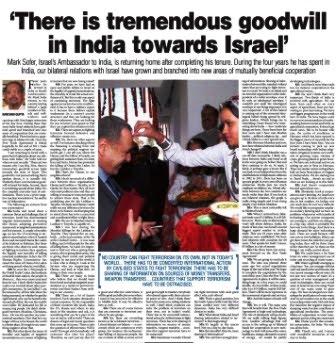
Mark Sofer, Israel’s Ambassador to India, is returning home after completing his tenure. During the four years he has spent in India, our bilateral relations with Israel have grown and branched into new areas of mutually beneficial cooperation

Four years after he arrived in India as Israel’s Ambassador, Mr Mark Sofer returns to his country, leaving behind a large number of friends and well-wishers and carrying with him happy memories of his stay here. During these four years India-Israel relations have gathered speed and branched into new areas of cooperation that are mutually beneficial. There has been a quantum leap in bilateral trade. Once the Free Trade Agreement is inked, hopefully by the end of 2011, trade could treble in a couple of years.

“I am returning to Israel with a great deal of optimism about our relations with India,” Mr Sofer told me when we met recently. “There are two reasons why I say this. First, there is tremendous goodwill across India towards the state of Israel. This goodwill is not just something that is spoken about, it is actually felt. Similarly, there is tremendous goodwill in Israel for India. Second, there is something special about India: It is the complete and utter lack of anti-Semitism. There is no a priori negative reaction towards Jews,” he said by way of elaboration.

To read excerpts from my conversation with Mark Sofer, click here.

Tuesday, June 08, 2010

On Israel, India plays Boy Scout


India has violated Sri Lanka's sovereignty to 'help' Tamils!
India has blockaded Nepal to 'teach Kathmandu a lesson'!
India votes with OIC countries; OIC countries votes against India!


It was the summer of 1987 and passions were running high in Tamil Nadu over the Sri Lankan Government’s decision to impose a blockade on Jaffna peninsula, which was the stronghold of the Liberation Tigers of Tamil Eelam. Colombo believed that it could force a breach between the Tamils of Jaffna and the LTTE by using coercive, non-military measures like an economic blockade: Starving masses would any day settle for food over homeland.

It didn’t quite work that way. The LTTE was in those days a fearsome fighting force and the civilian patrons of the Tigers were sufficiently impressed by V Prabhakaran’s machismo to begin believing in the balderdash about how Tamils constitute a separate nation and should not hesitate to pay any price for a Tamil Eelam. The LTTE demanded that the people of Jaffna should simply grin and bear the hunger and hardship caused by the blockade; the masses had no option but to concur.

Soon, the Tamils in India were seething with anger, as were their leaders with both AIADMK and DMK trying to outdo each other in ‘standing by’ their brethren in Jaffna. They demanded immediate intervention by India to ‘liberate’ Jaffna from the ‘clutches’ of Colombo. Rajiv Gandhi, who was then Prime Minister, was not particularly bothered about the deprivations forced on Jaffna’s Tamils by the blockade, but he was in a rage: How could Colombo thumb its nose at New Delhi in so blatant a manner in the middle of peace negotiations?

It was not possible to send an Indian armada across the Palk Strait, but Rajiv Gandhi did what he (or his advisers) thought was the next best thing: Indian planes were despatched to drop food packets over Jaffna. Six AN-32 aircraft made repeated sorties from Chennai to Jaffna, dropped food packets, and returned to base. Ostensibly, New Delhi was determined to showcase its human face in the neighbourhood. Of course, it’s another story that the same Rajiv Gandhi had ordered a virtual economic blockade of Nepal by closing all except one border crossing with Nepal to force Kathmandu to fall in line with New Delhi.

On spotting the AN-32 over Jaffna, it was Colombo’s turn to feel outraged: Its airspace had been violated with impunity by India. Nor were the Tamils of Jaffna pleased. This was no aid but mere scoring of political points. The subsequent India-Sri Lanka Accord and the disastrous Indian peace-keeping expedition are now footnotes of history.

Years later, Pakistan decided to repeat that act of Indian belligerence, albeit with a twist. It encouraged various Government-sponsored pro-azadi organisations based in Pakistan-occupied Kashmir to organise a long march to Srinagar. The idea was to create a spectacle of hundreds of thousands of men, women and children rushing through the Line of Control, leaving Indian security forces nonplussed: They couldn’t possibly shoot at civilians in such large numbers. Mediapersons from around the world gathered for the event as PV Narasimha Rao went into a tizzy, desperately trying to ward off a showdown. In the end, Mr Nawaz Sharif panicked (some say after a harsh telephone call from the White House prompted by Rao pleading with the Americans) and the Pakistani Rangers didn’t allow the ‘freedom marchers’ to proceed beyond Muzaffarabad.

The point is that India is the last country which should feel compelled to criticise Israel’s use of force to prevent the so-called ‘Freedom Flotilla’ led by a Turkish ship from breaching the naval blockade of Gaza. Having violated a similar blockade in another country and paid a terrible price for that folly, and also having enforced a pernicious blockade on Nepal which caused enormous and lasting damage to bilateral relations, and, last but not least, having scurried to the Americans for their help to stall a ‘Freedom March’ from Pakistan-occupied Kashmir to Srinagar, it ill behoves us to issue a denunciatory statement even before the full facts of what happened on the sea off the coast of Gaza were known. Had those who drafted the statement admonishing India bothered to watch the videotapes of the Israeli raid on the flotilla, they would have desisted from formally issuing it.

[Text of statement on 'incident involving boats carrying supplies for Gaza' issued by Ministry of External Affairs on May 31, 2010:

India deplores the tragic loss of life and the reports of killings and injuries to people on the boats carrying supplies for Gaza. There can be no justification for such indiscriminate use of force, which we condemn. We extend our sympathies to the families of the dead and wounded. It is our firm conviction that lasting peace and security in the region can be achieved only through peaceful dialogue and not through use of force.
New Delhi.]

It is amazing that we have not yet learned a lesson from voting blindly with the block of Organisation of Islamic Conference countries at all international and multilateral fora every time they have chosen to denounce Israel. This has not fetched India any benefits, diplomatic or otherwise. Nor has it stopped the OIC from adopting anti-India resolutions and repudiating India’s sovereign right over Jammu & Kashmir.

We can vote against Iran at the IAEA to please America (it would have been an entirely defensible and justifiable decision had New Delhi voted against Tehran on its own and not at Washington’s behest) but we can’t refuse to vote against Israel bearing in mind our national interest? Must we forget that Israel came to India’s help at a moment of national crisis when we urgently needed battlefield hardware during the Kargil incursion by Pakistani soldiers? More importantly, must we remain captive to vacuous political posturing of the past when it was fashionable to align with the Arabs against the Jewish state?

By rushing into criticising Israel, we may think we have scored brownie points with Turkey, which has recalled its Ambassador to Tel Aviv and threatened to snap six decades of diplomatic relations, but such expectations are entirely misplaced. The Islamist AKP regime in Ankara has made it abundantly clear that its sympathies lie with Islamabad and not New Delhi on a host of issues, especially the future role of Pakistan and India in Afghanistan; that it will facilitate Tehran’s bomb-in-the-basement programme through subterfuge and sleight of hand and, that it sees itself as the new centre of Islamic politics and Islamist revanchism.

If anything, India looks as silly as Nicaragua and South Africa — the first is trying to rediscover Left radicalism in a world that cruelly mocks at the Left; the second is blessed with a succession of Muslim Deputy Foreign Ministers who abuse Israel to satiate their lust for anti-Semitism. As if that were not enough, we have been bracketed with China which amazingly lectured Israel on the need to be mindful about safeguarding human rights. We could, of course, compare our hypocrisy with that of Britain which earlier this year expelled an Israeli diplomat over the targeted killing of a Hamas terrorist in Dubai. Few know that sanctimonious Britain provides caring shelter to Islamists wanted for horrible crimes around the world.

[This appeared as my weekly column Coffee Break in The Pioneer on June 6, 2010.]

Tuesday, June 01, 2010

Israel takes on bogus crusade


What's Turkey's Islamist AKP regime playing at?

It is laughable to hear the Prime Minister of Turkey describe Monday’s raid by Israeli commandoes on the so-called ‘Freedom Flotilla’ in which nine ‘peace activists’ -- eight Turks and an American of Turkish origin -- were killed as a “bloody massacre”. If the death of eight Turks who set upon the Israeli commandoes with knives and clubs, and shot at them after seizing their pistols, is a “bloody massacre”, then the chilling atrocities committed on Armenians by Turks surely amount to the genocide which they are described as but persistently denied by Turkey.

Let us not forget that the Armenian Genocide witnessed little girls being snatched from their mothers’ arms, dragged to the streets, raped and left to bleed to death; that young and old, men and women, were despatched to horrific deaths; that Armenian property was looted and what could not be stolen was set on fire; and, that tens of thousands were disinherited of their nationality and forced to seek shelter in alien lands. And all this happened without Turkish authorities lifting so much as a finger in admonishment.
Neither should we forget that till date Turkey has not owned up to that crime against its own people and against humanity, nor has it allowed others to recognise the massacre and worse for what it was. So much so, US President Barack Hussein Obama, who has sought a full report on the raid on the ‘Freedom Flotilla’ from Israeli Prime Minister Benjamin Netanyahu “ASAP”, chose not to use the word ‘genocide’ in his message on the 95th anniversary of the Armenian Genocide after promising to do so, presumably because he was mindful of Turkish sentiments.

Therefore, we really need not be distracted by the official reaction of Turkey which, apart from indulging in fiery rhetoric denouncing Israel and allowing thousands of Islamists to march on the Israeli Embassy in Ankara, has recalled its Ambassador to Tel Aviv. This could be Turkey’s first step towards snapping diplomatic ties with Israel, a country with which it has had cordial relations for six decades. It is Turkey’s sovereign right to decide how it conducts its foreign policy, as much as it is Israel’s right to decide how it responds to what is clearly a blatant Turkish provocation inspired by the ruling Justice and Development Party, or AKP, which is increasingly veering towards assertive Islamism for reasons which I shall dwell upon later. First, a brief account of what happened on Monday and who is responsible for what Turkey has so colourfully described as a “bloody massacre”.

The ‘Freedom Flotilla’, a convoy of six ships of varying sizes, led by the Turkish-flagged Mavi Marmara, had set sail for the coast of Gaza, ostensibly carrying “urgently required relief material for impoverished Palestinians” living in the blockaded territory. The three-year-old blockade of Gaza Strip is being enforced by two countries, Israel and Egypt, for different though inter-linked reasons. Israel has imposed its blockade, including maritime blockade off the coast of Gaza, because it is currently in a “state of armed conflict” with the Hamas regime which has repeatedly attacked civilian targets in Israel with weapons that have been smuggled in via the sea route and through tunnels connecting the Palestinian territory with Sinai in Egypt. Gaza’s Rafah border crossing with Egypt has also been consistently misused by the Hamas militia for smuggling in arms, ammunition and explosive material. Egypt, which has a peace agreement with Israel and whose President Hosni Mubarak is not enamoured of either the Muslim Brotherhood, which is the progenitor of Hamas, or the Islamists who dream of Hamastan instead of Palestine, has not only closed the Rafah crossing but is also building a steel-and-concrete underground wall to prevent tunnels from being dug. The blockade of Gaza Strip, really, is in effect a joint Jewish-Arab enterprise. We could endlessly quibble over the details, but that would not change the reality on the ground.

The ‘Freedom Flotilla’ was ostensibly organised by the ‘Free Gaza Movement’, which claims the 1.5 million Palestinians of Gaza Strip are living in abject poverty on account of the blockade. Israel says food, medicines, fuel and all civilian goods are allowed to pass through the blockade and tales of suffering, impoverished Palestinians are either sheer propaganda meant to generate support for Hamas or exaggerated to paint Jews as the persecutors of helpless Arabs, put countries otherwise favourably disposed towards Israel on a guilt trip, and keep the mills of anti-Zionism grinding in Arabia and beyond. What is true is that Israel has prohibited the supply of material which can be used for building tunnels and fashioning improvised rockets that are regularly fired by the Hamas militia.

The tenuous ceasefire that followed ‘Operation Cast Lead’ has held, but there’s nothing permanent about it as Hamas considers it no more than a hudna, to be used for regrouping and rearming its forces before launching fresh attacks. Israeli authorities had repeatedly requested the ‘Freedom Flotilla’ organisers to hand over its ‘relief supplies’ for inspection before being despatched to Gaza Strip and not to attempt reaching the Gaza coast. The organisers refused to either allow an inspection of the cargo or to hand it over to the relevant Israeli authorities.

That’s understandable, because the purpose behind the ‘Freedom Flotilla’ was not to help the poor and the famished of Gaza Strip, but make a political statement that would find a resonance around the world, forcing Governments and people to lend their voice to a ‘moral crusade’ while ignoring Israel’s national security imperatives. The media chose to romanticise the ‘Freedom Flotilla’, sensing a soft story that would tug at the heartstrings of newspaper readers and television viewers, instead of raising relevant questions about the entire dubious exercise and exposing the real organiser of the flotilla, the Turkish Insani Yardim Vakfi, or IHH, an Islamic charity with a radical anti-Western orientation. There is sufficient documentation to prove that beyond its legitimate philanthropic activities, the IHH provides extensive support to radical Islamist organisations, including Hamas, and that in the past it has maintained contacts with and provided support to global jihad organisations.

Given these facts about those behind the ‘Freedom Flotilla’ and its dubious cargo of material to help Hamas build tunnels and produce improvised rockets, Israel was within its rights under international law to stop the ships in international waters as the purpose behind the ‘moral crusade’ was to undermine Israel’s sovereignty. Israel had two options: Either score cheap brownie points by retreating before bogus ‘moral crusaders’, or court equally bogus international opprobrium by protecting its national interest. It chose the latter, which, we in India with an effete Government must concede, requires a lot of gumption.

This brings us back to the enraged reaction of Turkey, more specifically of the AKP regime in Ankara, to Monday’s unfortunate incident provoked by the belligerence of the so-called peace activists, among them a crew of Al Jazeera and a Pakistani television anchor, on board the Turkish ship Mavi Marmara. A recent poll suggests a dramatic shift in Turkish public opinion with the Left-secular Republican People’s Party, or CHP, surging ahead of the Islamist AKP. The CHP is now seen to be commanding 33 per cent of the vote, compared to 31 per cent for the AKP. The Right-wing Turkish nationalist MHP stands third with 19 per cent of the vote. The next election is scheduled for 2011, but the AKP, according to reports, has been toying with the idea of calling an early poll rather than risk a worsening economic situation. In such a scenario, what better way for the AKP to shore up its electoral fortunes than by painting Jews as villains guilty of “bloody massacre” of Turks and by extension Muslims? Other Islamist regimes have played this game successfully, so why not the AKP regime?

[This appeared as the main Edit Page article in The Pioneer on June 2, 2010.]

Wednesday, March 10, 2010

Spoof on Dubai assassination as marketing tactic!


Israeli actors mimic scenes in the surveillance footage from the Hamas assassination in Dubai for a supermarket commercial in Petah Tikva, central Israel, Wednesday, March 10, 2010. An Israeli supermarket commercial is looking to cash in on the infamous surveillance footage of an assassination team killing a Hamas commander in Dubai. A new TV campaign for the 'Mahsaney Kimat Hinam' supermarket chain shows actors wearing wigs and hats and carrying tennis rackets as they make their way through store aisles.

By IAN DEITCH

JERUSALEM – An Israeli supermarket on Wednesday looked to to cash in on the infamous surveillance camera footage showing suspected assassins stalking a Hamas operative in Dubai with a new advertising campaign.

The commercials for the "Mahsaney Kimat Hinam" supermarket chain shows actors carrying tennis rackets, and wearing hats, glasses and wigs — the same disguises worn by the alleged killers — as they make their way through store aisles.

"We offer killer prices," announced the advertisement's tagline.

Advertising executive Sefi Shaked says the campaign was inspired by footage released by Dubai police that allegedly shows the disguised killers prowling the halls of the posh hotel where Hamas commander Mahmoud Al-Mabhouh was slain on Jan. 19.

Israel's Mossad spy agency is widely suspected in the killing.

"It's a funny take of this event," Shaked said. "We were fascinated by the technique of using surveillance cameras instead of (expensive) high production commercial cameras, and the latest events in Dubai gave us a great opportunity."

An actor wearing a tennis outfit like the one seen in the Dubai footage browses the frozen food section. An actress wearing a wide-brimmed floppy hat mimicks Israel's policy of neither confirming or denying involvement in the assassination, saying she "couldn't admit to anything."

Dubai has accused Israel of carrying out the killing, an allegation strengthened by the fact that many of the forged European passports used in the operation bear the names and details of dual nationals living in Israel. Several European countries whose nationals' passports were used have summoned Israel's ambassadors for an explanation and have sent investigators to Israel.

Israel says al-Mabhouh was a key figure in smuggling weapons to anti-Israel militants in the Hamas-run Gaza Strip.

The commercials are expected to air in time for the upcoming Passover holiday season starting at the end of March.

Saturday, February 27, 2010

How legitimate are targeted killings?


What is a legitimate killing? And what makes a killing illegitimate? On the face of it, these are not difficult questions to answer. Those who take an absolutist position on right to life would argue that any killing is illegitimate. On the other end of the absolutist spectrum are those who would insist that when the state kills, no matter what the reason, it is legitimate; when individuals kill, unless they do so in self-defence, it is illegitimate. Then there are those who would cite the law to justify certain killings — for instance, killing enemy soldiers on the battlefield; executing those found guilty of committing capital offences; and, killing criminals who resist arrest or attack the police — but insist that extrajudicial killings by the state or agencies of the state are illegitimate. Human rights activists would strangely argue that while it is legitimate for ‘armed opposition groups’ to resort to violence and even indulge in senseless killings, the state, as the protector of human life and liberty, does not have the right to kill.

Macabre and distasteful as it might be, the debate over what is and is not legitimate killing came up, although fleetingly, during a recent television discussion on Maoist violence. The human rights activists who were present in the studio were most emphatic in asserting that the state, in this case represented by security forces, has no right to kill even if those who are targeted are known to have indulged in killing innocent people and policemen or, unless put down, can be expected to shed human blood in the future. Of course, this is an absurd proposition. If it is the state’s responsibility to ensure the security of its citizens, then it is equally its responsibility to take any measure that it may deem fit to protect them from marauders.

The argument proffered by human rights activists is fallacious for a second reason. Implicit in what they say is the suggestion that men and women in uniform (whether of the police or the military) are fair targets for ‘armed opposition groups’ — or ‘gunmen’, as terrorists are referred to by politically correct sections of ‘civil society’ — since they represent the state and hence the ‘enemy’. As if that robs them of the right to life which, for everybody else, is considered inviolable. This is not only chillingly callous, but also downright sinister. Thankfully, in real life it doesn’t quite work that way.

The reason why I have raised this issue is not to discuss whether it is right or wrong to adopt tough measures against Maoists; that’s a settled point and little or no purpose is served by endlessly debating it. Maoists must be crushed with minimum, if at all any, collateral damage. But we need to look beyond what has come to be accepted as the normal, textbook response to terrorism, never mind the shade of terror, which could range from shimmering green to dazzling red. Must the state entirely depend on ‘massive deployment’ of security forces? Should action be always visible to the people? Or has the time come to consider the adoption of strategic responses, for instance targeted killings, which could be more effective and virtually rule out the possibility of collateral damage?

After all, if the top leaders of an insurgency, Islamist or Maoist, were to be neutralised through surgical strikes, there would be disarray and demoralisation in the ranks and the cadre, no matter how motivated, would feel deterred from persisting with the ‘cause’. The Liberation Tigers of Tamil Eeelam did not become extinct because fighters were killed in scores if not hundreds. The LTTE became history only after its top leadership was annihilated. Till the moment the Sri Lankan Government released photographs of V Prabhakaran’s lifeless body, the Tigers fought back fiercely. Similarly, in Punjab the guns fell silent after the top leaders of the Khalistani insurgency were methodically neutralised. Perhaps far fewer lives would have been lost had this approach been adopted in the early days of separatist violence in Punjab — and in Jammu & Kashmir.

These thoughts come to mind while reading about the targeted killing of Hamas’s top military commander Mahmoud Al Mabhouh in Dubai on January 20 and subsequent investigations by the emirate’s police. The Government of Israel has refused to comment on what is widely perceived to have been a Mossad operation. No other organisation could have carried out such a daring and flawless execution, that too on hostile territory. If details pieced together from closed-circuit television camera footage collated from various spots and released by the authorities of Dubai are to be believed, a group of men and women travelled from foreign destinations on forged passports a day before Mabhouh arrived in the emirate. Apparently, he had come to Dubai to meet someone who had offered to sell arms to Hamas. It may have been a trap set up by his assassins who tracked their quarry to his hotel room and killed him before he could raise an alarm. Their mission accomplished, the assassins flew out of Dubai the same afternoon.

It could be argued that Mabhouh’s assassination will not lead to the collapse of Hamas or end its rule of terror in Gaza, just as ‘Operation Wrath of God’ and ‘Operation Spring of Youth’ did not result in the destruction of the PLO, although they did serve to revive and reinforce the fear of Gideon in rage. Mabhouh is not the first Hamas leader to be killed. Salah Shahade was assassinated in 2002; Sheikh Ahmed Yassin, a wheelchair-bound quadriplegic who would remorselessly direct suicide bombers to murder Israeli civilians, was killed in March 2004; within a month, Sheikh Yassin’s successor, Abdel Aziz Al Rantissi, was assassinated; and, in October that year, another senior Hamas leader, Adnan Al Ghoul, was put down. Hamas was no doubt shaken, but not necessarily deterred, or else there would have been no need for ‘Operation Cast Lead’. Although, the killing of Nizar Rayyan on January 1, 2009, during the Gaza raid did result in a hudna which is still holding.

Was Mabhouh despatched before he could acquire sufficient weapons for Hamas to break the truce and launch a fresh attack on Israel? Will his killing revive the fear of Gideon the righteous destroyer and reinforce the idea of Israel as a mighty warrior? Whatever the answer, the utility of targeted killing of terrorists — we need not go into the morality or legality of such counter-insurgency measures since terrorism is neither morally right nor a legal expression of dissent — is demonstrated by the fact that Israel has survived six decades of relentless and fierce hostility without ever feeling the need to capitulate before its enemies.

PS: Ever since Mabhouh’s assassination, there has been a phenomenal increase in the demand for custom-made T-shirts emblazoned with Mossad’s logo sold by an Israeli firm. Orders have been pouring in from countries across the world, including, hold your breath, India.

[This appeared as my Sunday column Coffee Break in The Pioneer on February 28, 2010]

Tuesday, January 01, 2008

Interventionism as policy


Kanchan Gupta / Essay / November-December, 2008.

Part I

US President Barack Hussein Obama’s utterances on Jammu & Kashmir, indicating that the so-called ‘Kashmir issue’ will figure on the agenda of his Administration, just as it featured on the ‘To Do’ list of Mr Bill Clinton during his first term as President, have raised more than eyebrows in India. To his credit, President George W Bush had steered clear of the ‘Kashmir issue’; he snubbed Pakistan each time it tried to push for a revival of American interventionism, insisting that Islamabad had to deal directly with New Delhi. Even Gen Colin Powell, with his pronounced pro-Pakistan bias, could not get Mr Bush to change his view and send in Nosy Parkers from the State Department to play their insidious games. Recall a busybody called Ms Robin Raphael whom Mr Clinton promoted during his first presidential term to ‘solve’ the ‘Kashmir issue’. She used the opportunity to forge the All-Party Hurriyat Conference with disastrous consequences in Jammu & Kashmir, and colluded with Benazir Bhutto to create the monster called Taliban in the hope Mullah Mohammed Omar would look after Unocal’s business interests.
With the shadow of American interventionism as policy looming large, it would be instructive to scan the past, if only to figure out the genesis of the West’s proclivity to interfere in an issue that neither impacts it directly nor does it understand entirely. Interestingly, much before the US decided to get into the act, it was the UK which manipulated events in a manner that whetted Washington’s appetite. Equally interesting is the reason that shaped Anglo-American perception and policy on Jammu & Kashmir, which does not figure in much of the discourse on this issue but has been presented in great detail by former diplomat C Dasgupta in his path-breaking book, War and Diplomacy in Kashmir — 1947-48.
First, some bare facts. Maharaja Hari Singh signed the Instrument of Accession on October 26, 1947, making Jammu & Kashmir an integral part of India. Simultaneously, Indian forces were airlifted to Srinagar to evict the Pakistani invaders and establish India’s sovereignty over its territory. The accession was — and remains — entirely valid in terms of the Government of India Act of 1935 and India Independence Act of 1947; it is total and irrevocable in international law. Speaking in the UN Security Council on February 4, 1948, the US representative, Warren Austen, said: “The external sovereignty of Kashmir is no longer under the control of the Maharaja... with the accession of Jammu & Kashmir to India, this foreign sovereignty went over to India and is exercised by India and that is why India happens to be here (at the UNSC) as a petitioner...”.
India went to the UN in good faith after Pakistan refused to vacate territory occupied by its armed raiders. In its formal reference, lodged with the Security Council on January 1, 1948 under Article 35 of the UN Charter, which permits member states to bring any situation whose continuance is likely to endanger international peace and security to the attention of the Security Council, India asserted: “Such a situation now exists between India and Pakistan owing to the aid which invaders, consisting of nationals of Pakistan and of tribesmen from the territory immediately adjoining Pakistan on the North-West, are drawing from Pakistan for operations against Jammu & Kashmir, a State which has acceded to the Dominion of India and is part of India... The Government of India request the Security Council to call upon Pakistan to put an end immediately to the giving of such assistance which is an act of aggression against India.”
In the reference, India also asserted its right, under international law, to self-defence by initiating military action against Pakistan by way of what is today termed as ‘hot pursuit’: “In order that the objective of expelling the invader from Indian territory and preventing him from launching fresh attacks should be quickly achieved, Indian troops would have to enter Pakistan territory...”.
In addition to the five permanent members, the UNSC in 1948 had Argentina, Belgium, Canada, Colombia, Syria and Ukraine as non-permanent members. The instant reaction of the UNSC was to issue a Presidential Statement on January 6, 1948, making an “urgent appeal (to India and Pakistan) to refrain from any step incompatible with the (UN) Charter and liable to result in an aggravation of the situation”. This was followed by Resolution 38 on January 17, 1948, reiterating the Presidential Statement and requesting both countries to immediately report to the Security Council any material change in the situation.
Across the Atlantic, the Commonwealth Relations Office entered the picture at this point, formulating a political perspective that came to greatly influence the Security Council’s subsequent handling of the ‘Kashmir issue’, at least up to the formation of the UN Commission for India and Pakistan. The CRO’s perspective was rooted, and strangely so, in the British Foreign Office assessment of the emerging political crisis in West Asia. Britain in those days stood accused by Arabs (and their sympathisers in Europe and the US) of having abjectly failed in its Mandate over Palestine as it had been unable to control the immigration of Jews. Britain was also seen as having failed in its responsibility to prevent or contain the outbreak of what was then referred to as ‘civil war’ (which still continues to rage between Palestinians and Israelis).
Britain took the Palestine issue to the UN in April 1947 and announced its decision to abandon its mandate by May 1948. The UN General Assembly immediately adopted a Resolution for dividing Palestine into separate Jewish and Arab states, paving the way for Israel’s re-birth as the homeland for Jews in Palestine and the Diaspora. The Arab reaction was vicious, instantaneous and directed in bulk against Britain.

* * *

Part II

After Britain took the Palestine issue to the United Nations in April 1947 and announced its decision to abandon its mandate by May 1948, resulting in the General Assembly adopting a Resolution for the creation of separate Jewish and Arab states, thus unleashing Arab rage against the West, especially the United Kingdom, the British Foreign Office embarked on a duplicitous and dangerous course. It convinced the British Government, struggling to cope with the rapidly changing post-War geopolitical realities, that the only way Britain could contain — and reduce — Arab anger was by adopting a policy on Jammu & Kashmir that would be perceived as weighing in favour of Pakistan, a Muslim state. It believed this would assuage enraged ‘Arab nationalism’ (which the British Foreign Office, to its credit, had the far-sight to recognise as incipient radical Islamism). A second factor that propelled British policy in this direction was Britain’s oil interests that had become crucial in post-War Europe’s search for energy sources that would reduce dependency on coal.
British Foreign Office records, including minutes of discussions approved by Secretary of State for Foreign Affairs Ernest Bevin, substantiate this assessment. For instance, a Foreign Office minute prepared for Prime Minister Clement Attlee said, “The Foreign Secretary has expressed anxiety lest we should appear to be siding with India in the dispute between India and Pakistan over Kashmir which is now before the United Nations Security Council. With the situation as critical as it is in Palestine, Mr Bevin feels that we must be very careful to guard against the danger of aligning the whole of Islam against us, which might be the case were Pakistan to obtain a false impression of our attitude in the Security Council.” If six decades ago the Attlee Cabinet was keen to appease Islamists by short-changing India on Jammu & Kashmir, Mr Barack Hussein Obama’s Administration may be tempted to do something similar to establish its credentials in the Islamic world since it won’t dare to push around Israel.
Interestingly, Louis Mountbatten, who had played no small role in steering the Jammu & Kashmir issue to the Security Council, found the British Foreign Office policy harmful to larger Commonwealth interests. In one of his reports he recorded: “Everybody here (in India) is now convinced that power politics and not impartiality are governing the attitude of the Security Council... Indian leaders counter this (attempts to dispel this conviction) by saying that the Anglo-American Bloc apparently attaches so high a value on the maintenance of Muslim solidarity in the Middle-East that they are even ready to pay the price of driving India out of the Commonwealth into the arms of Russia...”.
Not known for being tolerant of Indian sensitivities, Philip Noel-Baker, the Secretary of State for Commonwealth Relations, was easily persuaded by Bevin’s perspective and he took it upon himself to pro-actively lobby with the US and non-permanent Security Council members to toe a pro-Pakistan line in enforcing a solution to the Jammu & Kashmir issue through a UN-sponsored plebiscite. Noel-Baker had his way with Resolution 39 adopted by the Security Council on January 20, 1948, on the setting up of a three-member UN Commission for India and Pakistan which would visit the two countries, study the ground situation, and report back to the Security Council.
Noel-Baker followed this up by aggressively pushing a draft resolution that was crafted in a manner to favour Pakistan. The US representative was initially hesitant to go along with Noel-Baker’s draft, but was soon won over. Surprisingly, at this stage the Chinese representative came up with an alternative draft that was comparatively more balanced. In a change of tactics, necessitated by his being reprimanded by Attlee who feared ‘irreparable damage’ to relations with India, Noel-Baker seized upon this draft and cunningly had it amended to such an extent that it bore no resemblance with the original draft; the Noel-Baker version of the Chinese draft came to be adopted as Resolution 47 by the Security Council on April 21, 1948.
Resolution 47 set out the terms of reference in two parts. Part One increased the number of members of the UNCIP from three to five (Noel-Baker believed that a larger team would enable a report more in tune with his perspective) and instructed the UNCIP to “proceed at once” in order to “place its good offices and mediation” at the disposal of India and Pakistan with the twin goals of restoring peace and order and holding a plebiscite. Part Two comprised the Security Council’s recommendations to India and Pakistan for achieving these goals:
i. Pakistan should “use its best endeavours” to secure the withdrawal of the raiders (tribesmen and other Pakistani nationals) from Jammu & Kashmir;
ii. India should withdraw its forces and reduce them to the minimum level required for the maintenance of law and order; and,
iii. UNCIP might employ troops of either dominion “subject to the agreement of both the Government of India and the Government of Pakistan”.
Pakistan rejected Resolution 47, demanding an amendment that the deployment of Pakistani troops should not be subject to the agreement of the Government of India. The amendment was defeated. India rejected the Resolution on the ground that it was weighed in favour of Pakistan and that it skirted the main issue as contained in India’s reference to the Security Council — that of vacating the Pakistani aggression. India also pointed out that the Security Council had failed to issue a clear call to Pakistan to withdraw the raiders before going into the plebiscite arrangements. However, both India and Pakistan accepted the setting up of the UNCIP and agreed to receive the Commission.
The UNCIP visited India and Pakistan in July 1948. By May 1948, the ground situation had undergone a radical material change with Pakistani Army regulars being deployed in the occupied areas of Jammu & Kashmir. Zafarullah Khan admitted to the UNCIP that Pakistani Army regulars had been deployed since May 1948. This was seen by the UNCIP as a violation of earlier Security Council Resolutions that had insisted on there being no material change in the ground situation.
The UNCIP’s findings and its subsequent Resolutions (of August 13, 1949, and January 5, 1948) were not influenced by Noel-Baker primarily because there was no British representative in the commission. Also, by then India had launched a diplomatic offensive as well as demonstrated its determination to force out the Pakistani invaders militarily. Therefore, the UNCIP reports and Resolutions, unlike the Security Council’s Resolution 47, did not reflect a deliberate pro-Pakistan tilt; recognised that the entry of Pakistani Army into Jammu & Kashmir was a violation of Security Council Resolution 38; demanded that Pakistan must withdraw its forces from Jammu & Kashmir since their presence constituted a “material change in the situation”; and, conceded primacy to a ceasefire based on withdrawal of the invaders.
The rest is history.

Monday, December 03, 2007

West Asia politics


A time for peace in West Asia
Kanchan Gupta

West Asia peace conferences in the past have been big media events with every actor in this strange, never-ending passion play seeking to hog the limelight. From Camp David to Oslo to Tabah, via various other places including the Red Sea resort of Aqaba, the journey to a lasting peace and a final settlement has been extremely rough for both Israelis and Palestinians, with the Americans cheering from the sidelines and the Arabs slyly digging up the road for the vicarious pleasure of watching peace-makers stumble and fall. With media making a big show of earlier peace conferences and television reporters insisting, "History is being made inside those rooms you see behind me," when in reality everybody was just being cussed and cross, great expectations would be generated among the people in a region that has known nothing but conflict for the past six decades. Those expectations would soon be swamped by bitterness and loathing of the other.
Thankfully, the organisers of the Annapolis Conference were careful not to turn it into a media circus; US Secretary of State Condoleezza Rice has demonstrated that she is far smarter than her predecessors and is mindful of realities instead of possibilities. When she had embarked upon her mission to kickstart the stalled West Asia peace talks and thus gift the Bush Administration with a foreign policy success, perhaps she had hoped for something concrete to emerge from the Annapolis confabulations. She worked overtime to ratchet up the working relationship between Palestinian Authority President Mahmoud Abbas and Israeli Prime Minister Ehud Olmert, camping in Jerusalem and visiting Ramallah in the hope of getting the two leaders to agree on a joint statement listing the key areas of broad agreement.
In the event, President George W Bush read out a statement of intent on behalf of Mr Olmert and Mr Abbas who have now agreed to fast forward the peace process for a final settlement by the end of next year. Mr Bush could yet go down in history as the American President who brokered real peace in West Asia and solved a riddle that had tested the intelligence of his predecessors and left them stumped for a solution. Of course, there is no guarantee that Israel and Palestine will have worked out a two-state solution by this time next year. Apart from the proverbial slip between the cup and the lip, there are other imponderables that cannot be wished away.
In the rapidly shifting sands of Arab politics, what is true today can lie buried deep under a sand dune tomorrow. Hence, there is no reason to believe that the Arab endorsement of the Annapolis initiative -- Saudi Arabia's Foreign Minister was seen clapping more than once inside the conference hall and even Syria has grudgingly applauded the outcome -- will be as strong after a few months as it is now. King Abdullah has fashioned, or shall we say forced, a sort of Arab consensus on a durable peace based on the two-state formula by getting the Arab League to accept his pragmatic position at the Riyadh summit. But that does not necessarily mean ever Arab leader has stopped wishing Israel's demise, nor does it suggest that the Arab street is one with the Arab palace on carrying the Annapolis initiative to its logical conclusion.
For the moment, Saudi Arabia, Egypt and Jordan are mightily worried about Iran's expansionist dreams and a belligerent President Mahmoud Ahmadinejad's aggressive agenda of imposing Shia dominance in Sunni Arabia. If Iran is able to achieve a breakthrough in its basement nuclear programme and enrich sufficient plutonium to make a bomb, for which it has already secured the know-how from Pakistan's nuclear black-marketeer AQ Khan, then Mr Ahmadinejad would have the Arabs on the run. Already, with Tehran calling the shots through Iraq's shia clergy, Lebanon's Hizbullah and Gaza's Hamas, there is sufficient cause for worry in Riyadh, Cairo and Amman. The Iran-Syria nexus only adds to these concerns. On its part, Syria is worried that it is getting increasingly isolated among the Arabs states, a situation it is desperate to get out of, especially in view of the Israeli air strike on a strategic target (believed to be either a nascent nuclear installation or a storage facility for Iran's enriched uranium). Despite Syria protesting loudly and appealing to Arab sentiments, not a single Arab state has as yet condemned the Israeli strike. On the contrary, there is reason to believe key Arab leaders have conveyed their appreciation to Israel. This is bad news for the regime in Damascus.
Predictably, Iran and Hamas have rubbished the Annapolis Conference and declared their intention to undermine any efforts to forge a durable peace. There is matching cynicism, we can be sure, in the Arab street and opinion cannot but be divided in the Arab palace. Within Israel, there are many who are opposed to making the smallest of concessions, leave alone considering the restoration of the Green Line or returning to the 1967 border. Any talk of dividing Jerusalem, with the Palestinians getting East Jerusalem with its Dome of the Rock and Al Aqsa mosque as their capital, can inflame passions in Israel and bring down Governments, irrespective of their parliamentary strength. There is also the issue of right of return that Palestinians consider non-negotiable and Israelis, whether on the Left or Right, will not even countenance, leave alone concede. These are issues that one gets to hear and read about; there are others that are of strategic importance but not in the public domain. For instance, Mr Abbas is believed to be driving a hard bargain on sharing of waters, sending shivers down many Israeli spines.
Yet, both Israel and Palestine realise that this is perhaps the best time for putting the bitter past behind them and working on a future co-existence that will be mutually beneficial. The Arab leaders -- Kings, Princes, Sheikhs and Presidents -- realise that unless the Israel-Palestine dispute is resolved, Iran will prey on imagined victimhood both within their territories and in Palestine to further its agenda of Shia supremacy. Ironically, the nuclear arsenal Shia Iran desires and Sunni Arabia fears is seen by many Sunnis on the Arab street as Islam's ultimate empowerment which will spell Jewish Israel's nemesis.
Speaking at Annapolis, Mr Olmert, striking a note of caution, said, "We do not need to lose proportion... This was not meant to change history." He is both right and wrong. History was made 60 years ago last week when the UN adopted Resolution 181, virtually creating the states of Israel and Palestine. That reality can never be changed. But if the Israelis are able to convince Mr Abbas and his colleagues in Fateh that an honourable deal is in everybody's interest, and the Arabs underwrite such an agreement, then the course of history will change. For starters, Iran will be halted in its tracks.


December 2, 2007.


© CMYK Printech Ltd. Unauthorised publication prohibited.

Saturday, November 17, 2007

Israel Diary V


The hawk who turned dove
Kanchan Gupta
The writer with Shimon Peres in Jerusalem
Israel's President Shimon Peres does not have to exert himself to be in the news; the news chases him. This past week he featured in possibly every newspaper in West Asia for "making history as the first Israeli President to address the Turkish Parliament". To thunderous applause, Peres expressed gratitude to Turkey for providing refuge to Jews expelled from Spain in 1492.
What made the event important -- apart from an Israeli addressing Prime Minister Abdullah Gul's Islamist party-dominated Parliament -- was the presence of Palestinian Authority President Mahmoud Abbas. Yesterday's foes could not have come closer today; nor would an Israeli head of state have dreamt of asserting with any conviction that "peace is possible with the Palestinians and other neighbouring Arab countries ... in the entire region, from Syria to Yemen".
Yet there was a time when Peres would be counted among Israeli hardliners like David Ben-Gurion and Moshe Dayan who wouldn't countenance the very thought of accommodation with Palestinians, leave alone the Arab countries, and actively propagated the concept of settlements in Gaza and West Bank to push Israel's frontiers to its biblical past.
That was many decades ago; the hawk has now turned into a dove. He doesn't tire talking of peace in our time.
Few would recall today, including in Israel, that Shimon Peres was born Szymon Perski in eastern Poland in 1923. He arrived in the British mandate of Palestine in 1934 and seven years later entered politics as an elected official of the Labour Zionist Youth Movement. Later, he joined the Hagannah, procuring arms to defend Israel from its Arab neighbours. It's been a long time in politics and an eventful public life.
Peres was elected to Knesset in 1959, and since then has been a member of Israel's Parliament till his election as President in June this year -- easily a record of sorts for any politician in any country. Travelling across the political spectrum, from Mapai (which he left along with Dayan and Ben-Gurion after the 'Lavon Affair') to Kadima (which he joined convinced that Ariel Sharon alone could deliver peace), he now plays the role of senior statesman and peace-maker, having served as Prime Minister thrice and as Minister in 12 Cabinets.
Along the road to the highest (though largely ceremonial) office in Israel, he has picked up the Nobel Peace Prize along with Yitzak Rabin and Yasser Arafat for his role in the negotiations leading to the Oslo Agreements. Of the troika who reached the cusp of peace but didn't quite succeed in securing it, Rabin and Arafat are dead; the former was assassinated by an Israeli extremist for conceding too much.
Standing outside the President's residence in Jerusalem, waiting for security clearance as a young woman scrupulously checked my palms and fingernails for traces of explosives with a high-tech gadget, I wondered what would Peres be like in real life. A ponderous old man? A pompous politician? A cynical manipulator? As we were shown into his rather modest book-lined office (lesser 'leaders' in India have far more opulent offices), Peres, easily more than a couple of inches taller than me, lumbered over from his desk, exuding grandfatherly warmth and an easy charm. Over the next 45 minutes he held forth, effortlessly, on the coming Annapolis peace talks, the prospects of a lasting agreement on Palestine and Israel's alarm over Iran's nuclear programme.
Despite Cassandras both at home and abroad predicting that Annapolis will be another stillborn affair, Peres is confident that Israeli and Palestinian peace-makers will keep their date. "Diplomacy is the art of the possible. Annapolis will not be an end by itself, it will lead to a sort of beginning," he says. Like many other optimists in Jerusalem, Ramallah and Washington, he believes a declaration of intent will be issued and the "real negotiations will start".
Looking back at the wasted years spent hunting for an elusive deal acceptable to both Israelis and Palestinians, Peres recalls how King Hussein of Jordan signed a peace agreement with Israel in 1987 and offered his help to form a Palestinian confederation. "The Israelis torpedoed it ... I believe we shouldn't have taken on the job of managing Gaza and West Bank," he adds. Twenty years ago Peres wouldn't have said this.
But Israel wasn't to blame entirely. Referring to the talks preceding Oslo, he recalls, "Yasser Arafat agreed to the 1967 border." This is not what is popularly known of the Oslo talks -- Arafat would never agree to specifics, not at Oslo, nor later, including at Tabah. Then came the rider, "Without him we couldn't have started (talking), with him we couldn't finish." Then came Rabin's assassination and the suicide bombings which made "things difficult". That's putting it rather mildly.
He recalls how he was informed, while on his way to office in 1996, of a suicide bombing in Jerusalem in which 50 Israelis were killed. "The square was full of blood ... Next day there was a blast in Tel Aviv." Peres, who by then had begun to push for a land-for-peace deal with the Palestinians, was branded a "traitor" at home. "Extremism took over the centre," he says impassively.
That 'extremism' has now yielded space to pragmatism -- both in Jerusalem and Ramallah. Mahmoud Abbas realises that this could be the moment in history which Palestinians have been waiting for; Prime Minister Ehud Olmert feels Israel couldn't have a better opportunity to strike a deal and cut its losses. "We are closer to peace than ever before. Everything is negotiable ... prejudices, differences and obstacles," explains Peres.
But there can't be any compromise on Israel's position against conceding the Palestinians' demand for the refugees' 'right to return'. "They can return to the Palestinian state," he says. The steel in his voice can't be missed -- shades of the hawk? He pauses for a moment, and then adds with a flourish, "You don't look for the most popular but the most promising (deal)."
In 1994, Peres had famously declared, "History is one long misunderstanding." Does he still subscribe to that view? "These days I recommend young people not to read history," he says with a chuckle, rubbing his hands. Tea is served by two elderly ladies who fuss over Mr President. He has a sip, thinks for a while, and then picks up the thread of the conversation, really a long monologue, but not boring at all. "There was a time when people made a living from land, so they annexed territory ... Today, existence does not come from land but science. So, there's no reason for war. Intellectual energy will fuel the future," Peres says.
If only the real world had been so easily persuaded, it would have been a happier, peaceful place. As the meeting comes to an end, Peres remembers to mention that he continues to be "fascinated by India" and how he connects Jawaharlal Nehru with 'wisdom', MK Gandhi with 'moral strength' and Rabindranath Tagore with 'love'. It's a vastly different India today, one which would find such views quaint. I wish Peres could see it for himself.

November 18, 2007.


Monday, November 12, 2007

Middle East Affairs


UN's favourite terrorist
Kanchan Gupta
This weekend marked the third death anniversary of Yasser Arafat, lionised in life and in death as a ‘revolutionary’ who fought for Palestinian rights. But Arafat was not half the man he was made out to be by his Arab admirers and supporters across the world, notably in India where the lib-left intelligentsia hero-worshipped this false god. Here’s what I wrote after Arafat died – it’s as valid today as it was three years ago.
New York, United Nations: Supreme leader of Al Qaeda, Osama bin Laden, this morning strode into the hallowed United Nations General Assembly Hall, waving at the assembled gathering of representatives of 191 member states with one hand and holding aloft his trademark AK-56 rifle with the other.
As he took the podium, there was thunderous applause: The entire General Assembly was on its feet, giving a justly deserved standing ovation to the man fittingly described by UN Secretary General Kofi Annan as “the courageous symbol of pan-Islamic nationalism”.
An impossible scenario?
Not if you consider a similar despatch filed by news agencies (this was before the days and nights of 24x7 live television) that made waves around the world on November 13, 1974. On that day, the United Nations shamelessly opened its doors to a certain Muhammad Abdel Rahman Abdel Rauf al-Qudwa al-Husseini, alias Abu Ammar, aka Yasser Arafat. Sporting his pistol-in-holster trademark, he was allowed to enter the UN's premises armed, and address the General Assembly which was only to happy to anoint the progenitor of modern day Islamic terrorism as its ‘favourite and favoured terrorist’.
It took Arafat a decade-and-a-half spent masterminding the hijacking and blowing up of civilian aircraft, the massacre of pilgrims at Lod Airport, targeted assassination of diplomats (including one American ambassador), shooting down school children at Ma’alot (an event that played no insignificant role in inspiring the killers of Beslan) and killing Jewish athletes at the Munich Olympics, apart from gifting the world with a unique weapon of civilian destruction, the human bomb, and unleashing terror in a myriad forms, to secure legitimacy for his evil deeds from that high institution of low scruples, the United Nations.
A decade from now, that honour could be Osama bin Laden's. If Arafat, who spent his entire life leading a campaign of terror, sowing dragon’s teeth of hatred and fanning religious bigotry in the guise of ‘national resistance’ can be described as 'the courageous symbol of Palestinian nationalism' by Kofi Annan, there is no reason why similar accolades cannot be showered on an unrepentant Osama bin Laden.
After all, the inspirational force behind the ritual beheadings of ‘non-believers’ that are conducted with sickening glee by masked Islamists for Al Jazeera's prime time evening news bulletins is as much Osama bin Laden as Yasser Arafat. It was the undisputed leader of al Fateh, the chairman of the Palestine Liberation Organisation and the president of the Palestinian Authority who made ruthless violence fashionable, even romantic, during the decades of the Cold War; it was he who made terrorism chic among those manning the barricades and in the vanguard of proletarian revolution around the world.
Ironically, notwithstanding his status as the UN’s favourite terrorist and the EU’s favourite despot on whom the latter showered billions of dollars in aid, at the fag end of his life, Yasser Arafat had become irrelevant – in Palestine, in Arabia and in Israel, the country he was determined to obliterate but which reduced him to a pathetic shadow of his past, holding him prisoner in his decrepit and bombed out headquarters in Ramallah.
In the Arab street he was the object of contemptuous ridicule, and not without reason: He was seen as a charlatan who stole from the very people whose interests he claimed to protect. In 2003, when Forbes published its list of the world's richest people in a new category reserved for kings, queens, and despots, President Yasser Arafat ranked sixth, bracketed with Saudi Arabia's King Fahd, Iraq’s Saddam Hussein and Cuba’s Fidel Castro. According to Forbes, Arafat “feasted on all sorts of funds flowing into the Palestinian Authority”. Even as Palestinians were pushed into increasing impoverishment, desperate to eke out a living, Arafat lavished $100,000 a month on his wife, Suha, safely ensconced in luxury in Paris.
Few remember today that Arafat was not a product of the original Palestinian struggle for nationhood. Licking their wounds after their disastrous campaign against Israel following the birth of the Jewish state, Egypt, Syria and Trans-Jordan hit upon the idea of floating a Palestinian body that would be the Arabs' proverbial cat's paw. Thus was born the Palestine Liberation Organisation, headed by Syria’s nominee, Ahmed Shuqueri, in 1964. Following Israel's triumph in the Six-Day War of 1967, the Palestinian National Conference met in Cairo and the radicals, led by Arafat, whose al Fateh had by then emerged as the dominant group, took charge.
Similarly, few remember that Arafat was not a Palestinian by birth. He was born in Egypt and moved to Jerusalem to live with an uncle after his mother's death. He returned to Cairo for studies, spent his early adult years in Egypt and then moved on to Kuwait. A popular Arab street story has it that he changed his formal name from Muhammad Abdel Rahman Abdel Rauf al-Qudwa al-Husseini to Yasser Arafat not as part of his effort to radicalise his image (that was done with army fatigues, a chequered kafiyeh, dark glasses and a loaded pistol in a hip holster, immortalised by Time) but to erase his kinship with the infamous mufti of Jerusalem, Haj Muhammed Amin al-Husseini whose claim to fame was his collaboration with the Nazis during World War II.
After becoming chairman of the PLO in February 1969, Arafat never looked back. Like his fellow despots who rule over their fiefdoms, kingdoms and sheikhdoms in Arabia with an iron fist, he ruthlessly established himself as the sole spokesman, the sole leader and the sole public face of Palestinian nationalism, mastering the art of media spectacle and political timing that contributed in no small measure to his gaining an iconic status among liberals and leftists.
In a post-colonial world looking for symbols of national resistance, Arafat emerged trumps: unlike Che Guevara or Ho Chi Minh, he was the romantic face of revolution. So much so, he is perhaps the only resistance leader in modern times who was able to convincingly justify recourse to violence against civilians, even make it acceptable as a legitimate instrument of struggle against occupation.
But that does not minimise the fact that it was Arafat who fashioned political terrorism and never in his life apologised for the bloodletting that his Al Fatah is responsible for; on the contrary, even in his dying days, holed up in Ramallah, he continued to sanction repeated assaults by al Fateh’s al Aqsa Martyrs’ Brigade on Israeli civilian targets. After being feted with the Nobel for peace, he unabashedly justified suicide bombings – after a young suicide bomber had blown up Jewish civilians, Arafat consoled the boy’s parents by telling them the “young man who turned his body into a bomb is the model of statehood and sacrifice for the sake of Allah and the homeland”.
After becoming chairman of the PLO in February 1969, Arafat never looked back. Like his fellow despots who rule over their fiefdoms, kingdoms and sheikhdoms in Arabia with an iron fist, he ruthlessly established himself as the sole spokesman, the sole leader and the sole public face of Palestinian nationalism, mastering the art of media spectacle and political timing that contributed in no small measure to his gaining an iconic status among liberals and leftists.
In his lifetime, Arafat proved to be obdurate and intransigent in the face of the most reasoned logic of peace-making. If the Israelis and the Americans learned it the hard way – from Camp David to Oslo to Taba to Aqaba, Arafat moved one step forward only to take a giant leap backward – the Saudis had to rue coming up with their famous proposal that offered Israel full recognition in return of Israeli recognition of a Palestinian state. Arafat merely laughed up his sleeve.
In a sense, Arafat managed to maintain his stranglehold over Palestinian affairs by taking a maximalist position on peace-making. He rejected each and every offer on the specious plea that it did not offer the Palestinians the maximum he desired. By unswervingly insisting on Palestine of pre-1948 vintage, he was able to convince Palestinians that history could be rolled back and Israel wiped out from the map of Middle-East. That, or nothing else, was his consistent stand. Now that he is dead, Palestine is a possible reality.
Arafat saw himself as a modern day Saladin; he preached the language of hate and militated against reconciliation and accommodation. Through a skilful mix of Arab nationalism and radical Islamism, which he had picked up during his association with the Muslim Brotherhood in Egypt, he inspired generations to march to death and disaster. His was a life spent on fighting for Palestinian land, not for Palestinian lives.
In the end, he failed to drive the Jews out of Jerusalem, but has left behind a legacy of hatred that continues to drive Arabs against Jews, Palestinians against Israelis. It is a pity that India, and a large number of Indians, should honour such a wasted, and wasteful, life.


(This article originally appeared on http://www.rediff.com/ on November 19, 2004. See my Rediff homepage at http://www.rediff.com/news/gupta.htm )

Friday, November 09, 2007

Israel Diary - IV


Security fence for peace
Kanchan Gupta

He is all pine and I am apple orchard.
My apple trees will never get across
And eat the cones under his pines, I tell him.
He only says, 'Good fences make good neighbours'.
-- (Mending Wall by Robert Frost)
There are pines and sycamores and olive orchards, but no apple trees along what Israelis refer to as geder ha'hafrada and those unwilling to concede that Israel has the right to protect its citizens from Palestinian terrorists call the 'wall'. Geder ha'hafrada means the 'separation fence' or, given the purpose behind erecting it, the 'security fence'. The 'wall' could mean any one or all of these things: A racial barrier, an illegal separation, forced quarantine and, according to the more radical and therefore absurd voices, apartheid in practice. In reality, it is mostly a chain-link fence that escapes attention unless you look for it.
Driving from Tel Aviv to Jerusalem, you first encounter the security fence in its other avatar: Flat slabs of grey concrete strung together, providing a canvas for artists who are adventurous enough to brave the security cameras, the electronic sensors and the patrolling soldiers. The stretch of concrete wall, which has been built to prevent Palestinians from shooting at Israeli motorists on the highway that snakes along but has come to capture popular imagination beyond Israel as a symbol of "suppression" of Arab rights and "occupation" of Palestinian territory, comprises only three per cent of the planned 720-km security barrier; 97 per cent of it is a three-metre high chain-link fence that crawls along the pre-1967 line which separated Israel from West Bank. Gaza Strip was fenced off in 1994 along the 1949 armistice line, two years after Yitzhak Rabin, mourning the slaying of a teenaged Israeli girl by Hamas, promised that he would "take Gaza out of Tel Aviv".
The entire fence has not been erected -- there are yawning gaps and these are causing concern among both the security establishment and the people who live in fear of bombings by Hamas and Islamic Jihad that were commonplace till the barrier began to take shape. "Construction on many of the fence's stretches has been halted and new building contracts aren't being signed. Work is proceeding only where old contracts are still in force, like around Gush Etzion, as distinct from some unfenced areas of western Samaria, Modi'in and the Arava," says a report in The Jerusalem Post. It goes on to add, "Considering the enormous financial and political investment -- from almost all across Israel's political spectrum -- in promoting the fence and the concomitant separation from Palestinians which it embodies, it is bizarre in the extreme that a Government which includes the most outspoken of fence advocates (like Defence Minister Ehud Barak and Vice-Premier Haim Ramon) cannot come up with the funds to efficiently complete the project."
There are valid reasons for this disquiet and simmering anger, an Israeli official tells me over dinner at Restobar, a happening place in Jerusalem's upmarket Rechavia neighbourhood, a stone's throw from the Prime Minister's official residence. More than 900 Israelis have died in terror attacks, including suicide bombings, carried out by Hamas and Islamic Jihad. With Gaza Strip effectively cut-off by a security fence, terrorists would slip in from West Bank and effortlessly carry out their murderous mission.
Five years ago, Restobar was known as Moment Cafe. A suicide bomber walked in on March 9, 2002, and pulled the trigger, killing 11 people. A marble plaque at the entrance recalls that terrible night. All around Jerusalem, Tel Aviv and, indeed, across Israel, similar memorials bear mute witness to the slaying of innocent Israelis, often school children, in the name of Palestine. At a bus stop, the twisted stubs of steel poles have been set in concrete as reminder of a suicide bombing; at Mahane Yehuda market, where two bombs killed 16 people and injured 178 others, memories are still fresh of that horrific bloodletting. Everybody has a grim story to tell. Eric Silver, veteran journalist and old Israel hand, shows me the spot outside his 19th century house on the Street of the Prophets where a suicide bomber's belt went off accidentally. The man's head landed in the adjacent convent.
There has been a dramatic reduction in such attacks -- barring the firing of Qassem rockets at Sderot, which is a different story by itself -- and for the past year there have been no bombings. This is largely attributed to three factors: Better intelligence-gathering, robust patrolling by soldiers and the security fence. There is considerable apprehension that with peace talks coming up next month and Palestinian President Mahmoud Abbas making the right noises, Israeli Prime Minister Ehud Olmert may go easy on the fence. "That could be disastrous. Hamas and Islamic Jihad are waiting for us to lower our guard. Moreover, they will do anything to scuttle the Annapolis conference," a strategic affairs specialist with the Israeli Government tells me. Everybody is expecting a big bang that would force Mr Olmert to leave the negotiating table.
Israelis, therefore, believe that the only way to prevent the recurrence of terror bombings is to complete the construction of the fence which, apart from being a security barrier, is also a "key component in planned West Bank disengagement". Officials who highlight this point also take care to stress that the fence is neither aimed at annexing Palestinian land nor at establishing a border. There are a large number of crossings to allow Palestinians' free movement. Contrary to stories about long delays at these crossings, I drove into Ramallah without being asked for any documents. It is equally erroneous to claim that the fence is being built entirely on private Palestinian land; the portions that intrude on private land comprise a minuscule fraction of the fence. Full compensation is paid for private land over which Palestinian owners retain their right and if they do not wish to part with it, they can approach the courts, which are known to have ruled against requisitioning, as opposed to acquisition, of private land for erecting the fence.
All this apart, it is difficult to argue against the security fence because the Palestinian Authority has not been mindful of its obligations under the Oslo accords and subsequent agreements. Not only has it abjectly failed in preventing Hamas and Islamic Jihad from killing Israeli civilians but also done nothing to punish the perpetrators. Israel cannot be expected to abdicate its responsibility towards its citizens, nor does it make sense to demand that it should give up its right to self-defence. The fence can be dismantled; the dead cannot be brought back to life.
David Ben-Gurion had famously declared that "they (Arabs) will be there and we will be here". The security fence, which separates Israel from Palestinian territories in both Gaza Strip and West Bank, ensures this separation. It also proves Frost's neighbour right.

Israel Diary - III


Israel moves towards durable peace
Kanchan Gupta

Forty years after the 1967 war which gave Israel absolute control over West Bank and Gaza Strip, uniting Jerusalem but dividing the world between contesting groups aligned with or against Arabs, peace may descend in the land of prophets before 2007 draws to a close.
Across Israel, political differences have been set aside, at least for the moment, and there is a sense of quiet confidence in the Left and the Right that the moment to strike a deal with the Palestinian leadership has arrived. A similar upbeat mood prevails in the West Bank, more so in Ramallah.
With Hamas rapidly losing support -- Palestinians shocked by its reign of terror in Gaza are rallying behind President Mahmoud Abbas and his Fateh -- it finds itself squeezed out of the latest attempt to forge a durable peace in the theatre of the world's longest conflict. Mr Abbas is not complaining, neither are his interlocutors in Jerusalem.
US Secretary of State Condoleezza Rice was in Jerusalem last week, discussing the finer details of the Annapolis conference scheduled for November 26. Israel's Prime Minister Ehud Olmert is believed to have shown her his cards, as has Mr Abbas. The sets don't clash violently, and that's a huge movement forward.
The key issues have been narrowed down to final demarcation of Palestinian territories, the status of East Jerusalem and the right of return of refugees. Senior officials in the Israeli Government, including those involved with the latest peace initiative, feel a deal can be struck on all three points of contention.
For instance, Israel has 'more or less' agreed to the 1967 border as the territorial demarcation for a future state of Palestine. There are some areas which it is reluctant to give up, including those of strategic importance. But it is willing to do a land-for-land swap to retain these areas, some of which have big settler communities.
A senior Palestinian official in Ramallah told The Pioneer that Mr Abbas and Fateh are not averse to the idea. This is a big leap forward from the time when Yasser Arafat walked out of the Camp David, Oslo and Tabah talks, refusing to settle for anything less than 100 per cent - he was being offered 97 per cent. For the first time, both sides agree there are no absolutes, that compromises have to be made if a deal is to be signed.
On East Jerusalem, there is an emerging consensus of sorts. Israel is willing to give up its control over this part of the city, which is dominated by Arabs, so that Palestine can have its desired capital. The sticking point is the walled city with its Jewish, Arab and Christian quarters and symbols of all three Judaic faiths.
For Palestinians, East Jerusalem makes sense only if it includes Al Aqsa mosque and the Dome of the Rock. But this is something that no Israeli Government will ever agree to, not least because the Temple Mount and the Western Wall have been non-negotiable ever since Jordanian troops were forced to retreat in 1967 and Jerusalem was 'unified'.
The right of return of Palestinian refugees was non-negotiable, too. But there has been a subtle shift in the Israeli position, as also in that of the Palestinians. Today, Israelis are willing to discuss the possibilities of arriving at a 'settlement', which includes compensation for those Palestinians claiming refugee status.
On their part, Mr Abbas and his aides accept that it is absurd to expect Israel to pave the way for a demographic shift that would rob the Jewish state of its raison d'être by granting the right of return to four-and-a-half million Palestinians who claim 'refugee status'; not all of them are in Jordan, Lebanon and Syria.
Two ideas are being bandied about: First, Israel will agree to a certain number of 'refugees', possibly 10,000, exercising the right of return; and, second, it will offer monetary compensation to any 'refugee' who wishes to exercise this right. In Ramallah, both options are being considered with an open mind.
Does this mean Annapolis will see Mr Olmert and Mr Abbas signing on the dotted line? More important, will it be a deal or just a joint declaration of principles? Even the most optimist officials and politicians on both sides of the divide are not looking forward to a final settlement. But everybody is hopeful of a joint declaration of principles around which a final settlement could be crafted.
This would be a big breakthrough, provided Annapolis happens. Arab states, including Saudi Arabia, Egypt and Jordan, with a stake in Israel and Palestine arriving at some sort of an accord, are working behind the scenes, pushing both Mr Olmert and Mr Abbas.
With Shia Iran steadily grabbing space in the region and making its ambition of gaining control clear to all, Sunni Arabia has been quick to align with Israel. The Riyadh declaration of the Arab Leagur, calling for an end to hostilities between Arabs and Israel, is beginning to take tangible shape and form.
Which doesn't mean Iran's President Mahmoud Ahmadinejad is worried. For him, the Annapolis conference is a "Zionist conspiracy" and a move by the "enemy to deceive Muslims". But his shrill cry does not resonate in the olive groves of Mount Scopus and Mount of Olives which overlook this city that has rarely known peace since the days of the First Temple, yet looks bewitchingly at peace with itself and the world.

Israel Diary-II


India can learn from Israel
Kanchan Gupta

Hidden in the mountains, the stark, grey concrete structure of Yad Vashem looms before you as you approach the Avenue of the Nations dedicated to brave individuals who risked their lives to save Jews during the Holocaust. Sycamore trees line the avenue, and crowd the rugged space around Yad Vashem, each planted in the memory of men and women who defied Adolph Hitler's 'Final Solution' programme. A gnarled tree recalls memories of Oscar Schindler's valiant efforts to save Jewish men, women and children, using every possible skill, including bribery and lies, often escaping detection by the skin of his teeth. Those who have seen or read Schindler's List would connect easily to the bravery of the few who stood up to the murderous majority in Hitler's Germany and the Third Reich.
It is only fitting that Yad Vashem, the Holocaust memorial in Jerusalem, should look like the innards of a soulless concrete jail. Life in ghettoes and concentration camps could not be captured in a different setting. It is equally fitting that a visit to the memorial, which can be at once intensely personal and educative, should begin with an encounter with the first two dark deeds of the Nazis that paved the way for their subsequent brutality. The first was the burning of books which were perceived to be contrary to Hitler's supremacist theory that denied space to intellectual dissent and discounted the non-Aryan's right to flourish (later it would be the right to exist). The burning of books was to result in the burning of bodies -- the pathetic, decrepit remains of millions of Jews gassed to death. The second was the organised attack on Jewish property, business and synagogues on the night of November 9, 1938. The mass vandalism by Hitler's hoodlums was to be later known as Kristal Nacht: By dawn the next day, the streets were littered with shattered glass, charred shops and the burnt remains of any hopes that may have survived Hitler's coming to power.
The story of the Holocaust, in which six million Jews perished, the 'Final Solution' which nearly wiped out Europe's Jewry, is brought alive in the most telling, touching manner in the stone cold chambers of Yad Vashem. The evidence, painstakingly put together, largely stems from the Nazi obsession with documentation. The Nazis would photograph the horrific medical experiments, the wretched degradation, the mass executions, the cattle train rides to concentration camps, the stripping of Jews, the final journey to the gas chambers and the burning of bodies. Each detail would be documented and logged. Children's rag dolls, their shoes and the little things that symbolise life only serve to heighten the scale of the brutality that was perpetrated as the rest of the world slept. Till now, Yad Vashem has documented details, on the basis of testimonies that are bound and filed in alphabetical order, of three million Jews who perished during the Holocaust. These are stored in the last chamber where the only other display is a well which symbolises the dark void of life after the mass murder conducted by Hitler.
The numbing horror is further magnified in the memorial hall dedicated to children who perished in the Holocaust. Inside, in the pitch black darkness, a candle flickers, its image reflected and refracted a million times while a voice chants the names of those whose lives were snuffed out by a mad man and his criminal regime. Shades of that madness are visible in the rant of Iran's Mahmoud Ahmadinejad and his ilk who deny that the Holocaust ever occurred. I am told that a very senior member of the CPI(M), a comrade we often see on prime time television, refused to visit Yad Vashem when he was in Jerusalem this summer to attend a conference of the Israeli Communist Party. He is believed to have told his local guide that he had no intentions of "legitimising Israeli propaganda about the Holocaust" by visiting Yad Vashem. Such concerns did not bother him when, accompanied by his wife, he visited Al Aqsa and Dome of the Rock.
The most amazing thing about Israel is the country's sense of history. Apart from investing huge amounts of resources to restore and preserve antiquities that connect the modern state of Israel with its Biblical past, the Government also ensures that people do not forget their cultural and civilisational identity. At every historical site you can find soldiers and school children: They are taught about their past and encouraged to treasure it. The slogan 'Never Again', which is as much to do with the massacre at Massada as with the mass extermination at Auschwitz, gains significance with the inculcation of a sense of history. Children grow up proud of their heritage; soldiers defend not just Israel's territory but the very idea of a Jewish state. Across the political spectrum, people are resolute about doing whatever it takes to ensure the Jewish nation is not endangered again. No sacrifice is big enough, no contribution too small.
On Thursday night I visited the magnificent home of Frida and Arek Steinberger at a moshev. Frida is a ceramic artist, Arek a gentleman farmer. Their 21-year-old son Itay was killed in last year's war with Lebanon: He was hit by a missile on the battlefield while trying to rescue a fallen fellow soldier. He was among the 119 Israelis who did not return home from a battle that has caused tremendous political upheaval in Israel. What was his first reaction on hearing the news of his son's death, I asked Arek in the sprawling patio of their ranch. "I was stunned, I could not think. Later, I was consumed by anger. Now I have reconciled myself to this fact," he told me. There's a huge poster of Itay in uniform, the last photograph of him with his comrades-in-arms. But tragedy has not deterred either Frida or Arek, nor lessened their passion for Israel. Their daughter has just finished her stint with the Israeli Defence Forces. Their second son is in the Army. Their youngest son, a 16-year-old boy, will follow in the footsteps of his elder siblings.
A nation can be forged by tapping emotion. But for the nation to survive, you need determination and commitment to the national cause. There is more than a lesson here for us Indians.