Showing posts with label India. Show all posts

Monday, June 23, 2014

Get India going, don’t worry about Hindi

We really don’t need tax-funded babus to promote Hindi or protect India’s official language from Macaulay Putras. What we need is to focus on getting India going. Hindi has no role to play in that.

Language has always been a contentious issue in India which is probably the only country without a common link language that is indigenous or integral to its civilisational history. We could argue that the English language today is as much an Indian language as it is the lingua franca of Britain, and that it is the language that has contributed the most to a globalised world. But that would not detract from the fact that it was the language of our colonial masters and is part of the legacy the British left behind when they departed in 1947.

Hindi, on the other hand, was the language of anti-colonialism; along with khadi, it came to symbolise the struggle for swarajya by adopting, and extolling the virtues of, all that was swadeshi. This is largely because the leadership of the Congress, such as it was and crafted in large measure by Mohandas Karamchand Gandhi, came from what is known as India’s ‘Hindi belt’.

It is another matter that most of the Congress’s leaders were equally, if not more, comfortable with English, the language in which Jawaharlal Nehru embarked upon his ‘Discovery of India’ and Gandhi pamphleteered both in his early and later days. That section of the Congress which had not been seduced by the charms of European liberalism or Fabian socialism saw Hindi as one of the three mainstays of Indian nationalism – Hindi, Hindu, Hindustan was more than a slogan; it was a lofty idea.

However, this attempt to conflate the identity of a culturally homogenous Bharat with a single language, Hindi, was not embraced by a multi-cultural India. Resistance was both overt and covert. The Congress Government led by C Rajagopalachari, which tried to enforce Hindi as a compulsory language in schools in the Madras Presidency, met with stiff resistance to he propogation of  ‘national language’. The Justice Party, which was to later evolve into the Dravidar Kazhagam, led by EV Ramasamy, was relentless in its protest that ended only after Lord Erskine, the Governor of Madras Presidency, withdrew the order in February 1940.

Twenty-five years later anti-Hindi protests resurfaced in Madras State when the DMK refused to be mollified by Nehru’s Official Languages Act that was meant to ensure the continuation of both Hindi and English as India’s official languages after the constitutionally mandated period of 15 years. It required Mrs Indira Gandhi’s amendments to the Act to end the anti-Hindi riots, but by then language had become the instrument of regional politics. The DMK won the 1967 election, the Congress has never been able to resuscitate itself in what is now Tamil Nadu.

Tamil obduracy is well documented and remains the yardstick to measure popular sentiments against Hindi as India’s official language. But the opposition exists across the country beyond the ‘Hindi belt’. In the North-East, West Bengal, Odisha, Andhra Pradesh, Karnataka, Kerala, Goa, indeed across vast stretches of the country, Hindi is resented if not despised. Truth be told, many would see the promotion, leave alone imposition, of Hindi as an attempt to obliterate local culture and language. India nationalism, whether we like it or not, is the sum total of sub-nationalism; it’s best kept that way. It is debatable whether it was wise to opt for linguistic States, but having made that the foundation of the Union of India, tampering with it would be unwise.

These thought are occasioned by last week’s brouhaha over a circular issued by the Raj Bhasha Department of the Ministry of Home Affairs, asking Government officials to use Hindi, or Hindi and English, while communicating on social media platforms. As expected, the DMK was the first to object, followed by others who clearly rushed in to protest without even reading the circular. The media had a field day, spinning a story out of nothing. Worse, crucial details were suppressed to fuel the fire.

Even the most casual reading of the circular would have revealed to the outraged politicians and their followers, as also obnoxious Hindi bullies, that such instructions are routinely issued by the Raj Bhasha Department babus who, frankly, are more concerned about protecting their jobs and privileges than in promoting Hindi. It would have also revealed that the circular is based on a decision taken on March 10, 2014, when the Congress and not the BJP was in power. The circular is dated May 27, a day after Mr Narendra Modi took oath of office as Prime Minister and two days before Mr Rajnath Singh took charge as Home Minister. Most important, the circular is meant for officials in Category A States which, in any case, use Hindi as their official language.

Yet the circular was projected, wilfully so, by the media as an instruction issued by the Modi Sarkar. The Government was criticised and lampooned (depending on the news channel or newspaper) for getting obsessed with Hindi instead of focussing on bread and butter issues. Strangely, there was no immediate clarification by either the Government or the BJP. It required a clarification from the PMO to put an end to the manufactured controversy more than 72 hours after it surfaced as ‘Breaking News’.

Needless distraction from core issues of governance, and there’s enough on this front to keep the Government busy, is best avoided by reading out the riot act to the various departments that make up the mammoth Government of India: Nothing should be done to take away attention from immediate tasks and long-term goals. The Modi Sarkar came to power promising ‘India First’. For a junior babu to try and supplant that promise with ‘Hindi First’ is downright objectionable and outright dangerous. Others will take this as a cue to peddle their own agenda to protect their livelihood.

In any event, the Modi Sarkar is supposed to break the status quo and chart a new course. That should include abandoning misplaced notions of language chauvinism. Hindi is hale and hearty, spreading rapidly and subverting foreign languages like English, thanks to Bollywood and a thriving desi culture. We really don’t need tax-funded babus to promote Hindi or protect India’s official language from Macaulay Putras. What we need is to focus on getting India going. Hindi has no role to play in that.


Friday, May 09, 2014

Planning Commission releases study praising Gujarat’s success in manufacturing, focus on MSMEs

A new study, conducted for the Planning Commission, explains in detail how Gujarat has facilitated the growth of micro, small and medium enterprises, and emerged as among the top States in manufacturing. 

A new report, released by the Planning Commission, praises Gujarat for its innovative initiatives to promote the job-generating, growth-driving manufacturing sector. The report explains in detail how Gujarat has facilitated the growth of micro, small and medium enterprises, and emerged as among the top States in manufacturing. This finding negates the politically-motivated baseless allegation that only big industry is promoted in Gujarat.
The study, ‘Survey on Business Regulatory Environment for Manufacturing – State Level Assessment’, has been conducted by Deloitte Touche Tohmatsu India Private Limited (DTTIPL). Commissioned by the Planning Commission, the release of the report coincides with Commerce and Industry Minister Anand Sharma’s desperate attempt to downplay the DIPP-funded study on improving India’s business regulatory environment that hailed Gujarat’s land acquisition policy as the best in the country.
The ‘Gujarat Model’ just cannot be wished away, no matter how hard the detractors of the BJP’s Prime Ministerial candidate Narendra Modi, who as Chief Minister of Gujarat has taken the State to new heights of economic success, try to disprove facts. Anand Sharma will now have to contend with the report commissioned by the Planning Commission which supplements the findings of the DIPP-funded study.
The DTTIPL study has highlighted Gujarat’s iNDEXTb initiative which serves the dual purpose of facilitating enterprise and monitoring the implementation of investment proposals. The study says, “iNDEXTb is a nodal agency under the Industries Commissionerate, Government of Gujarat for providing hand-holding support to entrepreneurs. The Investor Facilitation Portal developed by iNDEXTb facilitates monitoring of investment proposals by generating MIS reports, which can be used by officials to identify applications on which action has not been taken within the stipulated time frame.”
The study points out how iNDEXTb assists entrepreneurs by helping them finalise their choice of location for setting up a manufacturing unit. This is done by providing critical information on access to three key basic inputs – land, power and water. The Investor Facilitation Portal’s assistance is available for micro, small and medium enterprises (MSMEs) as well as large enterprises across all sectors. The facilitation is for both setting up new industries as well as for expanding existing manufacturing units.
“Some of the States have developed GIS-based software which shows mapping of land plots in industrial estates,” the study says, adding, “The real time vacancy details can be checked by applicants and the applicants can select plots based on analysis of such location.” Citing the example of Gujarat, the study says, “iNDEXTb has a GIS-based software which shows the geographic mapping of industrial areas in Gujarat, including highways, GPCB zones, CRZs, port connectivity, soil quality, power and utilities grid connectivity, etc.”
Knocking the bottom out of mendacious allegation leveled by the detractors of Narendra Modi that the State Government promotes only a few big companies, the report says: “For reaching out to micro enterprises, iNDEXTb has set up kiosks at 26 district industries centres. These kiosks are equipped with infrastructure facilities such as internet connectivity, printer and scanner.”
The study refrains from assigning ranks to States. What it has done is to cluster States on the basis of six parameters. These are: finance and tax related compliances; labour law related compliances; infrastructure and utility related approvals; land and building related approvals; environmental clearances; and, other business regulatory compliances.
States have been clustered in three categories – ‘Top’ 33.33 percentile of States; ‘Middle’ 33.33 percentile of States; and, ‘Bottom’ 33.33 percentile of States.
The findings of the study show that Gujarat figures among the ‘Top’ category comprising nine States that have been assessed on all six parameters. Gujarat figures among the top States on four select parameters – finance and tax related compliances; infrastructure and utility related approvals; land and building related approvals; and, other business regulatory compliances. On environmental clearance, Gujarat has been put in the ‘Middle’ category of States. Only on labour law related compliances, Gujarat is placed in the ‘Bottom’ category of States.
Explaining the last categorisation, an analyst said “this classification can be turned around to trash the allegation that the Modi Government does not protect the interests of workers. The fact is that the Government protects the overall interests, which can at times be conflicting, of all stakeholders by holding growth and development for all as the supreme objective.”
The study comes with the rider that it solely focuses on assessing the existing business regulatory framework in individual States. “Other key factors that impact the performance of manufacturing units, like quality of infrastructure, availability of natural resources, market linkages, labour and skill availability, access to finance, etc, have not been covered in the current study,” it says, adding, “Consequently, the relative standing of individual States may differ from their relative contribution to India’s manufacturing GDP.”
Elaborating on this point, the study explains, “For example, a particular State may have been identified as being relatively mature in its business regulatory environment but may not have an equivalent standing in terms of contribution to India’s manufacturing GDP owing to limited natural resources within its geographic boundaries.”
Commenting on Gujarat’s success in manufacturing sector, it notes that the State ranked second in the country in terms of share of manufacturing GDP, contributing around 13.7 per cent of manufacturing GDP in 2011-12. The State’s manufacturing sector contributed 28.2 per cent to Gujarat’s GSDP in 2011-12, with a CAGR of 9.5 per cent between 2007-08 and 2011-12. The sector employed around 3.4 million people in 2009-10 representing 13.7 per cent of Gujarat’s working population.
Referring to interaction with industries, the study says: “It is understood that Gujarat is a power surplus State with respondents expressing satisfaction on quality and availability of power. It was also indicated that quality and availability of water has improved over the years.  Road network and rail connectivity have also shown improvement.”

Thursday, April 24, 2014

Priyanka Vadra should Google for ‘tandoor case’, ‘Bhanwari Devi’, ‘Kalpana Giri’…

May more women find themselves as privileged as Priyanka Vadra. May their husbands get to bypass airport security on account of their wives’ exalted status. And may they also get to buy farmland cheap and convert it to expensive industrial land. In brief, may more mothers-in-law be as ‘empowered’ as Sonia Gandhi, ‘safe’ in the knowledge that the long arm of the law is not long enough to touch them.

Faced with its worst-ever defeat as this summer’s general election winds down, the Congress has decided to blindly hit out at Narendra Modi, the BJP’s Prime Ministerial candidate riding an unprecedented popularity wave, hoping to score a sixer. It has had no luck till now.

On Wednesday, Priyanka Vadra, who describes herself as “daughter (of Sonia Gandhi), sister (of Rahul Gandhi), wife (of Robert Vadra) and mother (we shall keep children’s names out)” lashed out at Modi, saying, “If you’re talking about women’s empowerment, don’t snoop on their conversations.”

On Tuesday Mrs Vadra had feigned anger that her husband, the one and only Robert Vadra who is possibly the biggest landlord today after the Indian Railways, and has mastered the magic of turning a lakh of rupees into real estate worth thousands of crores of rupees in less than five years, was attacked by Modi in his election rallies. “My family … my husband are being attacked,” she had raged.

Mrs Vadra’s unstated assertion was clear to all: The Nehru household, the Dynasty, the Congress’s First Family, is beyond public scrutiny and criticism; hence, the Dynasty’s son-in-law too should be treated with absolute reverence by us natives and his black deeds should never be questioned.

As Narendra Modi told ABP News on Tuesday evening, he has “no majburi” to be deferential towards the Congress’s First Family. He is not alone. Many of us natives have no obligation to be nice to the members of the Nehru household and their damaad.

Mrs Vadra had also bemoaned the ‘harsh’ language being used by those opposed to the Congress. Frankly, she has not exactly been oozing sugar and honey in her carefully crafted interactions with voters and awestruck mediapersons, the kind whom Modi disparagingly refers to as ‘news traders’.

And now this sly attack on Modi – Mrs Vadra was obviously referring to what Modi’s detractors call ‘Snoopgate’. Till date the Congress and its cronies in the commentariat have not been able to make the ‘Snoopgate’ allegation stick on Modi.

On the contrary, the disgraced cop with a dubious reputation on whose baseless claim the Congress levelled its allegation has been found to be a pervert who constantly sought to sexually harass and abuse women, abusing his power. It’s not surprising that he should have found willing patrons in the Congress.

Mrs Vadra’s concern for women’s ‘empowerment’ and ‘safety’ – she said she was speaking as a “daughter, sister, wife and mother” – is laudable. May more women find themselves as privileged as her. May their husbands get to bypass airport security on account of their wives’ exalted status. And may they also get to buy farmland cheap and convert it to expensive industrial land. In brief, may more mothers-in-law be as ‘empowered’ as Sonia Gandhi, ‘safe’ in the knowledge that the long arm of the law is not long enough to touch them.

Meanwhile, Mrs Vadra would do well to recollect the Congress’s rather long dirty laundry list of scandals involving the abuse of women. Here are some of the stains – a few among the many – that sully the Congress which claims to be a champion of women’s ‘empowerment’ and ‘safety’:

» Sushil Sharma, a Youth Congress leader and Congress MLA, killed his wife, Naina, then proceeded to chop her body into pieces before shoving them into the tandoor at Bagiya, a restaurant in the heart of Lutyens’s Delhi, a short walking distance from 10 Janpath. Mrs Vadra could Google for ‘Tandoor case’ on her smart phone.

» Mahipal Maderna, a powerful Minister in the now ousted Congress Government of Rajasthan, is accused of sexually exploiting and then murdering Bhanwari Devi, an indigent woman. Then Chief Minister Ashok Gehlot tried to scuttle the investigation. Mrs Vadra could Google for ‘Bhanwari Devi case’ on her smart phone.

» Ram Kumar Chaudhary, a Congress MLA of Himachal Pradesh, was arrested for his alleged role in the murder of a young woman, Jyoti, with whom he is said to have had an ‘illicit affair’. He then dumped her as their ‘castes did not match’. Mrs Vadra could Google for ‘Jyoti murder case’ on her smart phone.

» Mahendra Vikramsinh Chavan, president of the Latur Assembly constituency Youth Congress, and Sameer Killarikar, also a Youth Congress leader, have been arrested for the murder of Kalpana Giri, a Youth Congress leader. They dumped her body in a lake after killing her. Mrs Vadra could Google for ‘Kalpana Giri murder’ on her smart phone.

We could also request Mrs Vadra to check out the colourful activities of senior Congress leader ND Tiwari – they were not exactly ‘empowering’ for the women ensnared by him, nor do they quite bear out the Congress’s concern for the ‘safety’ women.

A last point: it’s not exactly edifying for Mrs Vadra to speak so loftily of a party one of whose high-profile MPs was caught on tape, not many moons ago, in a sex-for-favour scandal. Lurid descriptions of what featured on the tape were the talk of Lutyens’s Delhi for days. Just in case Mrs Vadra missed them, Google Baba would oblige her with a huge amount of puke-inducing details about this scandal. She could then meet the woman, also a daughter, sister, wife and mother, exploited by her party MP in so hideous a manner, and ask her whether she feels ‘empowered’.

PS: The MP concerned has not been named as he was sharp enough to secure a court injunction preventing the publication of his identity and his activities behind the closed doors of his office.

Monday, March 03, 2014

Modinomics, the route to economic revival and growth

You need neither a degree from Harvard University nor ‘animal spirit’ to get the Indian economy going. What you need is common sense and commitment — Narendra Modi has both...
Modi is a maximalist who wants the most for India
Frankly you don’t need either a degree from Harvard or ‘animal spirit’ to revive the Indian economy. If knowledge imbibed at Harvard and unleashed animal spirit could have propped up the economy then it would not have been in such a sorry mess today nor would we have had to witness our Prime Minister and Finance Minister blaming the world for India’s plight. This reality, however, has not prevented our Harvard educated Finance Minister from rudely poking fun at the BJP’s prime ministerial candidate Narendra Modi. Among the many insults hurled by P Chidambaram is his boorish comment that Narendra Modi’s knowledge of economic affairs could be written on the back of a postage stamp. True to his style, Narendra Modi has given it back in full measure and more: While addressing economists, business executives and diplomats at the India Economic Convention 2014 organised by India Foundation in New Delhi last week, he said his knowledge was far less than what could be written on the back of a postage stamp.
The irony was not lost on those who tuned in to listen to Narendra  Modi talk about his economic agenda. That a Finance Minister who has spectacularly failed to halt, leave alone reverse, India’s rapid economic decline would have the temerity to scoff at a Chief Minister who has stayed the course of economic growth and development and heads a State whose contribution to the national economy has helped in no small measure to keep the latter afloat tells its own story of unbridled arrogance. But while being supercilious may titillate the establishment media, it does not detract from the fact that he will be leaving the robust economy which the Congress inherited in 2004 in a shambles.
Nor can P Chidambaram’s smart retort hide the fact that Manmohan Singh, touted as an ‘economist’ Prime Minister and wrongly credited for the 1991-1996 reforms that were part forced on us as part of a bailout package by the IMF and part driven by PV Narasimha Rao’s agenda to discard the baggage of Nehruvian socialism, has singularly contributed to killing the India Story. A feckless Prime Minister who chose to be in office as a stooge of the Nehru Dynasty and presided over a recklessly corrupt regime while feigning ignorance of the unrestrained loot right under his nose could not have been expected to fuel the economy with either policy or imagination. That many expected otherwise shows the Great Indian Rope Trick is not entirely a myth.
Speaking at three separate events in New Delhi this week, Narendra Modi demonstrated that the solution to the myriad woes that afflict the Indian economy can be found in good old-fashioned common sense and that thing called political determination. Both are understandably alien to those who survive on scraps from the high table of the Nehru Dynasty: Their Pavlovian response would be to peddle the voodoo economics of Sonia Gandhi’s National Advisory Council as the prescription to cure India’s creeping economic paralysis. There was a time when Manmohan Singh would, in unguarded moments of candour, call for out-of-the-box thinking — that was long before he decided to unleash his “animal spirit” only to discover even if the spirit was willing the flesh was too weak to respond to the looming crisis.
To think out of the box, to think radically, to think big and to think beyond today and tomorrow requires both common sense and commitment — call it political determination if you will. Narendra Modi is right when he says governance is not about rocket science, it is about clarity of purpose and integrity of action. Once these are in place, the rest follows by way of forward looking policy and implementable programmes that address short-term, medium-term and long-term concerns. It is not enough to talk about reviving investor confidence so that the tap of investment is turned on. To create that confidence, good governance is a sine qua non as is faith in the political leadership not to be persuaded by bogus schemes of which we have seen one too many during the wasted decade of UPA rule.
When Narendra Modi talks of investing in infrastructure, reviving the manufacturing sector, nursing the agricultural sector, boosting the service sector and infusing all of them with state-of-the-art technology, he is not really saying anything radically new. To meet the demand for 10 million jobs a year, all this needs to be done. But what makes him stand out and his voice heard in the cacophony of prescriptions is the sincerity with which he says this and the experience he draws upon. He does not pander to populism that the Congress believes fetches votes but also fetches ruination. He does not promise hollow rights but emphasises on dignity of labour and empowerment. He does not talk of giveaways but asset creation and tapping the entrepreneurial spirit and aspiration of Young India.
Many would argue that it’s not pragmatic to talk about the need for Indian companies to become globally competitive and bravely confront challenges in the run-up to elections. Even in the US, Presidential election candidates, irrespective of their political beliefs, turn to peddling protectionism and raising the bogey of foreign competition. That’s considered conventional wisdom. It requires courage to turn conventional wisdom on its head and Narendra Modi has dared to do precisely that. He has talked about the need for Indian companies, big and small, to become competitive and slug it out in the global market with competitors. He has talked about the need for changing attitudes, the need to look beyond the obvious, to embrace challenge as an opportunity, to invest in technology. He frames diplomacy of the future in terms of economic engagement and trade.
That a man whose knowledge can fit the back of a postage stamp eloquently talks about next generation technology, who calls for investment in biotechnology and environment technology, bears testimony to the stupidity of those who make bold to mock at him. Narendra Modi does not look at the small picture, the minor details, the nuts and bolts; that’s the job of those who are tasked with the responsibility of implementing policy. He thinks out of the box and he thinks big. That’s the way it should be. A Prime Minister should really be looking at the big picture, setting targets and goals which are seemingly impossible to meet. For evidence, go back to his speech at the BJP National Council on January 19 in which he talked of 100 new cities to cope with irreversible urbanisation, super-fast trains with dedicated corridors, new expressways and highways, and high technology-driven high yield farming, among a host of other big ticket ideas.
It would be easy to scoff at him and ask, but where will the money come from? The answer to that question is simple: Once investor confidence is restored and the economy’s slide is reversed, the India Story will once again capture the global imagination. Let us not forget that despite the post-Pokhran II sanctions the BJP-led NDA was successful in mobilising resources for path-breaking big ticket projects. Prime Minister Atal Bihari Vajpayee did not allow minor details to come in the way of realising big picture ideas. A lot happened. A lot more shall happen when Prime Minister Narendra Modi takes charge.

Thursday, August 04, 2011

Look beyond Bellary


When the Supreme Court’s Forest Bench takes up the issue of illegal mining on Friday (August 5, 2011) it should take a wider view and strike at the root cause of this crime.

Chief Justice of India SH Kapadia and his fellow judges Justice Aftab Alam and Justice Swatanter Kumar were understandably enraged upon reading the report of the Central Empowered Committee, comprising environment experts, on illegal mining in iron ore-rich Bellary district of Karnataka. Even without delving into the details of the extent of illegal mining and the resultant environmental degradation, it would have been fair to call for drastic action to put an end to both. After all, Bellary has been in the news for years, and not always for the shenanigans of the ‘Bellary Brothers’ or the alleged yet-to-be-proven indiscretions of the former Chief Minister of Karnataka, Mr BS Yeddyurappa.

That many of the 124 mining lease-holders in this district have been indulging in rampant illegal excavation of iron ore, either by encroaching into land beyond the leased area or by extracting more than the permissible amount, has been common knowledge for a long time. The Central Empowered Committee’s report has served to bring shocking details to the attention of the Supreme Court, for which it deserves to be lauded. Chief Justice Kapadia and his fellow judges on the Forest Bench also deserve applause for acting in a determined manner to halt illegal mining; action that should have been taken by the executive long ago, but wasn’t, has at last been taken by the judiciary. So once again we are witnessing the judiciary stepping into the breach created by the executive’s inaction, or, to be precise, failure to act.

Having said that, it would be in order to suggest that perhaps the Forest Bench acted in pique while imposing a total ban on mining in Bellary district and ordering reparations to be paid by mining lease-holders for the damage caused to the environment last Friday. Instead of allowing exasperation to get the better of reason, the Bench should have taken a wider view of the problem of illegal mining without limiting it to one district in Karnataka. It should have also looked at the real, unstated reason behind illegal mining — apart from the profit motive — without addressing which the crime of looting the wealth of the Earth and destroying its forest cover cannot be halted. While Bellary has no doubt come to symbolise illegal mining, it is not the only place where natural resources are being extracted in violation of rules and laws.

If a total ban needs to be imposed till the problem is solved and controls firmly put in place, then it should apply to all mining activity across the country. The “systemic failure” which the Bench has highlighted while regretting that “mining regulators failed, forest regulators failed...” does not begin and end with Bellary; that failure’s adverse impact is being felt in every State which is endowed (or, as some would say after seeing the unrestricted loot, cursed) with mineral resources. If the situation in Bellary is frightening, it is equally scary in Odisha, Jharkhand and Goa, to name only a few States where illegal mining thrives at the expense of forests and indigenous people, enriching a few while pauperising millions.

The mining regulators have failed in these States, too, as have forest regulators. That failure, it needs to be stressed, is by design and not by default: Regulators are known to hanker for crumbs thrown their way by mine operators. There exist on paper severe restrictions laid down by the Mines Department of each of the States where ore is mined; so are tough rules framed by the Forest Department. Together, these restrictions and rules control the amount of iron ore that can be extracted and transported.

But the very fact that despite there being such restrictions and rules illegal mining flourishes is ample evidence of corruption at the level of officials who are charged with the responsibility of implementing them. A full and impartial inquiry into how firms that have long ceased to exist are allowed to extract ore from mines for which leases have long expired, how mining lease-holders are allowed to plunder ore after destroying forests on land beyond their leased areas, and how illegally mined ore is legally shipped from ports under the watch of Government officials in Odisha would help understand the extent of the menace.

Hence, little or no purpose would be served by limiting judicial intervention to one district of one State or restricting executive action aimed at imposing penalties on a group of mining lease-holders. If the 124 mining lease-holders of Bellary are to be penalised for the destruction they have caused to forest cover, so should the hundreds of others who ‘operate’ mines across the country. Anything less than that would be unfair and fall short of justice. Which is not to suggest that damage to the environment caused by illegal — as well as legal — mining should not be addressed and reparations imposed, but to appeal for a uniform application of penalties as deemed appropriate by the Supreme Court and implemented by the Government.

Which brings us to the root cause of illegal mining. Much, if not all, of the illegal mining of iron ore that happens is on account of escalation of demand in the international market. For instance, China’s insatiable demand for iron ore to fuel its rapidly increasing production of steel has led to a dramatic rise in the price of this natural resource. A quick estimate would show that the price of iron ore has escalated by leaps and bounds in the last seven years, which coincides with the spurt in China’s demand. Mining lease-holders now find it more profitable to export iron ore than to supply it to local producers of steel. And this shift is more than endorsed, in fact it is encouraged, by the Union Government as it adds fat to lean export earnings. It is of no consequence to the Ministry of Commerce, and presumably also the Ministry of Finance, that higher earnings through exports has created, what one steel factory owner describes as, “pressure on iron ore pricing in India”, thus increasingly placing our domestic steel industry at a disadvantage and stunting its growth, whereas it should really have been the other way round.

Available statistics show that of the total production of iron ore, nearly half of it is exported. If this trend were to continue, a time would soon come when domestic steel manufacturers would be hard put to keep their furnaces going. India’s crude iron production in 2010-11 was 70 million tonnes which needed 112 million tonnes of iron ore. Over the next five years steel production in India is likely to reach 120 million tonnes per year which would require 175 to 180 million tonnes of iron ore. A limited or extended ban on mining may meet the demands of activism, but it would cause enormous damage to our steel industry.

The solution to the problem, therefore, does not lie in imposing a ban on mining, but regulating it in a manner that India’s national interest is protected. Countries around the world now think in terms of securing their future by expanding the scope of security strategies to cover natural resources, including water and minerals. Unfortunately, the Government of India thinks in terms of somehow or the other increasing its export earnings to balance the books of a badly managed economy. India’s steel industry has long been demanding that iron ore exports should be either banned or made less lucrative through the imposition of heavy export duties. That would not only make illegal mining an unprofitable venture and protect forests from ruthless buccaneers but also ensure that domestic steel manufacturers are not faced with a situation where their principal strength, abundant availability of indigenous iron ore, will be diminished.

As the Supreme Court takes up the issue of illegal mining today, perhaps the Chief Justice and his fellow judges on the Forest Bench would want to look beyond Bellary. If the judiciary must intervene, let it force the executive to do what should have been done long ago: Either impose a ban on the export of iron ore or introduce an export duty that is so high that China and others will look elsewhere to fuel their steel industry. That way lies the path to solving a problem that has come to haunt all of India, not just Bellary district in Karnataka.

[This appeared as the main Editorial Page article in The Pioneer.]

Tuesday, July 12, 2011

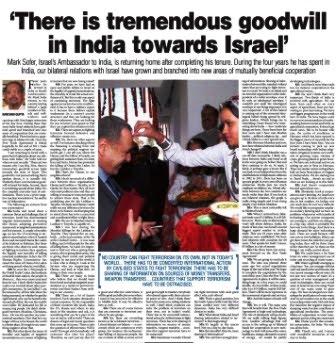
Upswing in relations with Israel


Mark Sofer, Israel’s Ambassador to India, is returning home after completing his tenure. During the four years he has spent in India, our bilateral relations with Israel have grown and branched into new areas of mutually beneficial cooperation

Four years after he arrived in India as Israel’s Ambassador, Mr Mark Sofer returns to his country, leaving behind a large number of friends and well-wishers and carrying with him happy memories of his stay here. During these four years India-Israel relations have gathered speed and branched into new areas of cooperation that are mutually beneficial. There has been a quantum leap in bilateral trade. Once the Free Trade Agreement is inked, hopefully by the end of 2011, trade could treble in a couple of years.

“I am returning to Israel with a great deal of optimism about our relations with India,” Mr Sofer told me when we met recently. “There are two reasons why I say this. First, there is tremendous goodwill across India towards the state of Israel. This goodwill is not just something that is spoken about, it is actually felt. Similarly, there is tremendous goodwill in Israel for India. Second, there is something special about India: It is the complete and utter lack of anti-Semitism. There is no a priori negative reaction towards Jews,” he said by way of elaboration.

To read excerpts from my conversation with Mark Sofer, click here.

Saturday, November 20, 2010

Yatha praja tatha Raja


We The People Are Corrupt!

It’s virtually impossible to check the veracity of AIADMK leader J Jayalalithaa’s assertion that the loss to the public exchequer on account of l’affaire Raja is more than the cumulative loot of India by its colonial masters during the days of John Company and later the British Raj. We could try and compute the official gains of the Empire from records in India House, but the value of the loot, in the strictest sense of the term, would be anybody’s guess. It is possible that the profits, both legitimate and illegitimate, that filled coffers in Britain over 200 years of its colonial enterprise in this part of the world added up to less than `1.76 lakh crore. Or, it is equally possible that it far exceeded the net worth of the Empire of Greed that A Raja built during his tenure as Telecom Minister under the tutelage of Prime Minister Manmohan Singh. Politicians are given to exaggeration and Ms Jayalalithaa is no exception.

Yet, the enormity of Raja’s loot can be minimised only at the risk of aping spokespersons of the Congress who refuse to accept that spectrum was sold for a song to firms many of which came into being only to grab a slice of the 2G pie. There is the additional risk of being seen as justifying the Prime Minister’s refusal to prevent the ‘Great 2G Spectrum Robbery’ since not to do so would be to repudiate the dharma of coalition politics. Needless to say, there was nothing dharmic about either Raja’s stunningly bald-faced defiance of all norms of probity or the Prime Minister’s resounding silence over the plunder that took place under his watch. By no stretch of the imagination does coalition politics mean allowing allies to denude the nation of its wealth: Rs 1.76 lakh crore is not exactly small change even in these days of rampaging inflation.

The outpouring of moral outrage over Raja’s crime may have served the purpose of forcing one of the most corrupt Ministers (by no means was he the lone wolf in the Cabinet) in the present regime to quit office in disgrace although he remains defiant as ever. But it has also swamped a revealing report on Global Financial Integrity that was released last week. The details of the report indicate the extent of corruption in India and confirm what we refuse to accept: We are a corrupt society with a corrupt system; a nation that silently indulges in corruption while raucously protesting against it, as is being witnessed at the moment.

The GFI report says, “From 1948 through 2008, India lost a total of $213 billion in illicit financial flows (or illegal capital flight). These illicit financial flows were generally the product of corruption, bribery and kickbacks, and criminal activities.” Illicit financial flows pertain to the “cross-border movement (or transfer) of money earned through illegal activities such as corruption, transactions involving contraband goods, criminal activities, and efforts to shelter wealth from a country’s tax authorities”. The total of $213 billion is a misleading figure because “the present value of India’s illicit financial flows is at least $462 billion,” the GFI report explains, adding, “This is based on the short-term US Treasury bill rate as a proxy for the rate of return on assets.”

What we are looking at is illicit financial flows of Rs 20.85 lakh crore over 60 years. This, however, is not the sum total of all illicit gains through corrupt practices. “This estimate is conservative,” the GFI report says, adding by way of a cautionary note, “as it does not include several major forms of value drainages out of poorer countries not represented by money”. Among these ‘major forms of value drainages’, the report says, are trade mispricing that is handled by collusion between importers and exporters within the same invoice; the proceeds of criminal and commercial smuggling such as drugs, minerals and contraband goods; and, mispriced asset swaps where ownership of commodities, shares and properties are traded without a cash flow. All this should sound very familiar to Indian ears.

The GFI report points out that the “total capital flight represents approximately 16.6 per cent of India’s GDP as of year-end 2008”; that “illicit financial flows out of India grew at 11.5 per cent per year”; and, that “India lost $16 billion per year between 2002-2006”. Who are responsible for this huge outflow of illicit funds? High net-worth individuals and private companies were found to be the “primary drivers of illicit flows”. India’s “underground economy is also a significant driver of illicit financial flows”.

The report explains that from 1948 through 2008, “the Indian private sector shifted away from deposits into developed country banks and towards increased deposits in offshore financial centres”, also known as ‘tax havens’ from where money was accessed by many of the fly-by-night operators who benefited from Raja’s largesse. The fact that deposits in tax havens have increased from 36.4 per cent of illicit financial flows in 1995 to 54.2 per cent in 2009 tells its own story.

The GFI report provides some other interesting insights. For instance, contrary to the claims of successive Governments, more vociferously by the UPA regime, India’s underground economy, which is “closely tied to illicit financial outflows”, continues to expand with each passing day. The present value of illicit assets held abroad ($462 billion) “accounts for approximately 72 per cent of India’s underground economy — which has been estimated to account for 50 per cent of India’s GDP ($640 billion at the end of 2008)”. Just above a quarter of illicit assets are held domestically.

Champions of unrestricted free market economics and liberalisation insist that these will help fight the menace of corruption and the acquisition of illicit wealth. But this is what the GFI report says: “In the post-reform period of 1991-2008, deregulation and trade liberalisation accelerated the outflow of illicit money from the Indian economy. Opportunities for trade mispricing grew and expansion of the global shadow financial system — particularly island tax havens — accommodate the increased outflow of India’s illicit capital flight.” What should also cause concern is the statistical correlation between increasing illicit financial flows and deteriorating income distribution.

A country where lobbyists have Ministers wrapped around their little fingers and can get policy tweaked to suit the interests of unscrupulous corporates, a society which sees nothing wrong with greasing the palms of babus, policemen and politicians to access services to which people are entitled, a nation whose people believe it is perfectly alright to jump the queue by paying middlemen and bribing the crook at the counter, and a people inure to the crime of all-round corruption should not feign anger and outrage over Raja emptying the till of the store he was supposed to look after and manage while cocking a snook at one and all, including a Prime Minister too effete to protest. A severely compromised media only highlights the rot within.

We are what we are, and so are those whom we elect to office.

[This appears as my Sunday column Coffee Break in The Pioneer on November 21, 2010.]

Saturday, October 16, 2010

When Hindus abandon Hindus under attack...


Humiliated and fearful of the organised fury of the Muslim mob, Hindus don't celebrate Durga Puja this year in Deganga.

(Photo shows desecrated Kali Mandir in Deganga)

There was a time, not that many decades ago, when Hindu grief in one part of the country would not go unnoticed in its other parts. And so it was that Hindus across north and central India, as it existed before the demise of British colonial rule a year later, observed a ‘black’ Diwali in the autumn of 1946 to commiserate with their co-religionists of Noakhali in Bengal. The infamous Noakhali riots, which erupted on October 10 even before the last corpse had been removed from the bustees of Calcutta which had burned for days following Mohammed Ali Jinnah’s call for ‘Direct Action’ on August 16, witnessed what Mohandas Karamchand Gandhi was to later describe as a call to Hindus to leave or perish in the “flames of fanaticism”. If Direct Action Day led to the ‘Great Calcutta Killing’, the “organised fury of the Muslim mob” — as an enraged member of the Bengal Legislative Assembly rudely but pithily put it — was unsparing in Noakhali. Hindu homes were set on fire, Hindu women were raped and girls abducted, Hindu men were murdered. It was this unrestrained butchery and the Hindu grief in its wake that moved a million Hindu hearts in central and north India and the diyas remained unlit that Diwali.

Six-and-a-half decades later, Hindus, it would seem, are no longer moved by the plight of Hindus. The pseudo-secularism aggressively peddled by political parties of all shades — even the BJP has begun to subscribe to the bunkum made fashionable by the Left-liberal intelligentsia in the hope of ridding itself of its ‘communal’ (read Hindu) tag — and the divisive politics of caste identity have made Hindus inure to the plight and sorrow of fellow Hindus. Nothing else explains the indifference of Hindus towards their hapless co-religionists in Deganga who, after suffering the “organised fury of the Muslim mob”, led by Trinamool Congress MP Haji Nurul Islam, have been virtually abandoned by both community and state to their fate. Starting September 6, Haji Nurul Islam and his thugs, who met with resistance when they tried to demolish the main Durga Mandap that has existed for long, ran riot in Deganga block of West Bengal’s North 24 Parganas district, a short distance from Calcutta. Hindu homes were ransacked, Hindu shops were set on fire, Hindu temples were desecrated. All this happened while the district administration and the police twiddled their thumbs. In West Bengal, the Marxists are loath to take on the mullahs; for the Trinamool Congress, the mullahs are powerful allies in Ms Mamata Banerjee’s quest for power at any price.

Humiliated and simmering with rage, abandoned and forsaken by their own in West Bengal and elsewhere, the grieving Hindus of Deganga decided not to celebrate Durga Puja, the most important festival in the Bengali Hindu calendar, this year. The Durga Mandaps in Deganga wore a deserted look, the joyous sound of dhaak, the traditional drum, was not heard, and an overwhelming sense of mourning prevailed. Fear played spoil sport, too: If the September riots were any indication, Muslim belligerence was not to be taken lightly. Meanwhile, in a demonstration of crude triumphalism, Haji Nurul Islam and his goons, with the full support and blessings of the Trinamool Congress, have built and inaugurated a new mosque right in the middle of Deganga market. The high-volume and high-pitched azaan is more a taunt to the Hindus than a call to prayers for the faithful.

The ghetto now rules Deganga. The Hindus, reduced to an awful minority by Muslim ‘settlers’ who entered West Bengal illegally and settled in Deganga as ‘citizens’ after being provided with ration cards by the local committee of the CPI(M) that facilitated the inclusion of their names in the voters list, can only grieve over their persecution today. Ironically, the Hindus voted en bloc for the Left, as did the illegal Bangladeshi immigrants-turned-Indian citizens. Then the demography changed radically; the pampered minority became the oppressive majority. That coincided with the waning of the Left Front and the waxing of the Trinamool Congress which, mindful of numbers, chose Muslims over Hindus in Deganga and strengthened its hold by patronising the likes of Haji Nurul Islam. When Ms Mamata Banerjee went around ‘inaugurating’ Durga Puja at various pandals in Hindu majority constituencies of Kolkata this year, she did not spare a thought for the Hindus of Deganga; she need not have because their votes do not matter. That’s the power of demographic change, forced and natural.

Nor does the Left Front, especially the CPI(M), care about the Hindus of Deganga. The Marxists believe survival depends not on alienating the mullahs but pandering to them. Hence the recently announced communal quota; hence, too, the West Bengal Government shamelessly looking the other way as students of a tax-payer funded Islamic ‘university’ — really an over-glorified madarsa — in Kolkata force their women teachers to wear the burqa on campus. Then there is the media which has blacked out the plight of Hindus in Deganga, striking an ideological posture with which we are all too familiar. But it is not Left-liberalism that has kept Deganga out of the columns of newspapers and prime time bulletins of 24x7 news channels: It is the fear of incurring the wrath of both Ms Mamata Banerjee and her Marxist foes. The tragedy that has befallen the Hindus of Deganga is similar to the stuff that once made Ripley’s ‘Believe It or Not’ a popular inclusion in Sunday papers.

Postscript: I have received the following e-mail from Hindu Samhati, the only organisation which has been trying to draw the attention of media and authorities to the fear that reigns in Deganga, admittedly without any success so far:

“Minor Hindu girl abducted by Muslim youth in Deganga in broad daylight on October 1.

Victim — Sangita Mandal; age 17 years, four months. Class 12 student. Daughter of Sukumar Mandal. Address: Village Purba Changdana, PS Deganga.

Kidnapper — Naharul Islam; age 22. Son of Abdul Rahim. Address: Village Doharia.

Sangita was abducted in a Maruti Omni van at Ambika Nagar in front of Polytechnic College.”


In a similar case of abduction and forced nikah when the mother of the minor girl appealed for justice to a division bench of Calcutta High Court earlier this year, the honourable judges of secular India’s secular justice system had cited sharia’h to legitimise the ‘marriage’, insisting that the age of the girl was inconsequential. We live in depressing times.

[This appears as my Sunday column Coffee Break in The Pioneer on October 17, 2010.]

Saturday, October 02, 2010

Ram ki Nagri, once again


But Ayodhya judgement at best a partial closure

During a recent television debate on ‘Saffron Terror’ (the coinage is an oxymoron, but such details don’t bother the ‘secular’ intelligentsia of this wondrous land of ours) I found myself seated next to Majlis-e-Ittehadul Muslimeen president and MP from Hyderabad Asaduddin Owaisi. Within minutes I was convinced that Mr Owaisi, dressed in an achkan and his heart bleeding profusely for suspected terrorists, lacked both manners and grace. He would interrupt everybody, insisting he had the right to have his say -- without, of course, conceding that right to others. Half way through the show, he suddenly turned towards me and smugly asked, “Will you accept the court’s verdict on Babri Masjid?” I refused to answer him, and for good reason. Later, after the show was over, I asked him, “Will you accept the verdict?” His answer was spontaneous, “Yes, we will.” And then added slyly, “But that’s not the issue. Will you accept it?” I headed for the studio exit.

Mr Owaisi’s question was not as innocuous as it may have seemed to others. For nearly three months a story had been doing the rounds in Delhi, the sum and substance of which was that the much-anticipated judgement in the Ayodhya case would be a two-one majority verdict in favour of the Muslims, upholding the Sunni Waqf Board’s claim to the disputed 2.7 acre land where the Babri Masjid stood till it was demolished by enraged Hindus on December 6, 1992, to reclaim Ram Janmabhoomi and rid India of one of its many monuments glorifying invaders who remorselessly laid the lives of kafirs to waste and destroyed their places of worship with vengeance.

Those who believed this story pointed to tell-tale signs: The pattern of deployment of security forces; the choice of date for the verdict (it was originally scheduled for September 24, a Friday); and the cockiness of Muslim organisations not known for holding the secular judiciary of India in high esteem and their repeated assertion that they would abide by the judgement. Mr Owaisi had obviously heard and believed the story. When I expressed my doubts about its veracity to a fellow columnist, he sneeringly replied, “You are living in denial.” Days before the judgement, questioning the wisdom of those who did not want it to be delayed any further, he tweeted that the “verdict will leave lotuswallahs disappointed”.

South Delhi’s commentariat is adept at the game of Chinese whispers, but it is also divorced from reality, preferring fiction over fact. The verdict of the Lucknow Bench of the Allahabad High Court -- really three separate judgements with the judges concurring on certain key issues -- bore no resemblance to the inspired ‘leak’. The judges agreed on three important issues: Muslims do not have exclusive claim to the site held sacred by Hindus; the ground where the central dome of the Babri Masjid stood belongs to Ram Lalla as has been argued for centuries by Hindus who believe it is Ram Janmabhoomi; and, a temple existed at the spot that was selected by Mir Baqi to build a mosque to celebrate Babur’s victorious military campaign in the region. On the third point, two of the three judges also agreed that the temple was desecrated and destroyed to build the mosque; one of them held this to be un-Islamic, a point validated by theology.

It’s politically correct to say there are no winners and losers following the Ayodhya verdict. But we all know that’s not true. Why else would Mr Owaisi, whose party was last in the news for opposing ‘Hyderabad Liberation Day’ celebrations on September 17 because “many Muslims (razakars) were killed” when the people rose in revolt in 1948 against the Nizam for refusing to join the Union of India, be incandescent with rage? The same man who, having willed himself into believing the cockamamie story that two of the three judges would rule in favour of the Muslims, told me he would accept the High Court’s verdict, is now indulging in what comes easily to him and his ilk: Intemperate, provocative language. “We are not satisfied with the judgement. The evidence presented by Muslims to the court was strong… It seems that it has not been given due consideration,” he told one newspaper. To another he said, “There is anger building up among the Muslim community over the verdict but, god willing, it may not translate into street violence.” Notice how he is leaving the option of mobs taking to the streets wide open. Mr Owaisi is not alone; he has Mr Mulayam Singh Yadav of “ek parinda bhi paar nahi kar sakta” fame, to keep him company.

At the same show I was interrupted by a leading light of south Delhi’s commentariat when I made bold to suggest that little purpose will be served if we keep on going back to history. “What history? Tell us,” he tauntingly said and, along with Mr Owaisi, broke into raucous laughter. I could have given the example of the vandalism that had occurred in Ayodhya in 1528, and elsewhere in India since then: Varanasi, Mathura, Ajmer, Delhi -- the list is endless. But I chose not to bite Mukul Kesavan’s bait, choosing, instead, to place my faith in the wisdom and fair play of our secular justice system. That faith stands vindicated today. At one level, the Ayodhya judgement liberates Ram Janmabhoomi and serves to address, albeit partially, latent and lingering Hindu disquiet. At another level, it is a deeply personal victory for me and some other writers, all of them close friends and professional associates, who chose not to sway with the wave and told the truth as it was rather than join the crowd of intellectually bankrupt dhimmis who unfortunately hold positions of power and authority in free, secular India. They are the real losers and look more pathetic than ever before.

Let me conclude by quoting Nirad C Chaudhuri, a writer whom I greatly admire for speaking his mind freely and without caring a hoot about how many toes he tread upon: “Muslims do not have the slightest right to complain about the desecration of one mosque in Ayodhya. From 1000 AD every temple from Kathiawar to Bihar, from the Himalayas to the Vindhyas has been sacked and ruined. Not one temple was left standing all over northern India. They escaped destruction only where Muslim power did not gain access to them for reasons such as dense forests. Otherwise, it was a continuous spell of vandalism. No nation with any self-respect will forgive this. What happened in Ayodhya would not have happened had the Muslims acknowledged this historical argument even once.”

Well-meaning people believe the Allahabad High Court’s judgement will help bring the Ayodhya dispute to a closure. But the Ayodhya dispute is a manifestation of the historical faultlines that run deep through our society. Till such time we admit the existence of the faultlines and accept the causative factors, there can be no real closure. Settling a title suit is not quite the same as addressing what Niradbabu described as the “historical argument” of India’s imperfect past which makes our future tense. Sadly, though not unexpectedly, there is little or no reason to believe that we are anywhere near a real closure in the absence of any meaningful and sincere acknowledgement of the “continuous spell of vandalism” as symbolised by the monument to honour Babur which stood in Ram ki Nagri till December 6, 1992, and whose reconstruction is still being sought.

Sunday, September 05, 2010

It’s India’s land that China occupies


Gilgit-Baltistan is part of Jammu & Kashmir
(The Karakoram Highway linking China and Pakistan)

While Prime Minister Manmohan Singh waxes eloquent on the need to bridge the “trust deficit” in relations between India and Pakistan, infusing fresh enthusiasm among mombattiwallahs on both sides of the border, the Government he heads faces a severe crisis of ‘trust deficit’ of a different kind. The confused response of the Government over the presence of Chinese troops in Pakistan-occupied Kashmir — what Beijing describes as “northern Pakistan” — demonstrates this point. It appears that the Ministry of External Affairs is now virtually out of the loop on crucial matters, starved of vital intelligence input necessary for a coherent response to issues that have a direct bearing on foreign affairs and policy. It is impossible that R&AW, which is well-clued into what’s happening in Pakistan-occupied Kashmir despite depleted ‘assets’, should not have been aware of PLA soldiers being flown into what were earlier known as Northern Areas and since 2009 are referred to by Pakistan as Gilgit-Baltistan after the recent floods caused massive destruction of strategic infrastructure, including the Karakoram Highway.

Yet, the Ministry of External Affairs commented on it only after Selig S Harrison, director of the Asia Programme at the Center for International Policy and a former South Asia bureau chief of The Washington Post, wrote about the “quiet geopolitical crisis ... unfolding in the Himalayan borderlands of northern Pakistan, where Islamabad is handing over de facto control of the strategic Gilgit-Baltistan region in the north-west corner of disputed Kashmir to China” in The New York Times. Even after the article was published, presumably placing in the public domain information that had already been secured and processed by R&AW, all that the Ministry of External Affairs could (or would) say is, “We are seeking an independent verification... If true, it would be a matter of serious concern and we would do all that is necessary to ensure the safety and security of the nation.”

That would have been reassuring had the Ministry, which is part of the national security structure, not been so woefully ill-informed. For, by then there was confirmation of the presence of PLA troops by Pakistani officials who said the Chinese were in Gilgit-Baltistan for “relief work”. Last week, China, while denying the presence of 11,000 of its soldiers in Gilgit-Baltistan, has confirmed that it is ‘helping’ Pakistan with men and material to cope with the disaster. India’s feisty Ambassador to China, Mr S Jaishankar — he should have been sent to Beijing long ago — has subsequently conveyed our ‘concerns’, but whether these have been taken seriously is anybody’s guess.

Two inter-linked facts are now abundantly clear and indisputable. First, China has crafted a Jammu & Kashmir policy that is apparently heavily loaded in favour of its ‘all-weather friend’ Pakistan and is inimical to India’s interests. In reality, it is designed to serve China’s strategic interests more than anything else. The main elements of this policy are: Delegitimise India’s sovereign right over Jammu & Kashmir by treating the State as ‘disputed territory’ (hence the stapled visas for Indians living in that State); legitimise Pakistan’s claim to all of Jammu & Kashmir and thus treat Pakistan-occupied Kashmir (including Gilgit-Baltistan) as Pakistani territory or ‘northern Pakistan’ (visas are stamped on Pakistani passports used by residents of Pakistan-occupied Kashmir); and, thereby seek to convert Pakistan’s patently illegal act of ceding 5,180 sq km of occupied Indian territory, known as ‘Trans-Karakoram Tract’ (virtually all of Gilgit-Baltistan) to China in 1963 into a legal transaction.

A resurgent China, having raced ahead of Japan and secured for itself the status of the world’s second largest economy and tamed the US into playing second fiddle (recall President Barack Hussein Obama paying obeisance in the Chinese court), now feels confident of pushing its strategic frontiers beyond geographical boundaries. This is where the second factor of China’s deftly-crafted Jammu & Kashmir policy comes in: It wants to assert its hold over the Northern Areas and make its presence felt to both Pakistan and India, albeit for different reasons. This precedes the planned expansion of China’s strategic infrastructure through and beyond the ‘Trans-Karakoram Tract’ by building a rail link between Kashgar in Xinjiang province and Havelian near Rawalpindi. With Gwadar Port providing it access to the Persian Gulf and an amplified land route across the Karakoram range in place, China would have vastly secured its strategic interests, trouncing those of India. That’s called pursuing a robust policy of enlightened self-interest which underpins both national security and strategy in the shifting sands of 21st century’s geo-politics.

Of course, duplicity laces this policy which is often articulated with a forked tongue. “As a neighbour and friend of both countries, China believes that the (Kashmir) issue should be left to the two countries so that it could be properly handled through dialogue and consultation,” Ms Jiang Yu, the spokesperson of the Chinese Foreign Ministry, told mediapersons in Beijing last week, insisting that China “has no intention to interfere in the Kashmir issue” which “we believe is an issue left over from history between India and Pakistan”. Such pious declarations of China’s ‘non-interference’, however, fly in the face of Beijing’s actions. Asked whether China would review the policy of issuing stapled visas to Indian passport holders of Jammu & Kashmir, Ms Jiang Yu said, “Our visa policy towards inhabitants in the Indian-controlled Kashmir region is consistent and stays unchanged”.

It would be easy to attribute such deliberately un-nuanced — some would say belligerent — articulation of how Beijing views New Delhi’s concerns to a rising China’s arrogance. But the belligerence of those with whom India does business, literally and metaphorically, is not entirely divorced from Indian realities. We cannot escape from the twin facts that our own Jammu & Kashmir policy is stuck in a grey zone of self-doubt, self-pity, self-flagellation and self-recrimination, and our political class is deeply divided on how to deal with an ever recalcitrant minority (that’s what the separatists in Kashmir Valley represent) in a State we insist is inseparable from the Union of India. The all-party resolution that was adopted by Parliament to stop then Prime Minister PV Narasimha Rao from persisting with his “anything short of azadi” approach at the behest of a certain Robin Raphel (who now oversees American aid to Pakistan), restating India’s sovereign right over all of Jammu & Kashmir, including Pakistan-occupied Kashmir of which Gilgit-Baltistan is an integral part, is now a forgotten document. If only successive Governments since then had premised their foreign policy on that resolution and aggressively sought to reclaim India’s territory from Pakistani — and de facto Chinese — occupation, we would have been spared the humiliation that is being heaped on us today.
[This appeared as my column Coffee Break in The Pioneer.]

Tuesday, July 06, 2010

Are we headed this way?


From the film, The Stoning of Soraya M. It is a drama based on the true story of a young Iranian woman who, after being falsely accused of adultery by her estranged husband, was stoned to death by her fellow villagers.
Woman to be stoned to death in Iran
By Hala Jaber

She was only 14 years old when she was forced into a loveless marriage with an older man.Yet within a year of her wedding Azar Bagheri had been charged with adultery and sentenced to be stoned to death.
The sentence could not be carried out until she reached 18.So for the past four years she has been languishing on death row while courts waited for her to reach maturity.
According to Mina Ahadi,an Iranian human rights activist,Bagheri was denounced by her own husband,who accused her of committing adultery with two men.
Ahadi said the teenager had been subjected to two mock stonings.On each occasion she was taken out of her cell and buried up to her shoulders in the yard of Tabriz prison,in northwest Iran,as if being prepared to be pelted to death with stones.
Bagheris lawyers are now planning to ask judges to reduce her sentence to 99 lashes,Ahadi said.Buoyed by an international campaign against Irans death sentence for women convicted of adultery,they hope the court will show mercy.
Last week,after widespread condemnation of the sentence of stoning passed on another woman,Sakineh Mohammadi Ashtiani,43,the Iranians backed down.
Their embassy in London said that according to information from the relevant judicial authorities,the stoning would not go ahead.But campaigners warned that Bagheri could still be executed by other means.
Amnesty International noted that three Iranians sentenced to death by stoning last year had been hanged instead.A mere change of the method of execution would not address the injustice, said Amnestys Hassiba Hadj Sahraoui.SUNDAY TIMES,LONDON. [Courtesy: Times of India, July 12, 2010.]


Plight of a mother

This Iranian woman, a 42-year-old mother of two children, has been held guilty of 'adultery' by sharia'h court on the basis of a forced confession extracted under duress (which she has since retracted), punished with 90 lashes and sentenced to death by stoning. She will be buried neck deep and then stones will be hurled at her. The stones, by law, will be big enough to inflict pain but not kill her instantly.

Her son and daughter have appealed for help to save their mother.
Beware the ominous signs in India
It's no doubt barbaric and horrific. But aren't we who flaunt the secular credentials of the Republic of India heading the same way? Look at the atrocities being committed by khaps in western Uttar Pradesh, Haryana, Punjab and even in the national capital, Delhi, in the name of caste and gotra. Young men and women are being murdered in cold blood and the murders are being glorified by the murderers as 'honour killings'.

Meanwhile, in Kerala an illegal Taliban-style sharia’h court (Darul Khada or god's abode or god's court) ordered that the right hand of Prof TD Joseph, a professor of Malayalam at Newman's College, Thodupuzha, holding him guilty of “insulting Mohammed” through “derogatory references” in a question paper he had set. The sentence was carried out by members of the Islamist organisation, Popular Front, on July 4 when Prof Joseph was waylaid while returning hom from church along with his sister and mother.

Prof Joseph was arrested in April after the question paper set by him for the BCom second year internal exams sparked protests by Muslim outfits, which claimed it had “hurt their religious sentiments”. He was later suspended from college and was out on bail when attacked. Ironically, the disputed question referred to a book written by a Muslim writer of Kerala.

And another story reported from Bihar:

Woman stripped and whipped on orders of kangaroo court
Katihar, July 13: A 35-year-old woman was allegedly stripped and whipped after she defied the diktats of a kangaroo court in Bihar's Katihar district to remarry her second husband. The illegal court at the Gwaltoli-Kalyannagar village summoned the woman on July 8 and directed her to to remarry her second husband from whom she had divorced earlier, Superintendent of Police P Kanan said, quoting the FIR lodged by her.
Kanan said the woman's first husband died four years after the marriage and after some time she married a man named Mohammad Islam of the same village and the couple had a son. But, the marriage did not work and the couple divorced.
Subsequently, when her five year-old son was down with fever, she had to call her divorced husband as she was living in penury, the SP said. After the son recovered Islam left.
He said that Islam and his brother Samsuddin later connived in summoning the kangaroo court which was headed by a former mukhiya, Akalu. The kangaroo court first asked her to pay money equivalent to that required for construction of a house, besides wheat and rice to the former mukhiya.
As she refused she was dragged to a mango grove on the outskirts of the village stripped and whipped.
The SP said the woman lodged an FIR on July 11 after which Akalu and Samsuddin were arrested.
If we the majority remain silent, we won't be able to keep the barbarians at bay. Sooner or later, they will come for us too. And an effete Government, looking at caste vote-banks, won't lift its little finger in admonition. The Congress, remember, hasn't acted against khaps yet.

The Cabinet, which met on July 8, was divided on amending the CrPC to deal with crimes committed by khaps and the adherents of their regressive diktats. Strangely, Minister for Youth and Sports MS Gill put up the strongest objection to a "sweeping law". Our limp-wristed Prime Minister, of course, failed to exercise his authority, though not for the first time. Instead, he decided to set up yet another GoM to "study the complex issue". What's there to study?

A Prime Minister who can be so determined to push his agenda on foreign affairs, especially in regard to relations with America and Pakistan, can't take a decision on an important domestic issue? Indifference? Incompetence? Or plain scared?

Is this the India of 21st century we keep on boasting about? Can we truly claim to have entered a new era of development and modernity? What use is high GDP if such forces prevail?

Reflect. Resolve. React.

Tuesday, June 29, 2010

Red Terror unabated, India watches football


Maobadis slaughter 27 CRPF jawans
UPDATE
.According to Chhattisgarh DGP Viswa Ranjan, at least 15 Maobadis were possibly killed when CRPF personnel retaliated during the ambush. The bodies of the Maobadis have however not been found. Maobadis are known to take away the bodies of their cadre killed in encounters with security forces.
.Around 100 Maobadis, who struck with automatic rifles, were involved in the ambush and the gunbattle lasted for two to three hours.
.The death toll in Tuesday's attack on CRPF personnel has gone up to 27 after the body of a CRPF constable was found by search parties.

Maobadis have struck again, this time in Chhattisgarh, killing 27 CRPF jawans in a deadly ambush on Tuesday, June 29. Eight security personnel (among them four SPOs of Chhattisgarh Police) were injured, five of them seriously. The attack took place while the CRPF jawans were returning after clearing a road in a remote area of Chhattisgarh's Narayanpur district. Among the dead is Assistant Commandant of the force Jatin Gulati.

Union Home Secretary GK Pillai said in New Delhi: “A large number of heavily-armed Maoists, perched on a hilltop, opened fire from automatic weapons on a 63-member security contingent which was returning on foot from road opening duty.”

The latest attack by Maobadis comes three months after the massacre of 75 CRPF jawans and one Chhattisgarh policeman in Dantewada district on April 6. On May 17, Maobadis blew up a bus carrying 50 people, including 18 special police officers, near Sukma in Dantewada. Only six people -- all seriously injured – were believed to have survived that attack; the rest, including women and children, were killed. On May 8, eight men of the CRPF were killed when Maobadis blew up a vehicle in Narayanpur district.

On May 28, Gyaneswari Express was derailed in West Bengal’s Midnapore district after men of the PCPA, a Maobadi front organisations, damaged the tracks. At least 141 passengers died after a goods train came and rammed into the derailed express almost immediately.

[My views on Maobadi attack on Gyaneswari Express on NDTV special programme.]

Some points to ponder upon:

. UPA Government continues to flounder in its search for an effective counter-Maobadi strategy.
. Ongoing security offensive remains largely ineffective as there are no well-defined objectives.
. In the absence of well-thought out tactics, Maobadis continue to have the upper hand.
. The Prime Minister is either indifferent or incompetent to deal with the Maobadi challenge.
. Manmohan Singh says Maobadis pose ‘single biggest threat to internal security’; does nothing.
. Home Minister P Chidambaram’s efforts to launch a fight-back are stymied by a ‘limited mandate’.
. CCS meets and disperses without even discussing counter-Maobadi strategy.
. Army and IAF chiefs speak out of turn ruling out military intervention.
. Coordination among States remains abysmally poor, near absent.
. Senior Ministers continue to speak in different voices on how to confont the menace.
. Sonia Gandhi and her cronies like Digvijay Singh are pushing for ‘dialogue’ and a soft line.
. Congress is a divided house: Nobody wants to take a firm stand.
. Congress’s ally Trinamool Congress won’t let UPA act with firm determination.
. Mamata Banerjee refused to blame Maobadis for Gyaneswari derailment.
. CBI inquiry shows PCPA (a Maobadi front) planned and executed Gyaneswari disaster.
. Maobadis continue to enjoy upper hand; jawans, innocents regularly with impunity.
.India continues to bleed. Urban middleclasses, since they are not affected, are not bothered.
. Media glosses over Maobadi crimes, offers platform for ‘intellectuals’ to propagate Maobadi ideology.

Trust the National Human Rights Commission, now headed by retired Chief Justice of India KG Balakrishnan, to claim the ‘human rights’ of Maobadis are being violated by security forces! A statement issued by NHRC on Tuesday, June 29, says:
The National Human Rights Commission has taken suo motu cognizance of media reports depicting photographs of security men carrying the bodies of Naxalites, including women, with their hands and feet tied to bamboo poles.
The report was published on the 18th June, 2010. It was alleged that the photograph was taken following an anti-Naxal operation in West Midnapore, West Bengal.
The Commission in its proceedings on the 21st June, 2010, observed that the report, if true, raises a serious issue of violation of human rights of the victims.
A notice has been issued to the Secretary, Ministry of Home Affairs, Government of India inviting factual report in the matter by the 27th July, 2010.
In a major success, security forces had gunned down 12 Maoists, including three women (among them one who had led the attack on the EFR camp at Sildah, West Bengal, in which 24 jawans were killed) in a fierce encounter in Ranja forest of Salboni in West Midnapore on June 16.

Since NHRC is so bothered about the ‘human rights’ of the practitioners of inhuman barbarity, they should take note of this story from Jhargram, West Bengal, filed by PTI on June 29:
A 10th class student was killed by Maoists at Jamirdiha village in West Midnapore district. Police said the bullet-riddled body of Phulchand Mahato, still in his school uniform, was found on the side of Kasmar canal Tuesday morning. The Maoists left a poster near the body proclaiming Mahto as a ‘police informer’.
Mahto had attended classes on Monday and left his Banspahari High School building in the afternoon but remained untraced ever since, prompting his family to lodge a missing report at Belhapari police station Monday night. The family identified the body on Tuesday.
It may be recalled Maobadis had raped a 16-year-old girl in Jharkhand for daring to stand up to them, and threatened to kill her if she went to the police.
Whose side is NHRC on? The people of India or those who are waging war on the state and the people of India?
Another report says:
Five Maoists, including a top aide of the outfit's senior leaders Kishenji and Telugu Dipak, were arrested from the outskirts of Kolkata on Tuesday. Acting on a tip off, five Maoists were arrested from South 24 Parganas. Of the arrested Maoists, Madhusudhan Mondal alias Narayan, Rajesh Mondal, Sachin Ghosal were arrested from Amtala, while Siddhartha and Sanjay from Garia in the district. Madhusudhan alias Narayan was the zonal committee secretary of the Maoists during the Nandigram movement and was close to Kishenji and Telugu Dipak. He arranged the stay of Kishenji when he went to Nandigram.

So Nandigram wasn't a 'people's movement' after all!

And here is a chronology of Maobadi terrorism in the past couple of years:
June 29, 2008: Maoists attack a boat on Balimela reservoir in Orissa carrying four anti-Maoist police officials and 60 Greyhound commandos, killing 38 troops.
July 16, 2008: 21 policemen killed when a police van is blown up in a landmine blast in Malkangiri district of Orissa.
April 13, 2009: 10 paramilitary troops killed in eastern Orissa when Maoists attack a bauxite mine in Koraput district.
April 22, 2009: Maoists hijack a train with at least 300 people on board in Jharkhand and force it to Latehar district before fleeing.
May 22, 2009: Maoists kill 16 policemen in the jungles of Gadchiroli district in Maharashtra.
June 10, 2009: Nine policemen, including CRPF troops and officers, ambushed by Maoists during a routine patrol in Saranda jungles in Jharkhand.
June 13, 2009: Maoists launch two landmine and bomb attacks in a small town close to Bokaro, killing 10 policemen and injuring several others.
June 16, 2009: Maoists kill 11 police officers in a landmine attack followed by armed assault. In a separate attack, four policemen were killed and two others seriously injured when Maoists ambush them at Beherakhand in Palamau district.
June 23, 2009: A group of motorcycle-borne armed Maoists open fire on Lakhisarai district court premises in Bihar and free four of their comrades including the self-style Zonal Commander of Ranchi.
July 18, 2009: Maoists kill a villager in Bastar and in a separate incident torch a vehicle engaged in road construction work in Bijapur district of Chhattisgarh.
July 27, 2009: Six persons killed when Maoists trigger a landmine blast at Dantewada district in Chhattisgarh.
July 31, 2009: A special police officer and another person killed by Maoists in Bijapur district.
Sep 4, 2009: Maoists kill four villagers in a forest in Aaded village in Chhattisgarh's Bijapur district.
Sep 26, 2009: Maoists kill BJP MP from Balaghat Baliram Kashyap's sons at Pairaguda village in Jagdalpur (Chhattisgarh).
Sep 30, 2009: Maoists set ablaze Gram Panchayat offices at Korchi and Belgaon in Gadchiroli district of Maharashtra.
Oct 8, 2009: 17 policemen killed when Maoists ambushed them at Laheri police station in Gadchiroli district of Maharashtra.
Feb 15, 2010: 24 personnel of the Eastern Frontier Rifles (EFR) killed as Maoists attack their camp in Silda in West Midnapore district of West Bengal.
April 4, 2010: Maoists trigger a landmine blast killing 11 security personnel of the elite anti-Maoist force Special Operations Group (SOG) in Koraput district of Orrisa.
April 6, 2010: 75 CRPF personnel and a Chhattisgarh police official killed in a Maoist attack in Dantewada district.
May 8, 2010: Eight CRPF jawans were killed when Maoists blow up a bullet-proof vehicle in Bijapur district of Chhhattisgarh.
June 29, 2010: At least 15 CRPF personnel killed in a Maoist ambush in Naraynpur district of Chhattisgarh.

[Bus attack photograph courtesy ANI.]